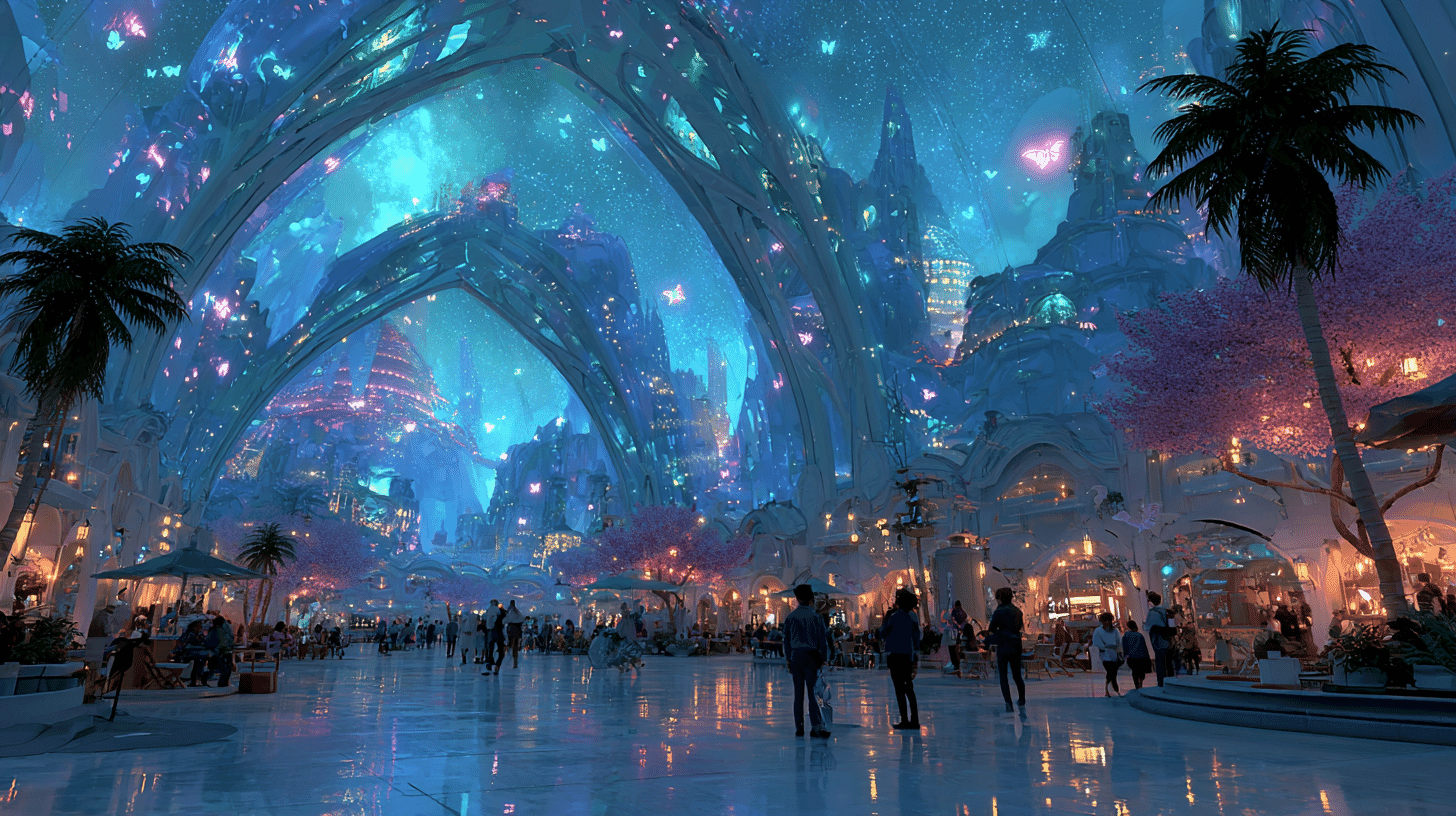
🎮 Imagine a theme park where the story changes based on how you feel. Japan's telecom giant NTT and major broadcaster TBS are building an AI-powered entertainment facility where every child gets a completely personalized adventure. With anime, games, and merchandise on the horizon, this could reshape how entertainment IPs are born.
NTT and TBS Launch the "e6 Project" — A New Vision for AI Entertainment
On February 10, 2026, two of Japan's corporate heavyweights announced an ambitious partnership. NTT, Japan's largest telecommunications company, and TBS Holdings, one of the country's top TV broadcasters known for hit dramas and variety shows, jointly unveiled the "e6 project" (pronounced "e-six project").
The project has two pillars: developing an original fantasy IP (intellectual property) called "Emotional Knight" (感情騎士 / Kanjō Kishi), and establishing a permanent "AI Theme Park" (working title) where visitors can physically experience that fictional world — with AI shaping every moment.
The "e6" name stands for six English words beginning with "E": Education, Entertainment, Experience, Emotion, Evolution, and Epiphany. At its core, the project is rooted in "edutainment" — the concept of learning through play.
Why an AI Theme Park, and Why Now?
The project was born from a simple but powerful observation: in an age where generative AI like ChatGPT can instantly produce answers, ideas, and solutions, what matters most for children is not accumulating knowledge — it's developing the ability to decide for themselves.
NTT and TBS believe that when AI can provide countless "plausible answers" at the push of a button, children need to strengthen their capacity to ask "which one do I actually want?" and "what do I truly care about?" The project positions emotion as the compass for navigating a world without clear-cut right answers.
Rather than teaching children about AI, the project uses AI behind the scenes to create emotionally resonant stories and experiences that draw out each child's own preferences, passions, and decision-making instincts.
"Emotional Knight" — A Fantasy Adventure About Invisible Feelings
The project's first original IP, "Emotional Knight," is an adventure fantasy about a quest to find "invisible emotions." Through the story, children gradually discover their own values and what truly matters to them.
What makes this particularly interesting from an industry perspective is its planned multi-platform rollout. "Emotional Knight" is designed from the start for media mix expansion — anime series, video games, merchandise, and more — all connected to the physical theme park experience.
In Japan, media mix (メディアミックス / media mikkusu) is a well-established strategy where a single IP is deployed across multiple formats — manga, anime, games, toys, and live events. However, it's rare for a telecom company and a TV broadcaster to co-create a brand new IP with an integrated physical venue from day one.
How the AI Theme Park Works — Personalization at Every Step
The "AI Theme Park" concept breaks fundamentally from traditional theme parks where every visitor goes through the same ride or show.
Using advanced technology, the park will track each child's behavior and emotional responses in real time. The story, environment, staging, and even difficulty level will adapt dynamically based on how each individual child is feeling. If a child is excited, the adventure accelerates. If they're hesitant, a different path opens up. Every visit becomes a unique, unrepeatable experience.
NTT CEO Akira Shimada described it as an attempt to create moments where children's own willpower awakens — not by making AI a subject to study, but by delivering heart-stirring stories and experiences.
The Technology Behind It — IOWN and tsuzumi 2
NTT brings serious technological firepower to the table. The company will integrate its next-generation information and communication infrastructure called IOWN (Innovative Optical and Wireless Network), which uses cutting-edge photonics technology to enable ultra-high-speed, high-capacity data transmission with massive computational resources.
Also central to the project is NTT's proprietary large language model (LLM) called "tsuzumi 2." These technologies will serve as the "play infrastructure," enabling the park's systems to react and evolve in real time based on children's actions and emotional shifts.
TBS, for its part, brings decades of storytelling expertise from producing some of Japan's most popular TV dramas and entertainment shows. The company has established a dedicated "Edutainment Business Center" specifically for this type of initiative, leveraging its creative capabilities to build immersive fictional worlds that children can't help but get lost in.
Three Cycles of Experience Design
The e6 project organizes its experience around three interconnected cycles:
Immersion combines entertainment with education. Instead of "studying," children become absorbed in "play" that naturally sparks curiosity about technology and new ideas.
Judgment merges experience with emotion. Through hybrid digital-physical encounters, children become aware of how their hearts respond — what excites them, what moves them, what they dislike. This emotional awareness becomes their personal compass for evaluating AI-generated options.
Awakening fuses evolution with epiphany. Through collaboration with AI "buddies," children encounter breakthrough ideas they couldn't have reached alone. By incorporating technology as a personal tool, each child experiences genuine growth.
These three cycles feed into each other continuously, creating a loop where children naturally develop their own agency while learning to coexist with AI.
Impact on the Anime and Game Industry — A New Model for IP Creation
One reason this project deserves attention is its potential to establish a new model for creating entertainment IPs.
Traditionally, successful Japanese anime and game IPs emerge from manga serializations, light novels, or standalone video games. "Emotional Knight" takes the opposite approach: a telecom infrastructure company and a broadcaster are co-developing an IP where the theme park experience, anime adaptation, game versions, and merchandise are all designed as an integrated system from the very beginning.
TBS CEO Ryujiro Abe stated his conviction that this collaboration opens a new path for IP creation and global expansion, expressing hope that this initiative becomes a new standard that spreads from Japan to the world.
The first experiential content details are scheduled for announcement in late February 2026.
What Do You Think? How Is AI × Entertainment Evolving in Your Country?
In Japan, the fusion of telecom technology and broadcasting creativity has produced a vision for an AI-powered theme park that adapts to every child's emotions in real time. The idea of dissolving the boundary between education and entertainment — and using AI to read children's feelings as they play — is a distinctly forward-looking approach to preparing kids for an AI-saturated future.
How is AI being used in children's entertainment and education where you live? Would you feel comfortable with a theme park that reads your child's emotions? What excites or concerns you about this kind of technology? We'd love to hear your perspective!
References
Reactions in Japan
NTT and TBS — that's an interesting combo. A telecom company and a TV station making a playground for kids? Wouldn't have imagined this 10 years ago.
"Emotional Knight"... The naming has that chuunibyou (adolescent fantasy) vibe and I kinda like it. Kids might love it, but it'll depend on the anime quality.
The concept is admirable, but joint projects between big Japanese companies tend to lose direction midway. IOWN and tsuzumi aren't exactly proven yet, so I'm worried this might end up as just another grand plan on paper.
Working with kids daily, I truly feel how important the 'ability to decide for yourself' is. In an age where AI serves up options, kids who can choose based on their own feelings are strong. I relate to the concept.
Real-time tracking of children's emotions... doesn't that feel a bit creepy? I'm concerned about data handling and privacy.
Just another press release full of buzzwords. Zero concrete details. I'll hold my judgment until the follow-up in late February.
The direction of IP development is interesting. Theme park → anime → games is a reverse flow, similar to Disney's approach. The question is how compelling they can make the IP itself.
Happy there'll be a new place to take kids! But if the price is theme park level, we can't go often 💦 If it's educational, it'd be nice to have municipal subsidies.
I experienced NTT's IOWN at the Expo pavilion, but honestly didn't get it. The real challenge is making it accessible for children.
Edutainment has been around as a concept, but I appreciate the attempt to seriously implement it with generative AI and personalization. Still, whether 'the ability to decide for yourself' truly develops through play needs proper validation.
Where's it gonna be? Tokyo? People outside the city will probably just end up watching the anime on YouTube.
TBS anime slots have focused on Jump titles recently, so competing with their own IP is a new phase. They can easily secure broadcast time, so I'm curious what kind of world they'll build.
They say it's for children but isn't it really a data collection business? I can't believe NTT is seriously thinking about children's education.
They mentioned at earnings that tsuzumi 2 has about 2,000 domestic inquiries. If they can build a track record in entertainment too, that'd be huge for NTT's AI strategy.
Showed it to my second-grader and he instantly said 'I wanna go!' Kids' instincts are amazing. As a parent though, I'd first want to confirm the safety measures are solid.
They mention global expansion, but has any Japanese company's theme park business actually succeeded overseas? They should build domestic results first.
As someone in the theme park industry, 'stories that change per visitor' is technically extremely challenging. Even Disney hasn't fully achieved it yet. But NTT's telecom expertise might actually make it possible.
In Sweden, fostering children's autonomy is deeply embedded in education, but converting that into entertainment through AI is a novel idea. However, companies collecting children's emotional data will face scrutiny under EU's GDPR.
Honestly, 'edutainment' has gone through boom-and-bust cycles in the West multiple times. I'm curious if Japan can redefine it with AI, but if you lead with 'educational,' kids will bounce. Fun has to come first.
In India, millions of kids play games on smartphones, but access to physical AI theme parks would be limited. If this project has app or online versions, it could reach children in developing countries too.
Japan is world-class at creating IPs through anime and games. Adding AI and a theme park is a logical next step. But 'Emotional Knight' might sound a bit cheesy in English. Localization will be key.
Hearing about AI that reads children's emotions reminds me of 'Inside Out.' That movie was incredibly effective at helping kids understand emotions. If you can experience the same thing interactively, that'd be amazing.
As a German engineer, IOWN's photonics technology is genuinely innovative. But running a theme park requires completely different expertise. Technology alone won't guarantee success.
China already has several AI-based educational facilities, but few focus on 'emotions.' Japan's approach is interesting, but bringing it to China's massive market would require cost adjustments.
Korea also has moves to expand K-content IPs into experience facilities. If Japan takes the lead with AI + theme parks, Korea can't afford to fall behind. Competition is about to heat up.
In France there's a strong push to reduce children's screen time, so an AI theme park might seem to go in the opposite direction. But if it's a physical space where kids move around, it's different from being glued to phones.
Brazilian kids love anime and games too. If this new Japanese IP is appealing, it could become popular in South America. The theme park itself probably won't come here, but I'm hoping for global anime and game releases.
As an American parent, I'd be cautious about a project where AI collects children's emotional data. From a COPPA (Children's Online Privacy Protection Act) standpoint, the hurdles would be significant.
Japanese anime is hugely popular among young people in the Middle East. Content that fuses education with entertainment easily gains parental support. If 'Emotional Knight' has moral education aspects, it would be well-received here.
Singapore's edtech market is mature with countless AI learning apps. But combining a physical experience venue with an anime IP is new. I'd love to see it expand to Southeast Asia.
Interesting concept, but 'personalized experiences' basically means an algorithm decides what children see, right? Doesn't that contradict the goal of nurturing 'the ability to decide for yourself'?