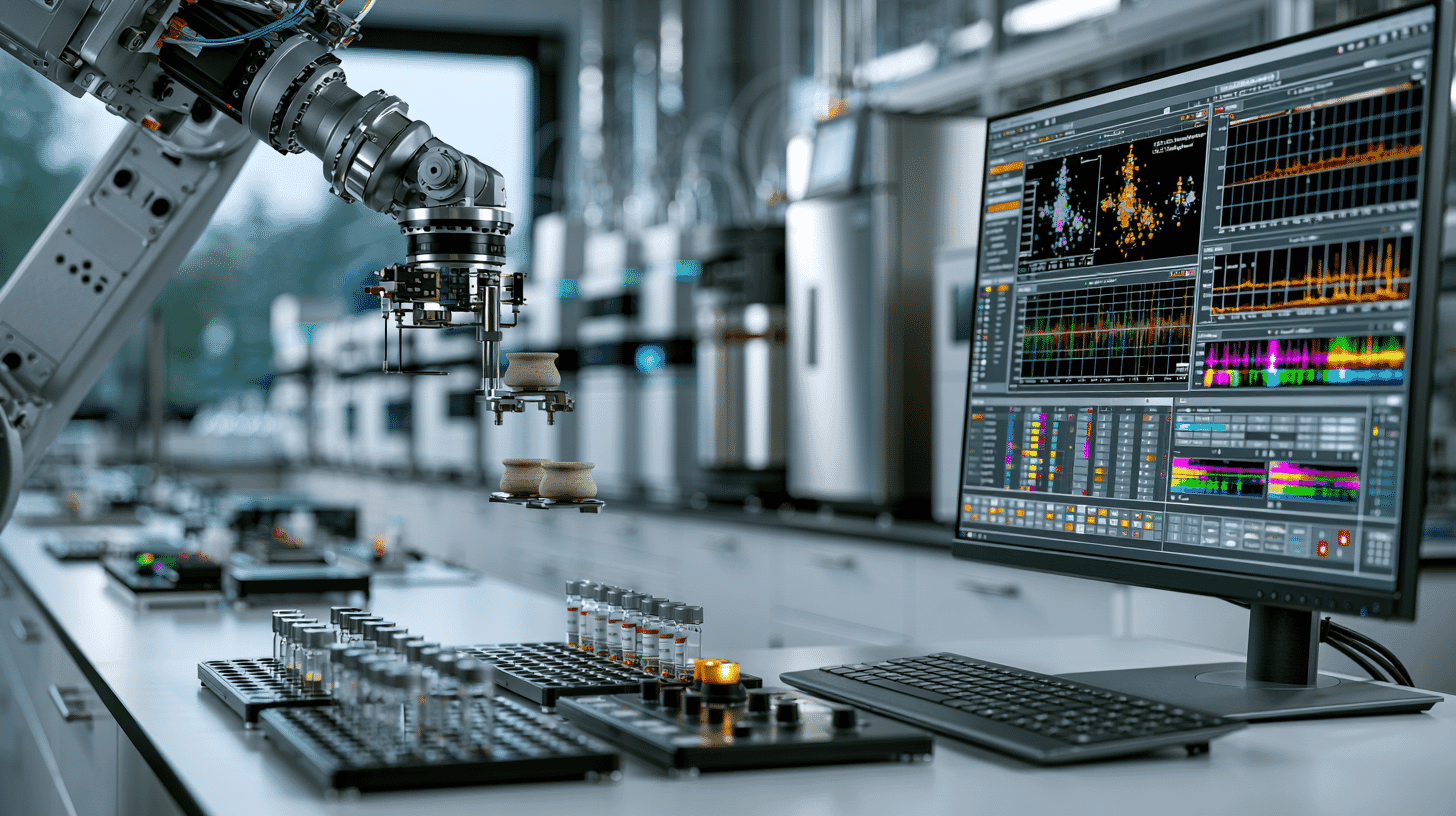
🤖 Picture a lab where a robotic arm mixes and bakes a new material, an AI reads the results the moment they come out, and the same AI decides what to try next. No researcher in the loop. That kind of "self-driving lab" is now taking shape in Japan. In July, Toyota, Shinshu University and eleven other companies and institutions said they are building one together, betting that robots and shared data can compress a process that normally takes a decade.
The robot runs the experiment, the AI picks the next one
On April 1, 2026, Shinshu University and Toyota began a joint project with a deliberately unglamorous name: a new approach to AI- and data-driven materials discovery using a fully automated, autonomous laboratory. Strip away the jargon and it describes a loop. A robot synthesizes a sample. Instruments measure it. An AI analyzes the data as soon as it lands, then sets the conditions for the next experiment. The cycle repeats on its own, testing far more possibilities in far less time than a human team working by hand.
The work happens at the Aqua Regeneration Collaborative Research Center (ARCH) on the university's Matsumoto campus, where a roughly 150-square-meter crystal synthesis robot lab houses about 110 robots that are eventually meant to run experiments around the clock. It pairs a technique Shinshu has spent years refining, the "flux method" (a way of growing high-quality inorganic crystals out of a molten solvent), with robotic automation and Toyota's materials informatics, the practice of using data and machine learning to decide which materials are worth making. Results flow into a Toyota data-sharing platform called WAVEMAP, so other labs and companies can build on them.
From a two-partner pilot to a 13-member consortium
That pilot was the seed. On July 2, the partners went public with something bigger: a consortium for robotic, integrated inorganic materials development, 13 companies and institutions in all, organized around Shinshu's Aqua Regeneration Institute. Toyota and Denso are joined by instrument and chemical makers including JEOL and Resonac, and by automation specialists such as Kawada Robotics, Toray Engineering and Rigaku.
The plan runs on a division of labor. Shinshu synthesizes an inorganic material and measures its basic physical properties. It then ships samples to material users like Toyota, who test how the material performs inside an actual product. Both datasets, the fundamental numbers and the real-world performance, pile up in a shared pool that academia and industry can draw on. Synthesis recipes get shared too, with an eye toward scaling promising materials up to mass production. In effect, the group is trying to wire the whole pipeline, from first sample to factory, into one feedback loop. At the July 2 session, university president Soichiro Nakamura described the lab's job as inventing not new materials but new ways of making them.
Why materials science moves so slowly
Materials development is famously patient work. Getting from an idea to a product on the market routinely takes more than ten years, much of it eaten up by slow, manual trial and error at the bench. A researcher can only mix, heat and measure so many samples in a day.
Autonomous labs go straight at that bottleneck. The machine never tires, and the AI learns from every result, so the system can work through combinations a human would never have time to try. Just as important, it chooses what to attempt next instead of following a fixed script. Materials have long been a strength of the Japanese economy, which is reason enough to want that leap.
The US got there first, and got a reality check
Japan is not first into this race. In late 2023, the A-Lab at Lawrence Berkeley National Laboratory, led by Gerbrand Ceder and Yan Zeng, ran for 17 days without human hands and reported making 41 new inorganic compounds out of 58 targets, about 21 experiments a day. The targets were drawn from computational databases, and the run was done together with Google DeepMind's GNoME, an AI that had predicted hundreds of thousands of candidate materials. The setup could process 50 to 100 times as many samples per day as a person.
It also drew sharp criticism. Robert Palgrave, a chemist at University College London, argued that the lab's automated analysis had not actually confirmed that any genuinely new materials were made. Ceder answered with more data, but granted that a human could interpret the results more carefully, and that replacing scientists was never the point. The exchange became a useful caution for the whole field: automating the hands is easier than automating the judgment.
The American push has not slowed. Startups such as Lila Sciences are raising large sums to build AI-run labs, though as MIT Technology Review noted late last year, they are still waiting for their "ChatGPT moment." In November 2025 an executive order launched the Genesis Mission, putting the US Department of Energy's 17 national laboratories and some 40,000 scientists and technical staff behind AI-driven science, with the stated aim of doubling the productivity of American science and engineering within a decade.
China's robot chemist, and a national race
China arrived early too, and with a flourish. Also in November 2023, a team at the University of Science and Technology of China unveiled a robotic "AI chemist" that produced an oxygen-generating catalyst from Martian meteorites. It ran a laser over five meteorites, either Martian or close to Martian in composition, and picked out six elements: iron, nickel, calcium, magnesium, aluminum and manganese. Those yielded 3,764,376 possible formulas, a search the researchers estimated would take a human roughly 2,000 years. The system got through it in about six weeks. The demo was pitched at deep-space exploration, but the underlying claim matched everyone else's: an AI can design and make new materials on its own.
Behind projects like that sits heavy state backing. Autonomous experimentation and "embodied AI" show up in China's national planning, and materials-data platforms have become a strategic priority. It is the same instinct Japan's consortium is chasing, scaled up to the level of national policy.
Where Japan is placing its bet
Arriving late has pushed Japan toward a different wager. Rather than chase one dramatic demonstration, its consortium is built around collaboration and industrialization: many firms pooling data, university synthesis tied directly to corporate product testing, and the road to mass production treated as part of the experiment instead of an afterthought. That plays to a real national strength, a deep and established materials industry, and to Shinshu's specific expertise in crystal growth.
The caveats are honest ones. This is still a concept and a consortium, not a shelf of proven new materials. The US experience shows that automating discovery is one thing and validating it is another, and that the "self-driving" label can outrun what the machines actually deliver. Whether Japan's data-sharing, factory-minded approach yields materials the flashier demos did not is the open question, and a genuinely different bet on how this technology pays off.
How is materials or AI research organized where you live: around big national labs, private startups, or something in between?
References
- https://newswitch.jp/p/49650
- https://www.shinshu-u.ac.jp/institution/arch/news/news/-ai.html
- https://www.nature.com/articles/s41586-023-06734-w
- https://www.chemistryworld.com/news/new-analysis-raises-doubts-over-autonomous-labs-materials-discoveries/4018791.article
- https://www.technologyreview.com/2025/12/15/1129210/ai-materials-science-discovery-startups-investment/
- https://www.nature.com/articles/s44160-023-00424-1









Global Discussion
3 comments