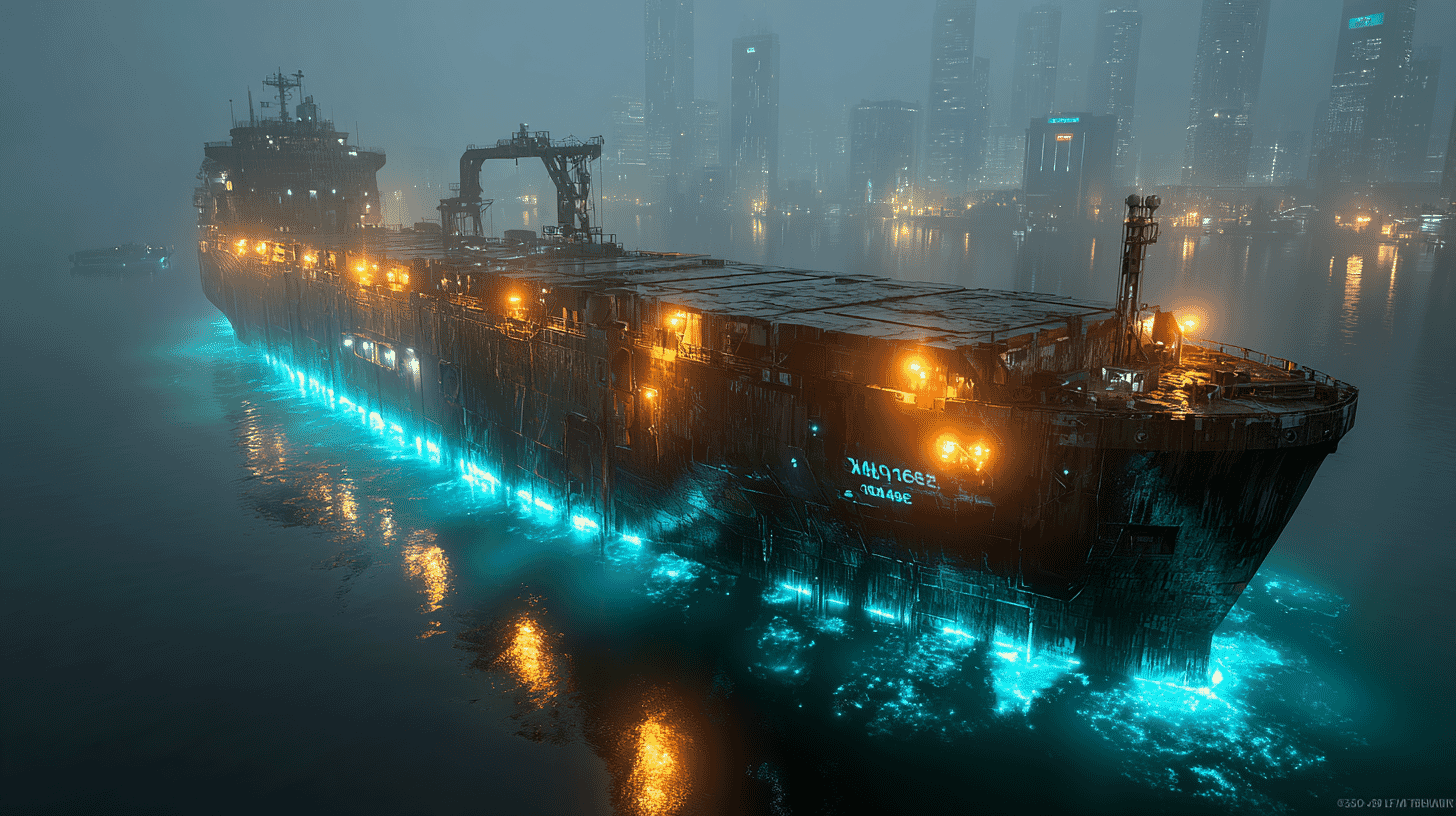
As AI pushes data center electricity demand higher, shipping giant MOL and tech conglomerate Hitachi have announced a plan to convert retired cargo ships into floating data centers. No land required, cooled by seawater, converted in about a year. It is the kind of answer a maritime nation reaches for.
The Triple Crisis Facing Data Centers: Land, Power, and Cooling
The explosive growth of generative AI has sent data center demand skyrocketing worldwide. A widely cited estimate holds that a single ChatGPT query uses roughly ten times the electricity of a web search, though more recent analyses put the gap far lower and the figure is contested. Either way, as AI models grow more powerful, the power appetite of the data centers running them only intensifies.
First, there's the land problem. Large-scale data centers require vast tracts of real estate, but prime urban land is scarce and expensive, while building in remote areas introduces latency, the delay in data transmission that can cripple real-time AI applications.
Next, the power problem. Japan alone may see its data center power demand multiply several times over the next decade, potentially overwhelming existing electrical grids.
And finally, the cooling problem. Servers generate enormous amounts of heat that must be continuously dissipated. Cooling systems can account for roughly 40% of a data center's total power consumption, a staggering figure when you consider that these facilities are already energy-hungry.
Two Japanese companies believe the ocean answers all three at once.
MOL × Hitachi: The Floating Data Center Blueprint
On March 30, 2026, Mitsui O.S.K. Lines (MOL), Hitachi Ltd., and Hitachi Systems announced they had signed a memorandum of understanding (MOU) covering the development, operation and commercialization of floating data centers (FDCs) built from used ships. It is MOL's second FDC tie-up: in July 2025 the company signed an MOU with Kinetics, a Karadeniz Holding subsidiary, to jointly develop an FDC platform.
What makes this project stand out is the decision to repurpose retired vessels rather than build from scratch. A converted car carrier ship, for example, offers roughly 54,000 square meters (about 581,000 sq ft) of floor space, comparable to Japan's largest land-based data centers.
Key Advantages
1. No Land Needed FDCs are moored in harbors or rivers, eliminating the need for expensive urban real estate. The regulatory hurdles of land acquisition and community negotiations are dramatically reduced.
2. Seawater Cooling Slashes Energy Costs The biggest selling point: surrounding seawater or river water can be used directly for cooling. This eliminates the need for massive air conditioning systems and can dramatically cut both the power consumed for cooling and overall operating costs.
3. Lightning-Fast Deployment Conversion is expected to take about one year, compared to the three to five years typically needed for conventional data center construction. That's a potential three-year head start in meeting surging AI demand.
4. Relocatable on Demand Since these data centers float, they can be towed to wherever demand is highest. If one region's needs decline while another's surge, the entire facility can be repositioned.
5. Environmental Benefits Reusing retired ships avoids the CO2 emissions associated with manufacturing new construction materials. Existing onboard systems, HVAC, water intake, generators, can be repurposed, reducing initial investment.
Division of Roles
Each partner brings distinct expertise to the table:
- MOL: Ship conversion planning, port authority coordination, maritime operation requirements, and financing
- Hitachi Ltd. & Hitachi Systems: Data center design, construction and operation technology, IT infrastructure and security, and customer development
The three companies plan to verify demand in Japan, Malaysia, and the United States, with operations targeted to begin in 2027 or later.
Global Context: The Race to Put Data Centers in Water
The idea of using water to cool data centers is not entirely new. But earlier attempts have taken very different approaches, and hit very different walls.
Microsoft's Project Natick (United States)
The most famous predecessor is Microsoft's Project Natick. In 2018, Microsoft sank a sealed capsule holding 12 racks and 864 servers to the seafloor 117 feet down off Scotland's Orkney Islands. After two years of unmanned operation, the underwater servers had a failure rate roughly one-eighth that of their land-based counterparts. Microsoft credits the sealed nitrogen atmosphere, stable water temperatures, and the absence of humans bumping into things.
In June 2024, Microsoft confirmed it no longer has any active underwater data centers. "I'm not building subsea data centers anywhere in the world," said Noelle Walsh, who runs the company's Cloud Operations and Innovation team. "My team worked on it, and it worked." The lessons, she said, would be applied elsewhere. The industry's common reading is that a sealed capsule cannot be reopened to swap or add GPUs, which is disqualifying in an AI buildout, but Microsoft has not spelled out its reasoning.
China's Underwater Data Center in Hainan
China took a different path. In 2023, tech firm Highlander deployed what it calls the world's first commercial underwater data center off Hainan Island. Each 1,300-ton capsule sits about 115 feet underwater and uses seawater pumped through radiators to cool its 24 server racks. The facility reportedly achieves 40–60% greater power efficiency for cooling compared to traditional data centers.
Hainan province's five-year plan envisions 100 such capsules, which would save an estimated 105,000 tons of freshwater and 122 million kilowatt-hours of electricity annually.
How Japan's Approach Differs
The MOL-Hitachi FDC concept diverges from both precedents in a crucial way:
| Microsoft Project Natick | China Underwater DC | Japan FDC | |
|---|---|---|---|
| Location | Seafloor (120 ft deep) | Seafloor (115 ft deep) | Sea surface (floating) |
| Maintenance | Impossible (sealed) | Requires lifting | Direct access at port |
| Scalability | Very limited | Add more capsules | Flexible within vessel |
| Relocation | Not possible | Very difficult | Tow to new location |
| Scale | Small (experimental) | Medium (per capsule) | Large (entire ship) |
| Status | Ended 2024 | Commercially active | Targeting 2027 |
The key distinction: Japan's FDCs float on the surface rather than sitting on the ocean floor. This solves the maintenance and scalability problems that ultimately doomed Project Natick while still capturing the cooling benefits of surrounding water.
There's also a distinctly Japanese philosophy at work here. Converting retired ships rather than building new vessels reflects the spirit of mottainai, the deeply ingrained Japanese concept of not letting anything go to waste. It's the engineering equivalent of turning yesterday's car carrier into tomorrow's AI brain.
Japan's Geographic Edge as a Maritime Nation
Japan is an archipelago of roughly 6,800 islands with approximately 35,000 kilometers (21,700 miles) of coastline. Its exclusive economic zone (EEZ) ranks sixth largest in the world. This geography provides a natural advantage for floating data center deployment.
MOL operates a fleet of over 900 vessels worldwide, including LNG carriers, car carriers, and tankers. Combined with Japan's well-developed port infrastructure, the technical barriers to mooring and maintaining floating data centers are relatively manageable.
Japan's surrounding waters also offer favorable conditions for cooling. While temperatures vary by season, northern regions, particularly around Hokkaido and the Sea of Japan coast, benefit from cold currents that could further boost cooling efficiency.
Building AI's Future Infrastructure From the Ocean Up
Verification toward a 2027 launch is just getting started. Where Microsoft's Project Natick closed out as a research project, the MOL-Hitachi FDC is built around commercialization from day one. How much that difference is worth remains to be seen: port authority approvals, mooring safety, and telecom links are all still unproven at sea.
In Japan, people are looking to the sea for solutions to AI infrastructure challenges. How is your country tackling data center power consumption and space constraints? We'd love to hear your perspective.
References
- https://www.mol.co.jp/pr/2026/26022.html
- https://eetimes.itmedia.co.jp/ee/articles/2604/01/news027.html
- https://natick.research.microsoft.com/
- https://news.microsoft.com/source/features/sustainability/project-natick-underwater-datacenter/
- https://merics.org/en/comment/china-commercializing-energy-efficient-underwater-data-centers







Global Discussion
15 comments