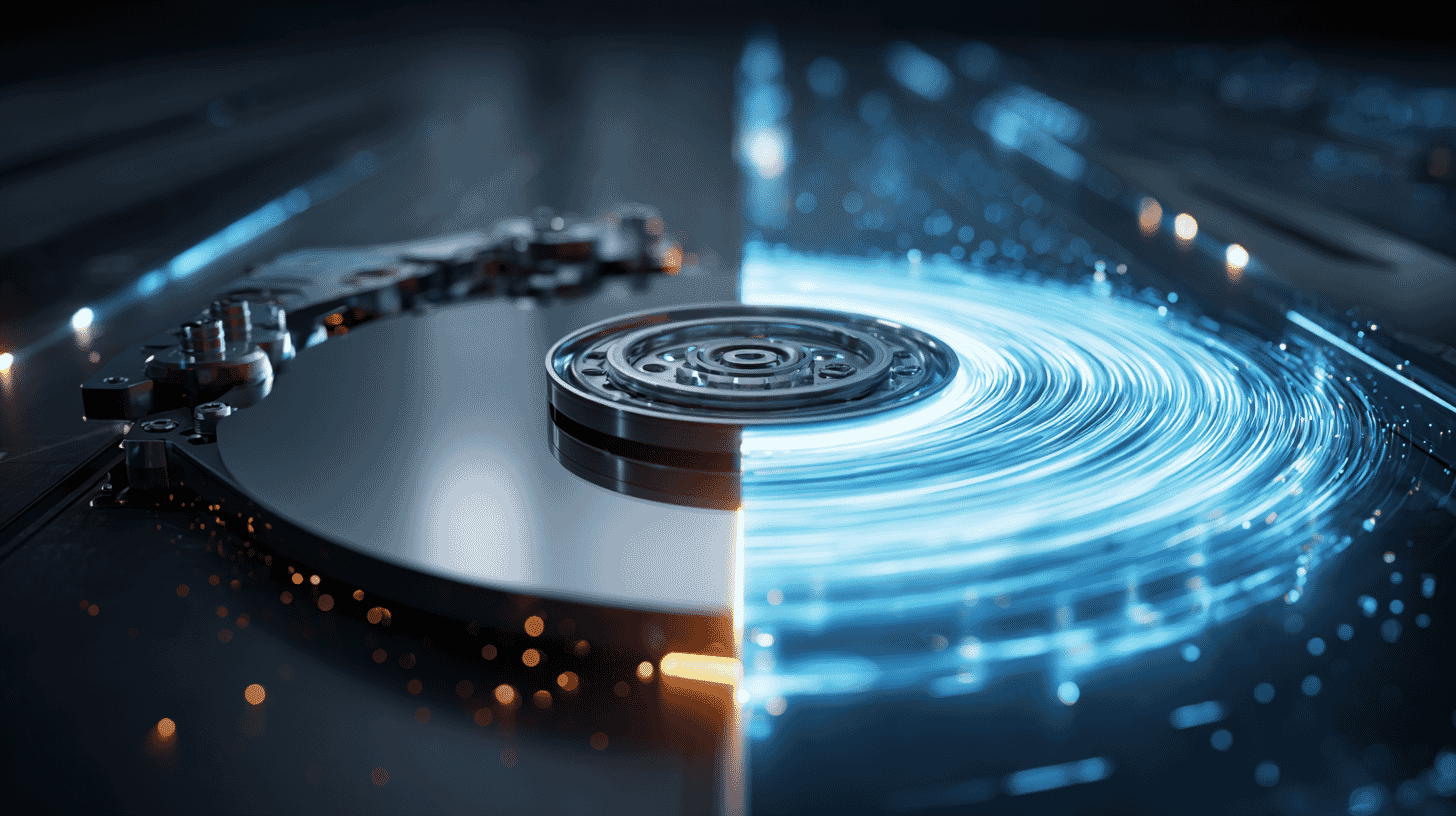
Imagine storing 20,000 movies on a single hard drive. That's where we're headed. In February 2026, storage giant Western Digital (WD) announced its plan to deliver a 100TB HDD by 2029. In an age where AI is generating data at unprecedented rates, the "cheap and massive" hard drive isn't dead; it's getting a second life.
WD's Roadmap to 100TB
On February 3, 2026, WD (formerly Western Digital) held its "WD Innovation Day 2026" event, revealing an ambitious roadmap to dramatically scale up HDD capacity. Alongside the announcement, WD unveiled a new brand logo, signaling its transformation into what it calls "a storage infrastructure partner for the AI-driven data economy."
WD's current flagship is a 40TB HDD (UltraSMR ePMR technology), the highest capacity in the world. It's already undergoing qualification testing with two hyperscale cloud providers, with volume production planned for the second half of 2026. HAMR drives are in qualification with two hyperscalers as well, with ramp production targeted for 2027. Here's what comes next:
- Late 2026: 40TB ePMR HDD enters mass production
- 2027: HAMR (Heat-Assisted Magnetic Recording) HDDs begin mass production
- 2028: ePMR reaches 60TB; Dual Pivot technology HDDs arrive
- 2029: HAMR HDDs reach 100TB
The key feature of this roadmap is WD's "dual-path strategy." The company will extend existing ePMR technology to 60TB, borrowing innovations from HAMR to get there without raising power draw, while developing next-generation HAMR in parallel. Since both are built on a shared architecture, data center customers can transition at their own pace without being forced into disruptive infrastructure changes.
What Is HAMR? Writing Data with Lasers
The technology that makes 100TB possible is called HAMR (Heat-Assisted Magnetic Recording).
Traditional HDDs write information using a magnetic head on spinning disks. But as you try to pack data more densely, the magnetic signals become unstable, a fundamental physics limitation. HAMR solves this by using a tiny laser to heat a precise spot on the disk's surface just before writing. The heated area becomes temporarily easier to magnetize, and once it cools, the data remains stable.
This technology can boost recording density from today's roughly 4TB per platter to as much as 10TB per platter. With 14 platters in a single drive, that's a theoretical ceiling of 140TB, and WD's roadmap extends past 2032.
WD has also spent six years developing a proprietary "vertical-emitting laser" to replace conventional "edge-emitting lasers." This new design wastes less light energy, takes up less vertical space, and allows platters to be packed more tightly together, meaning more disks in the same 3.5-inch enclosure, improving both capacity and efficiency.
Two New Technologies to Close the SSD Gap
The HDD's biggest weakness has always been speed. A typical modern HDD transfers data at around 250–300 MB/s, while SSDs can be several times to dozens of times faster. WD is introducing two technologies to narrow this divide.
High Bandwidth Drive Technology
In a conventional HDD, a single read/write head follows a single track. High Bandwidth Drive technology enables multiple heads to access multiple tracks simultaneously, like expanding a one-lane road to two, four, or eventually eight lanes.
Currently delivering 2x the bandwidth of traditional HDDs, this technology has a roadmap to reach up to 8x. On simple arithmetic, that would push HDD transfer speeds from roughly 300 MB/s to beyond 2 GB/s (2,000 MB/s). This technology is already in customer validation.
Dual Pivot Technology
Traditional HDDs mount all read/write heads on a single pivot arm. Dual Pivot adds a second, fully independent pivot on the opposite end of the drive. Two separate actuators working independently can double sequential I/O performance.
Unlike earlier dual-actuator designs that sacrificed one disk's worth of space, Dual Pivot actually reduces the spacing between disks, allowing more platters. More capacity and more speed from the same change. Scheduled for 2028, and combined with High Bandwidth Drive technology, WD says it can deliver up to 4x I/O performance improvement.
Why Do We Need 100TB HDDs? AI's Data Explosion
The driving force behind WD's aggressive capacity push is AI's insatiable appetite for data. AI training and inference require enormous datasets, and WD expects nearline shipments, measured in exabytes, to grow more than 25% a year over the next five years.
About 80% of hyperscale storage still sits on HDDs. For hyperscalers like Google, Amazon, and Microsoft, storing everything on SSDs is simply too expensive. By WD's estimate, flash costs 6 to 10 times more per terabyte than HDDs. For bulk storage, hard drives are far cheaper.
WD reported fiscal Q2 FY2026 revenue of $3.02 billion, up 25% year on year, of which cloud accounted for $2.7 billion, or 89% of the total. It shipped 215 exabytes, up 22%, at a record non-GAAP gross margin of 46.1%. On the earnings call, CEO Irving Tan said the company was "pretty much sold out for calendar 2026," with firm purchase orders from its top seven customers and some agreements running into 2027 and 2028.
HDD vs SSD: The Era of Coexistence Continues
The notion that "HDDs are dead and everything will become SSD" is a persistent one. But in real-world data centers, HDDs remain indispensable due to their cost-to-capacity ratio.
In the consumer PC market, SSDs have largely won. SSD share in laptop storage is nearly 95%, and over 88% in desktops. By unit shipments, SSDs outsell HDDs roughly 3 to 1.
However, in terms of total shipped capacity, HDDs still deliver over three times more than SSDs. In the "nearline" storage tier of data centers, large-capacity storage for data that's accessed occasionally but needs to be available in seconds rather than hours, HDDs dominate. This "warm" to "cold" data layer is HDD territory.
SSDs are advancing too. Solidigm has announced a 122TB PCIe SSD (estimated at around $30,000), showing that capacity competition is real. On cost per terabyte, though, the 6-to-10x gap mentioned above is still wide.
WD's strategy is to protect its cost advantage while shrinking its performance disadvantage. A power-optimized HDD drawing 20% less energy is expected to enter customer qualification in 2027, blurring the line between warm and cold tiers. The same year, WD plans an open-API software layer aimed at customers operating at 200 petabytes and above. For data that's too active for tape but too expensive for SSD, HDDs at optimal cost are WD's answer for the AI era.
The Competition, Seagate and Toshiba Are Also Scaling Up
The race for high-capacity HDDs isn't WD's alone. Chief rival Seagate is ahead in volume production with its own HAMR technology, "Mozaic," and has laid out plans for 50TB in 2028, 60TB in 2029-2030 and more than 80TB in 2031. Its research prototypes have also reached 7TB per platter.
Toshiba has verified technology that stacks 12 platters and plans a 40TB-class drive in 2027 and a 55TB-class drive by 2030. With all three major manufacturers investing heavily in capacity scaling, the industry clearly believes data center HDD demand has a long future ahead.
For consumers, HDD price increases in 2026 are worth noting. AI-driven demand has tightened supply, and WD has said outright that its calendar 2026 capacity is sold out, with Seagate in much the same position. NAND shortages have pushed SSD prices up at the same time, leaving the whole storage market in a seller's position.
Update: 40TB Shipped on Schedule, While Seagate Leads on HAMR
In its earnings report on August 5, 2026, WD said it began shipping its next-generation 40TB ePMR drives in the quarter ended in early July and had entered volume production for two customers, keeping to the "second half of 2026" plan it set out in February. Its 44TB HAMR drive is due to ship in the first half of 2027, and High Bandwidth Drive technology is now sampling with five customers. Quarterly revenue was $3.75 billion (about ¥560 billion), up 44% year on year.
On HAMR volume production, however, Seagate is ahead. It began shipping its Mozaic 4 platform, which supports up to 44TB, in March 2026, and HAMR now accounts for about 40% of its nearline exabyte shipments. WD will reach 44TB with HAMR about a year later. On the road to 100TB the three makers look level, but in today's production lines the gap is real.
Data center construction is accelerating in Japan, and AI-related storage demand keeps growing. SSD speed is attractive, but if HDDs of more than 100TB arrive within a few years, the cost-performance math could change significantly. In your country, which is still the workhorse, HDD or SSD?
References
- https://www.westerndigital.com/company/newsroom/press-releases/2026/2026-02-03-western-digital-accelerates-storage-innovation-for-ai-era
- https://blog.westerndigital.com/performance-optimized-hdd-4x-throughput-hbdt-dual-pivot/
- https://www.tomshardware.com/pc-components/hdds/western-digital-unveils-massive-40tb-hdd-that-records-data-using-lasers-plans-100tb-hamr-hard-drives-by-2029
- https://www.tomshardware.com/pc-components/hdds/western-digital-details-14-platter-3-5-inch-hamr-hdd-designs-with-140-tb-and-beyond
- https://eetimes.itmedia.co.jp/ee/articles/2602/18/news105.html
- https://www.westerndigital.com/en-sg/company/newsroom/press-releases/2026/2026-08-05-wd-reports-fiscal-fourth-quarter-and-fiscal-year-2026-financial-results
- https://www.storagereview.com/news/wd-bets-8x-bandwidth-beats-more-terabytes-as-40tb-ultrasmr-starts-shipping
- https://www.tomshardware.com/pc-components/hdds/high-capacity-hdd-roadmap-the-race-to-100tb-and-zettabyte-scale-storage-toshiba-seagate-and-wd-outline-three-distinct-strategies
- https://nand-research.com/research-note-western-digital-innovation-day/









Global Discussion
15 comments