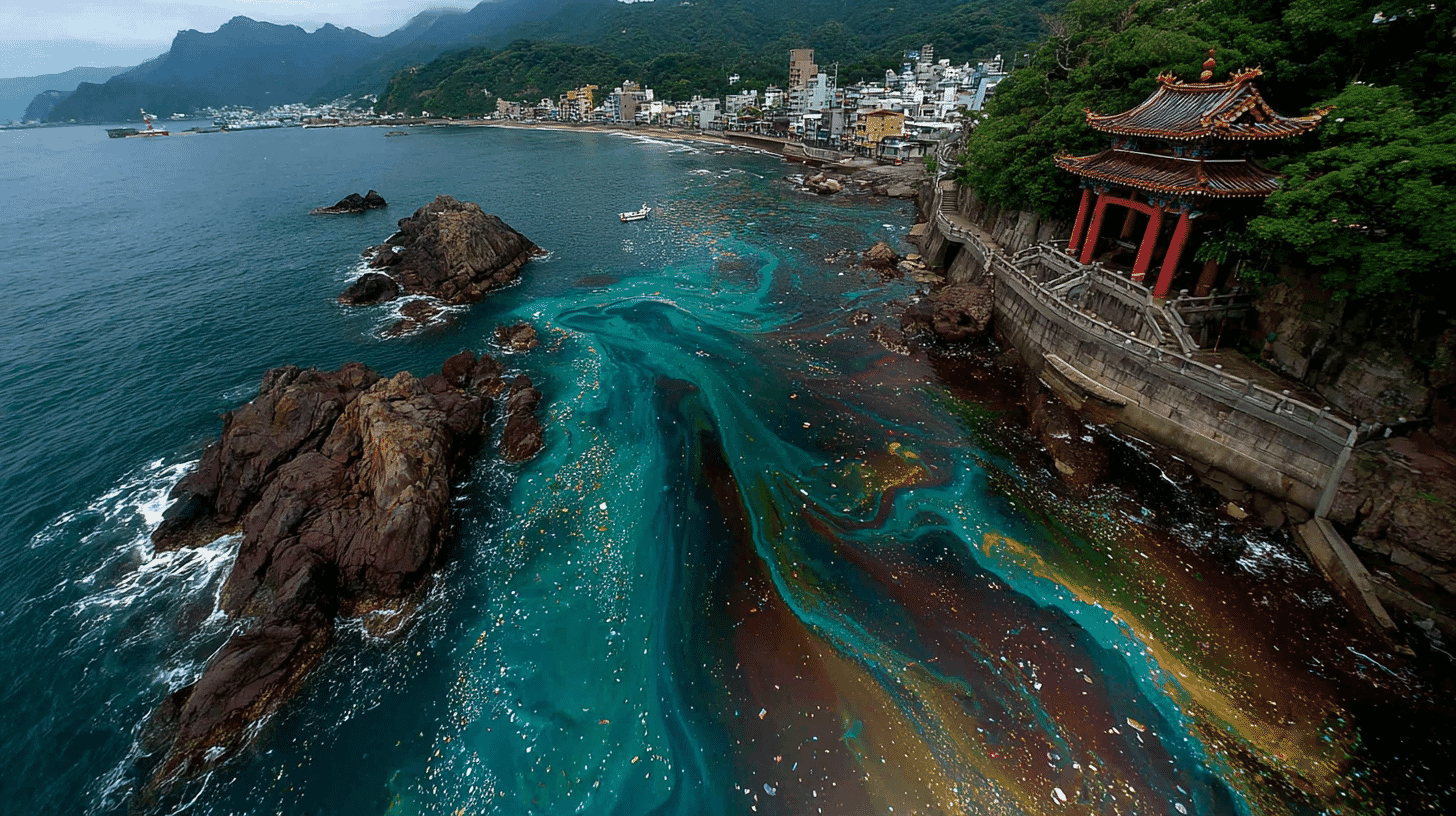
The waters around Japan contain 27 times more microplastics than the global ocean average. Carried by the Kuroshio and Tsushima Currents from across East and Southeast Asia, plastic pollution has turned Japan's seas into one of the world's worst hotspots. An estimated 28,000 tons sink to the deep sea floor every year, and fishing-related plastic accounts for roughly half of all coastal debris. In June 2026, the world's first dedicated ocean plastic center opened.
27 Times the Global Average: The Numbers Behind Japan's Plastic Crisis
According to research by JAMSTEC (Japan Agency for Marine-Earth Science and Technology), the density of microplastics, plastic fragments smaller than 5mm, floating on the sea surface near Japan is approximately 27 times the global average. A separate 2014 survey by Japan's Ministry of the Environment found concentrations in Japanese waters to be about 16 times higher than the broader North Pacific average.
The explanation lies in ocean currents and geography. The majority of plastic entering the world's oceans via rivers originates from East and Southeast Asian countries. Two major currents, the Kuroshio (Black Current) flowing northward along the Pacific coast, and the Tsushima Current flowing through the Sea of Japan, funnel enormous quantities of this debris toward Japanese waters. Japan itself contributes an estimated 11,000 to 27,000 tons of plastic leakage into the ocean annually, according to the Ministry of the Environment.
Pollution Reaching the Deep Sea: 28,000 Tons Sinking Per Year
The problem doesn't stop at the surface. JAMSTEC researchers conducted a two-year observation study off the Boso Peninsula, east of Tokyo, in the Kuroshio Extension recirculation zone. They found that an average of 352 microplastic particles per square meter were sinking to the deep sea every single day. Extrapolated across the study area, this translates to an estimated 28,000 tons of microplastics being transported to depths of 4,900 meters (about 16,000 feet) each year.
The mechanism involves "marine snow", aggregates of plankton remains and organic matter that trap microplastics and carry them downward. Microplastics have been detected even in ultra-deep sediments below 6,000 meters (nearly 20,000 feet), places barely touched by human activity.
Extreme weather amplifies the problem dramatically. After one typhoon passed through Sagami Bay near Tokyo, microplastic concentrations surged to roughly 1,300 times pre-storm levels, according to JAMSTEC researcher Ryota Nakajima.
Fishing Gear: Half of All Coastal Debris
Between 30,000 and 50,000 tons of debris wash up on Japanese coastlines each year, with plastic making up the largest category. Strikingly, fishing-related plastic, nets, ropes, buoys, and other gear, accounts for approximately half of all coastal litter collected in Japan.
Japan's Fisheries Agency has been investing in the development of environmentally friendly fishing gear materials, designing equipment that's easier to recycle, and studying the effects of microplastics on marine life used in aquaculture. However, the fishing industry remains deeply dependent on plastic materials for their durability and low cost, making a full transition to alternatives a slow process.
Concentrations Predicted to Double by 2030
Research by Kyushu University's Professor Atsuhiko Isobe projects that if current plastic leakage rates continue, microplastic concentrations in the North Pacific, including Japanese waters, will roughly double by 2030 and quadruple by 2060.
The "Osaka Blue Ocean Vision," agreed upon at the 2019 G20 Summit in Osaka, set the ambitious goal of reducing additional ocean plastic pollution to zero by 2050. However, achieving this would require a 32% reduction from current levels by 2035, a target that appears increasingly difficult to meet.
PLA PLA: The World's First Ocean Plastic Center Opens June 2026
Against this backdrop, an innovative new facility is taking shape on the Hado Cape in Karatsu City, Saga Prefecture, on the northwestern coast of Kyushu. The World Ocean Plastic Planning Center, nicknamed "PLA PLA", opened on June 7, 2026 as the world's first facility dedicated entirely to the ocean plastic problem. The project budget is approximately 600 million yen (about $4 million).
Hado Cape is a scenic spot within Genkai Quasi-National Park, but it is also one of Japan's most heavily impacted coastlines for marine debris. Seasonal northwesterly winds and the Tsushima Current drive massive quantities of plastic ashore, especially during winter months, including polyethylene tanks, PET bottles, and fishing gear believed to originate from neighboring countries.
PLA PLA is far more than a museum. Visitors will be able to participate in the entire process, collecting plastic from the beach, sorting, washing, and upcycling it into new products. The facility integrates education, research, hands-on experience, and material regeneration under one roof, aiming to spark behavioral change in every visitor.
Japan's Efforts and Remaining Challenges
Japan has implemented significant policy measures, including the Plastic Resource Circulation Promotion Act (enacted 2022), mandatory charges for plastic shopping bags, and the "Plastic Smart" national campaign. Its PET bottle recycling rate exceeds 84%, among the highest globally.
Yet significant challenges remain. Japan's per-capita plastic packaging waste ranks among the world's highest. Much of what Japan counts as "recycling" is actually thermal recovery, burning plastic for energy, rather than true material recycling. Critics argue this inflates recycling statistics without genuinely closing the loop.
Furthermore, an estimated 150 million tons of plastic already exists in the world's oceans, and current technology makes large-scale recovery virtually impossible. Stopping the flow is essential, but addressing the accumulated pollution is an equally urgent and far more daunting task.
Japan's Ocean Plastic Problem in Numbers
- Microplastic density near Japan: 27 times the global average (JAMSTEC)
- Compared to the North Pacific average: 16 times higher (Ministry of the Environment, 2014)
- Annual microplastic sinking to the deep sea off Boso Peninsula: est. 28,000 tons
- Annual plastic leakage from Japan into the ocean: est. 11,000–27,000 tons (MOE)
- Annual coastal debris collected in Japan: approx. 30,000–50,000 tons
- Fishing-related plastic as a share of coastal debris: approx. 50%
- PLA PLA project budget: approx. 600 million yen (~$4 million)
- 2050 forecast: ocean plastic weight to exceed the weight of all fish (World Economic Forum)
Japan finds itself in a paradox: despite having one of the world's most advanced waste management systems, its geographic position at the terminus of major Asian ocean currents makes it one of the planet's worst microplastic hotspots. This is not a problem any single country can solve, it demands international cooperation.
How does your country handle ocean plastic pollution? Are beach cleanups and single-use plastic reduction gaining traction where you live? We'd love to hear about your experience.
References
- https://www.jamstec.go.jp/j/pr/topics/explore-20250130/ (JAMSTEC BASE – Microplastic observations near Japan)
- https://www.jamstec.go.jp/j/about/press_release/20240826/ (JAMSTEC – Deep-sea microplastic sinking estimates)
- https://www.jamstec.go.jp/j/pr/topics/explore-20240221/ (JAMSTEC BASE – Deep-sea plastic accumulation)
- https://www.env.go.jp/policy/hakusyo/r01/html/hj19010301.html (Ministry of the Environment – Annual Environmental Report)
- https://www.jfa.maff.go.jp/j/sigen/action_sengen/190418.html (Fisheries Agency – Ocean plastic measures)
- https://spur.hpplus.jp/sdgs/dearearth/2026-01-30-PZ6PVw/ (SPUR – PLA PLA feature)









Global Discussion
13 comments