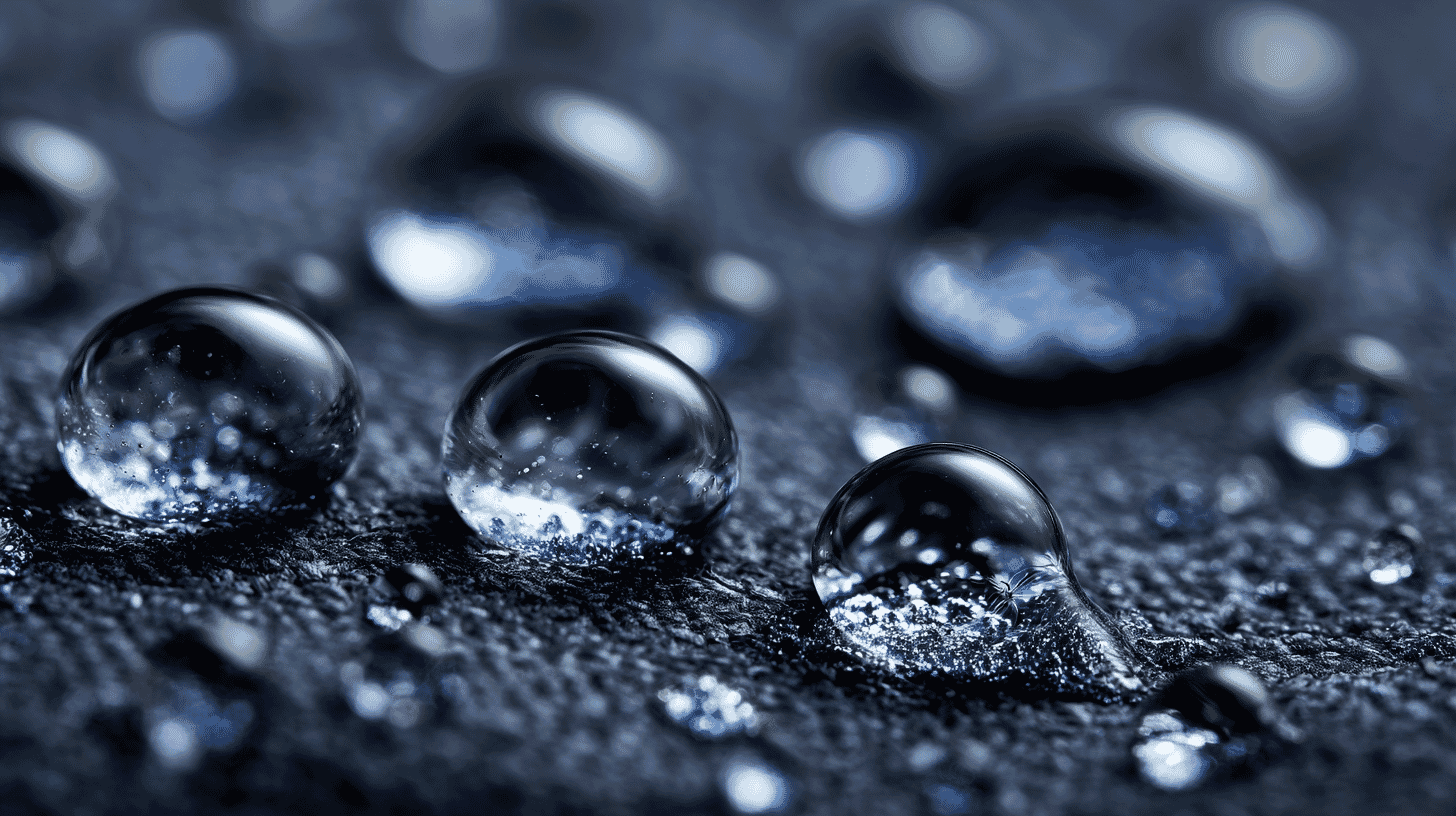
🌊 You've watched water bead up and skate off a raincoat or a freshly waxed car. It looks like the drops are gliding on a film with no friction at all. For close to two centuries, physicists have argued over whether something similar happens down at the scale of single molecules: whether water truly "slips" along surfaces that repel it. A team in Japan and the United States just delivered the cleanest answer yet, and it's the opposite of what most people assume: water barely slips. Whether a surface loves water or hates it turns out to make almost no difference.
"Slip" isn't the thing you're picturing
Start with a distinction that clears up most of the confusion. When a droplet rolls off a lotus leaf, that's real, and it is not what scientists mean by "slip."
In fluid mechanics, "slip" describes what happens in the very first layer of liquid touching a solid wall. For two hundred years, engineers have built their equations on the no-slip condition, the assumption that this bottom layer effectively sticks to the surface and doesn't move, while the layers above it slide past. Picture a deck of cards: the bottom card stays put, the top ones glide. How far the liquid pinned to the wall actually manages to creep is captured by a number called the slip length: zero means perfect sticking, larger numbers mean more sliding.
The long-running hunch was that water-repellent (hydrophobic) surfaces should let water slip more, giving a longer slip length, because the water doesn't "want" to cling. If true, that would be a free lunch for anything that pushes water through narrow channels: less drag, less pumping energy. Plenty of people wanted it to be true.
Why nobody could pin it down
Here's the awkward part. For decades, experiments trying to measure that slip came back all over the map. Some reported water-repellent surfaces with enormous slip; others found next to none. The numbers didn't agree with each other, and they didn't match what computer simulations predicted. The simple question, does water actually slip on a water-repellent surface?, had no trustworthy answer.
The trouble is that slip at this scale is tiny, and almost everything contaminates the measurement. Microscopic bumps, dissolved gas, stray impurities, even minute nanobubbles (gas bubbles a few billionths of a meter across) clinging to the wall can all fake the look of slip. Measure carelessly and you'll "see" water gliding when really it's riding over a patchy cushion of trapped gas.
Building a more honest ruler
The group, Haruya Ishida, associate professor Hideaki Teshima and professor Koji Takahashi at Kyushu University, working with Vishwanath Ganesan and professor Nenad Miljkovic at the University of Illinois Urbana-Champaign, went after the measurement problem itself.
They adapted a tool called frequency-modulation atomic force microscopy (FM-AFM), which drags an impossibly fine vibrating tip across a surface and reads how its vibration shifts to sense forces atom by atom. Their version maps the slip length and the surface's shape at the same time, at nanometer resolution, so genuine slip can be told apart from an artifact caused by a bump. According to JST, the method is 159 times more sensitive than existing approaches.
Run across smooth surfaces spanning contact angles from 3 to 111 degrees, the verdict was consistent: the slip length was essentially zero, no matter whether the surface repelled water or attracted it. The water-repellent surfaces did not give water the free ride everyone assumed.
There was one tidy exception. On graphite sitting in pure water, the team did measure a real slip of 43.2 ± 5.8 nanometers, small but genuine. The instant they switched to a potassium-chloride (electrolyte) water, even that slip nearly vanished. Crucially, all of these results lined up with the physics simulations, which is the strongest sign that the new ruler is finally measuring the real thing rather than the noise.
So the "slipperiness" was mostly a mirage
Put together, the work suggests those eye-catching big-slip measurements from past decades were largely "apparent slip": illusions produced by surface roughness and nanobubbles, not water actually gliding along the wall.
Which brings us back to the lotus leaf. The droplet really does roll off, but that's a separate, larger-scale effect: a water-repellent surface props the drop up on a high contact angle and a film of trapped air, so it barely touches the solid. That isn't the same as a sheet of flowing water slipping frictionlessly along the wall of a pipe. The visible magic trick is real; the molecular one, it turns out, mostly isn't.
Why a number near zero is good news
This might sound like a letdown, a discovery that something doesn't happen. For engineers it's the opposite. Whole categories of technology hinge on knowing exactly how water behaves where it meets a solid: desalination membranes that squeeze salt out of seawater, cooling devices that carry heat away from chips, and energy-harvesting systems that draw power from flowing liquids. Design any of these assuming water slips when it doesn't, and your predictions drift off course.
What the team really delivered is a way to treat slip length as a reliable material property: a number you can trust and design around, instead of one that shifts every time someone re-runs the experiment.
The findings were published in the journal Nano Letters on May 15, 2026, and announced by Kyushu University and the Japan Science and Technology Agency (JST) on May 20.
Next time water beads up and runs off your jacket, you can enjoy the show knowing the truth is sneakier than it looks: the drop is rolling, but it isn't really slipping. Are water-repellent coatings (on umbrellas, phone screens, car glass, rain gear) a big deal where you live, or is "waterproof" just a label nobody quite trusts? Tell us how it holds up in your corner of the world.
References
- JST / Kyushu University press release: https://www.jst.go.jp/pr/announce/20260520-3/index.html
- Paper (Nano Letters): "Hydrophobicity Does Not Affect Water Slip: Insights from Slip Length Mapping," DOI: https://doi.org/10.1021/acs.nanolett.6c01403





Global Discussion
3 comments