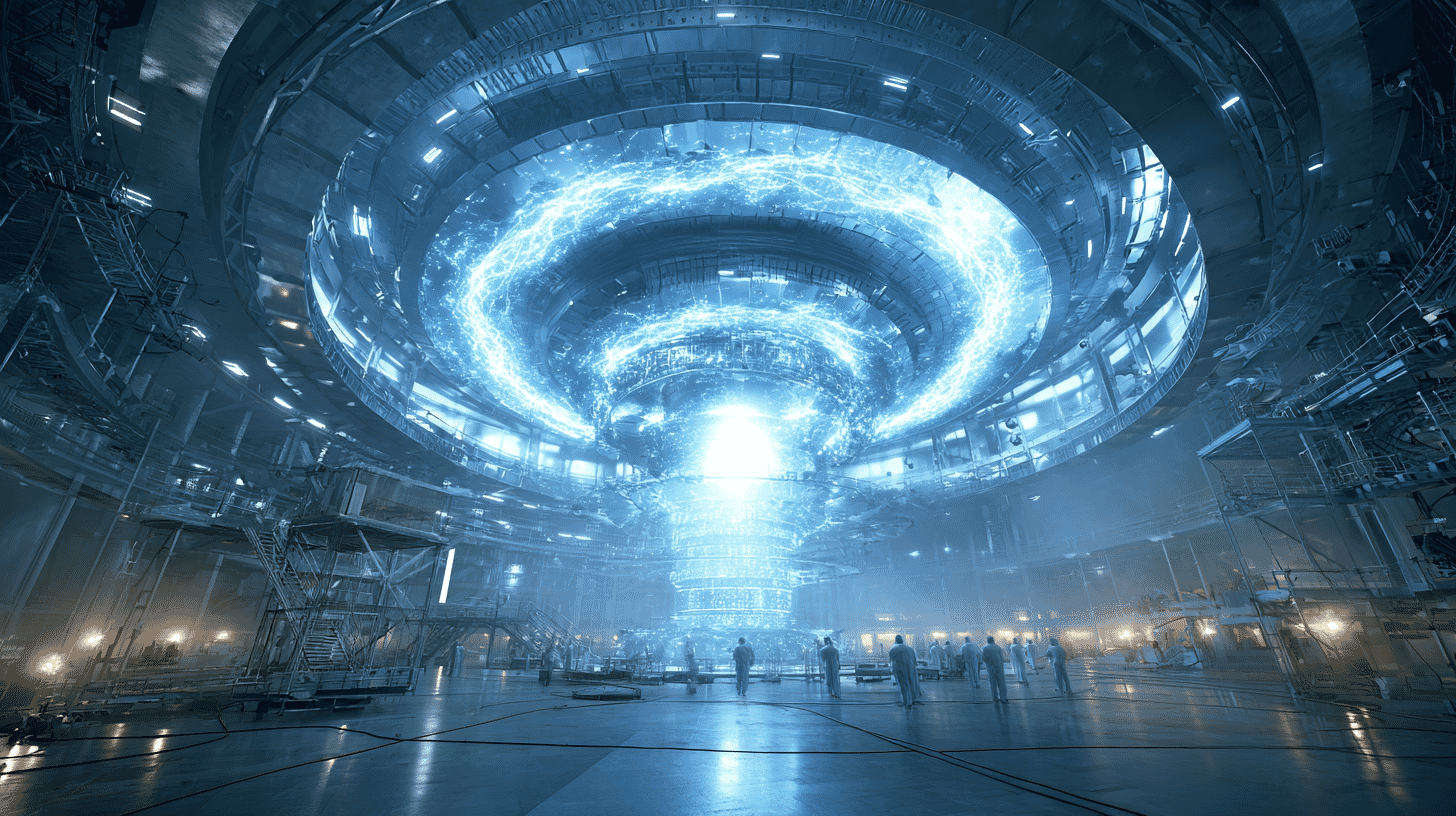
"Build a sun on Earth." That dream now has an address. On March 13, 2026, the Japanese fusion startup Helical Fusion announced where it will build Phase 1 of Helix HARUKA, its final demonstration device: inside the grounds of the National Institute for Fusion Science in Toki, Gifu Prefecture. Manufacturing and construction are already under way with partners across Japan, aimed at an energization test in 2027. While tokamak startups raise billions abroad, Helical Fusion is betting on Japan's own helical approach.
What Is Helix HARUKA?
Helical Fusion has laid out a development roadmap called the "Helix Program": the final demonstration device Helix HARUKA in two stages, followed by the first power-generating unit, Helix KANATA.
Phase 1 (Magnet Demonstration), announced this week, involves assembling three-dimensional, helically-shaped high-temperature superconducting (HTS) coils and verifying their performance through energization tests. In a fusion reactor, the magnet system is like the engine in a car, it determines the overall performance, reliability, and cost of the entire device.
Phase 2 (Integrated Demonstration) will combine the magnet with a "blanket-divertor" system, a component that captures neutrons from the fusion reaction and converts them to heat, to demonstrate sustained high-temperature plasma confinement. This phase will not generate electricity.
The final stage, the Helix KANATA prototype power plant, aims to achieve steady-state operation with net power generation in the mid-2030s.
Why NIFS? Leveraging 70 Years of Research
The choice of NIFS as the construction site is no accident. NIFS operates the Large Helical Device (LHD), one of the world's most advanced helical-type plasma research machines. The LHD has achieved plasma temperatures exceeding 100 million degrees Celsius and sustained plasma for approximately 3,268 seconds (about 54 minutes), remarkable achievements that have positioned Japan at the forefront of helical fusion research.
Helical Fusion was spun out of NIFS in 2021, directly building on decades of helical research. Since 2024, the company has maintained a dedicated collaborative research space on the NIFS campus through the "HF Joint Research Group." The decision to build Phase 1 here tightly connects R&D and hardware construction, accelerating the engineering feedback loop.
Japan has accumulated roughly 70 years of helical fusion knowledge. This intellectual heritage is Helical Fusion's greatest competitive asset, one that no amount of venture capital can replicate overnight.
Tokamak vs. Helical: Understanding the Two Main Approaches
Achieving fusion power requires confining plasma at temperatures exceeding 100 million degrees for extended periods. There are two dominant approaches.
Tokamak reactors use ring-shaped coils arranged around a donut-shaped vessel, requiring an electrical current to flow through the plasma itself to create the necessary magnetic confinement. ITER, the massive international fusion project under construction in France, and MIT-spinoff Commonwealth Fusion Systems (CFS) both use this design. While well-studied and proven, tokamaks face challenges with maintaining continuous operation because the plasma current must be externally sustained.
Helical reactors (part of the stellarator family) use twisted, helically-shaped coils to create magnetic confinement without needing plasma current. This enables "steady-state" operation, the reactor can run continuously without interruption. For commercial power plants that need to supply electricity 24/7 as baseload power, this is a significant advantage. The trade-off is that the three-dimensional coil geometry is extraordinarily complex to manufacture.
Helical Fusion is tackling this manufacturing challenge with proprietary HTS cables and a one-of-a-kind coil fabrication machine developed in collaboration with Sugino Machine, a veteran industrial equipment maker based in Toyama Prefecture.
The Global Fusion Startup Race: Billions on the Line
More than 50 startups worldwide are pursuing commercial fusion, with cumulative private investment now in the billions of dollars. Here's how the major players stack up:
Commonwealth Fusion Systems (USA) leads in funding with approximately $2.9 billion raised from investors including Google, NVIDIA, and Breakthrough Energy Ventures. Its SPARC tokamak is under construction in Massachusetts, targeting net energy gain by 2027. The commercial ARC plant in Virginia is planned for the early 2030s, with Google already committing to purchase 200 MW of its output.
TAE Technologies (USA) has pursued fusion for over 25 years using a field-reversed configuration approach. In late 2025, TAE made headlines with a $6 billion merger with Trump Media & Technology Group, potentially creating one of the first publicly-traded fusion companies. TAE plans to begin building a 50 MW utility-scale plant in 2026.
Helion Energy (USA) takes a pulsed fusion approach, raising over $1 billion with backing from Sam Altman and SoftBank. Helion has signed a power purchase agreement with Microsoft, targeting electricity delivery by 2028.
Tokamak Energy (UK) pursues a compact spherical tokamak design with HTS magnets, having raised approximately $336 million. The company aims for 500 MW commercial plants by the mid-2030s.
By comparison, Helical Fusion had raised approximately $35 million as of March 2026, a fraction of its competitors. But what it lacks in capital, it compensates with institutional backing from a national research laboratory, seven decades of accumulated helical research data, and a partnership network of precision manufacturers across Japan.
Japan's Government Goes All-In on Fusion
A major tailwind for Helical Fusion is the Japanese government's aggressive push into fusion energy.
Prime Minister Sanae Takaichi's administration, which took office in October 2025, has positioned "crisis management investment" and "economic security" as central pillars of its growth strategy. Fusion energy was explicitly mentioned in the Prime Minister's inaugural policy address as a priority for early social implementation.
The government's updated "Fusion Energy Innovation Strategy," released in June 2025, sets a roadmap for power generation demonstrations in the 2030s. Fusion is one of 17 designated priority investment sectors, with a budget exceeding 100 billion yen (approximately $670 million), of which about 60 billion yen ($400 million) is earmarked for private-sector projects. A dedicated "Fusion Energy Office" has been established within the Ministry of Economy, Trade and Industry (METI).
The Fusion Energy Industry Association (J-Fusion) now counts over 100 member companies, spanning manufacturers, electric utilities, general contractors, and trading houses. Industry leaders have declared 2026 "Year One of Fusion Energy" in Japan.
The Bottom Line: A Different Bet in a Billion-Dollar Race
Helical Fusion's strategy stands in stark contrast to the capital-heavy approach of its overseas rivals. Instead of raising billions, it's combining national research infrastructure built over 70 years, the precision manufacturing capabilities of Japan's industrial base, and strategic government support to overcome its funding gap.
If the Phase 1 energization tests succeed in 2027, it will represent a significant milestone for the helical approach to fusion. Of course, commercial power generation still requires overcoming major technical hurdles and potentially hundreds of billions of dollars in investment. But the promise of a technology that generates electricity using the same principle as the sun, with no CO2 emissions, no long-lived radioactive waste, and fuel extracted from seawater, makes the pursuit worthwhile.
How far has fusion energy research progressed in your country? Do you believe fusion will truly become the energy source of the future? We'd love to hear your perspective!
References
- https://prtimes.jp/main/html/rd/p/000000059.000089262.html
- https://www.helicalfusion.com/technology
- https://www.jaif.or.jp/journal/japan/32255.html
- https://www.nikkei.com/article/DGXZQOSG225C60S5A021C2000000/
- https://www8.cao.go.jp/cstp/fusion/index.html
- https://www-lhd.nifs.ac.jp/pub/LHD_Project.html







Global Discussion
14 comments