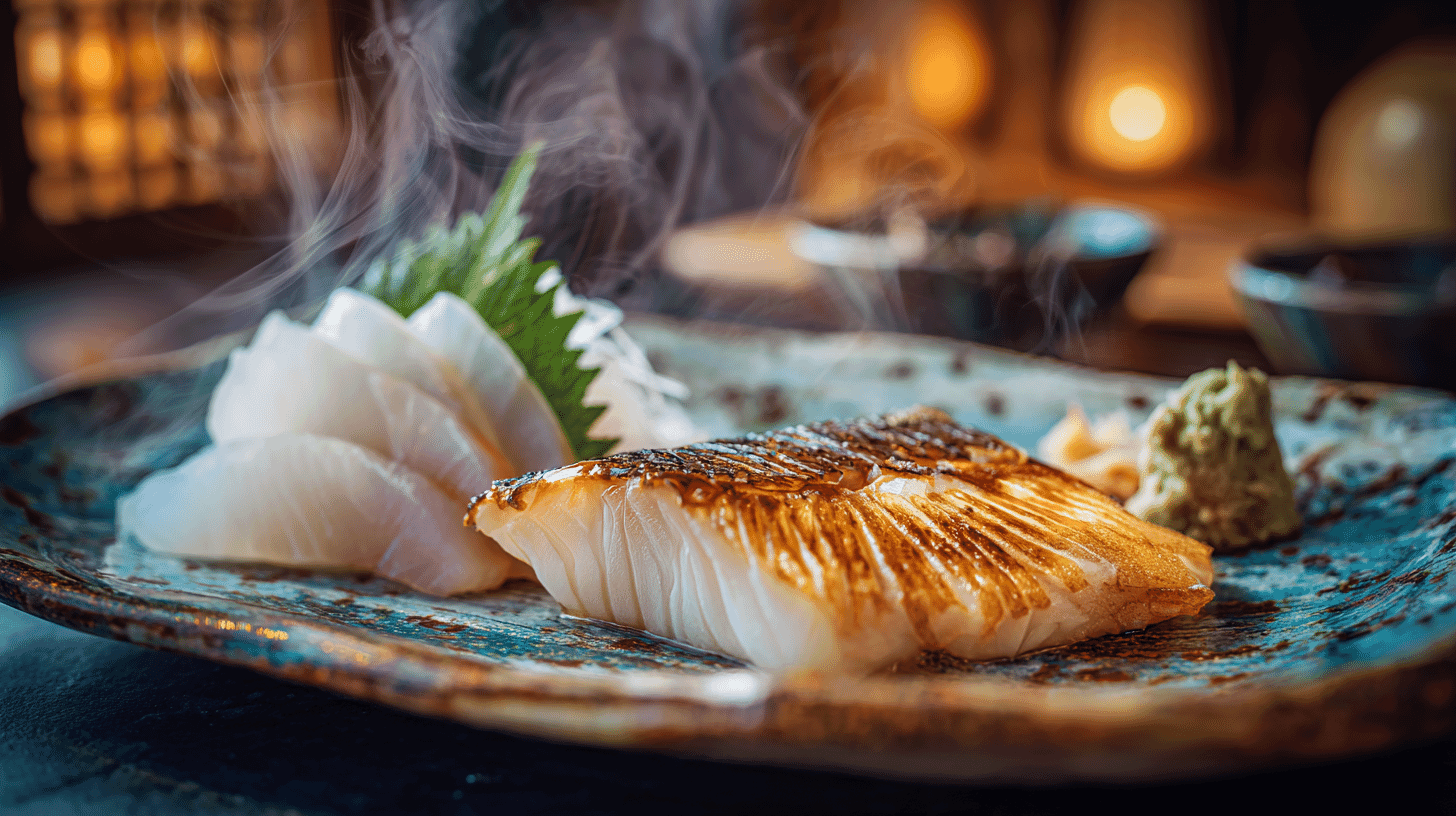
Japan's "white-fleshed toro" may soon be farm-raised. Nodoguro, a deep-sea fish that can sell for over $65 per kilogram, was long considered impossible to farm: it is sensitive to light and sound, and more than 90% of hatchlings turn out male. After a decade of painstaking research, Kindai University has achieved the world's first full-cycle aquaculture of the fish. Here is the story behind it and why it matters.
What Is Nodoguro? Meet the "White Toro" of the Deep Sea
Nodoguro, formally known as Akamutsu (Blackthroat seaperch, Doederleinia berycoides), is a deep-sea fish found primarily along Japan's Sea of Japan coast at depths of 100 to 200 meters (330–660 feet). Its name literally means "black throat" in Japanese, referring to the distinctive jet-black interior of its mouth.
What makes Nodoguro legendary among fish lovers is its exceptionally rich, buttery fat content that stays consistent year-round. When grilled, the fat renders into a delicate sweetness that melts on the tongue, earning it the nickname "White Toro," a reference to the prized fatty belly of tuna (toro) that sushi enthusiasts know well. Nodoguro gained nationwide fame in Japan when tennis star Kei Nishikori, after finishing runner-up at the 2014 US Open, told reporters that the first thing he wanted to eat back home was Nodoguro. Demand soared, and prices have remained sky-high ever since.
At Tokyo's Toyosu Fish Market, Nodoguro can fetch prices 10 times that of red sea bream and five times that of tuna. A single large specimen can sell for over $65. For restaurants, wholesale prices have roughly doubled in just four years, from around $26–$33 per kilogram to over $65.
Why "Full-Cycle Aquaculture" Is a World First
On February 5, 2026, Kindai University's Aquaculture Research Institute announced it had achieved the world's first full-cycle aquaculture (known as kanzen yoshoku in Japanese) of Nodoguro at its Toyama Experimental Station.
Full-cycle aquaculture means completing the entire life cycle under human management: hatching fish from eggs, raising them to maturity, breeding those farm-raised adults, and successfully hatching their offspring. Unlike conventional aquaculture, which often relies on catching wild juveniles to stock farms, full-cycle aquaculture eliminates dependence on wild populations entirely.
This distinction is crucial. Conventional fish farming can actually increase pressure on wild stocks by removing young fish from the ocean. Full-cycle aquaculture breaks that cycle completely, creating a self-sustaining production loop that protects natural ecosystems.
A Decade of Setbacks and Breakthroughs
Kindai University began Nodoguro research in 2015 at its facility in Imizu, Toyama Prefecture, along the Sea of Japan coast. The path to success was anything but smooth.
Nodoguro presented unique challenges that no aquaculture team had tackled before. As a deep-sea species, it is extremely sensitive to light, sound, and environmental changes. There was virtually no existing academic research on Nodoguro farming, meaning the team had to develop everything from scratch: tank conditions, feeding protocols, disease management, and breeding techniques.
The first artificial hatching came in 2016, but securing quality eggs proved difficult. Wild Nodoguro fishing schedules didn't align with the fish's spawning times. In 2018, the team partnered with Niigata Prefectural Marine High School and the Joetsu Fisheries Cooperative. Local fishermen adjusted their trawling schedules to match spawning times, enabling consistent access to egg-bearing females.
By 2022, the lab was producing around 10,000 fry; by 2023, that number exceeded 30,000. Then disaster struck. The January 2024 Noto Peninsula earthquake caused soil liquefaction at the Toyama facility, damaging tanks and piping and killing some of the Nodoguro. Roughly 8,000 surviving juveniles were released into the sea off Itoigawa, Niigata Prefecture, the first-ever Nodoguro release program.
The Breakthrough: When Nature Wasn't Enough
The final push toward full-cycle aquaculture began in August 2025. The team selected three-year-old Nodoguro, hatched from eggs collected off Joetsu, Niigata, in 2022, as breeding parents.
First, they tried natural spawning by housing males and females together and raising water temperatures above 20°C (68°F) to mimic natural breeding conditions. Eggs were laid, but none were fertilized.
Next came hormone-induced maturation. Hormones were administered to promote egg development, and females were again placed with mature males. Five females produced roughly 200,000 eggs across seven spawning events. Still, no fertilization occurred.
The team then pivoted to artificial insemination. Hormone-treated females yielded approximately 360,000 eggs across eight extraction sessions from six fish. These eggs were manually fertilized with sperm from mature males. On October 6, 2025, the first successful hatching was confirmed, and full-cycle aquaculture was officially achieved.
By October 10, four separate hatching events had succeeded. Two batches are currently being raised, totaling roughly 7,200 juveniles. As of early February 2026, the oldest fry were 122 days old and measured 45–50mm in length.
The 97% Male Problem
Perhaps the most striking challenge ahead is the extreme sex ratio imbalance. Over 90% of artificially hatched Nodoguro are male, with females making up only about 3% of the population.
Professor Keitaro Kato, Director of the Aquaculture Research Institute, has noted this as a critical priority. Without more females, sustaining egg production for future generations becomes nearly impossible.
Interestingly, Kindai University has already demonstrated expertise in fish sex manipulation. The university recently succeeded in sex-reversing male Siberian sturgeon into females and harvesting caviar from them, technology that could potentially be adapted for Nodoguro.
Kindai University: Japan's Aquaculture Powerhouse
Kindai University's Aquaculture Research Institute, founded in 1948, is one of the world's premier marine farming research institutions. Its track record is remarkable.
The institute's crowning achievement came in 2002 with the world's first full-cycle aquaculture of Pacific bluefin tuna, a breakthrough 32 years in the making. Marketed as "Kindai Maguro," the university even opened dedicated restaurants in Osaka and Tokyo's Ginza district to showcase its farm-raised fish.
To date, the institute has achieved full-cycle aquaculture for over 30 species, including Pacific bluefin tuna, Japanese eel, red sea bream, and yellowtail. These are not just laboratory curiosities, many have been scaled to commercial production, with Kindai-bred juveniles supplying roughly 25–30% of Japan's farmed red sea bream market.
When Will Farm-Raised Nodoguro Reach Your Plate?
Kindai University plans to begin supplying farm-raised Nodoguro to restaurants within three years. The first offerings will appear at the university's own seafood restaurants in Osaka and Ginza under the working name "Kindai Nodoguro."
However, significant hurdles remain before commercial-scale production becomes reality. The team must still develop optimal feed formulations, establish disease prevention protocols, improve growth rates (Nodoguro grows much slower than species like yellowtail), and, critically, solve the female scarcity problem.
Broader market availability, with Nodoguro reaching consumers through supermarkets and general restaurants, is projected around 2030.
Why This Matters Beyond Japan
This achievement carries significance that extends well beyond Japanese dining tables.
Marine resource conservation: Rising ocean temperatures have pushed Nodoguro habitats northward, reducing catches in traditional fishing grounds. Full-cycle aquaculture offers a supply route completely independent of wild stocks, essential as climate change reshapes marine ecosystems worldwide.
Global food security: With the world's population growing and demand for seafood increasing, especially in Asia, sustainable protein production technology becomes ever more critical. Japan's full-cycle aquaculture expertise represents a proven pathway that other nations can learn from and adapt.
Technology transfer potential: Kindai University has established academic partnerships with Malaysian universities and has dispatched aquaculture technicians to Canada and Australia. The knowledge gained from Nodoguro research could benefit aquaculture programs globally.
Japan has a cultural concept called "mottainai", a deep-rooted philosophy of not wasting resources. This ethos has historically driven Japanese innovation in sustainability, and Kindai University's aquaculture research is a direct expression of it: finding ways to enjoy premium seafood without depleting the oceans.
In Japan, the "impossible" keeps becoming possible when it comes to aquaculture. What about in your country? Are there luxury seafood items you wish could be farmed sustainably? What aquaculture innovations are happening where you live?
References
- https://kindaipicks.com/article/003245
- https://www.itmedia.co.jp/news/articles/2602/05/news129.html
- https://news.mynavi.jp/techplus/article/20260205-4083814/
- https://www.watch.impress.co.jp/docs/news/2084028.html
- https://newscast.jp/news/4083473
- https://www.kindai.ac.jp/rd/research-center/aqua-research/aquaculture/tuna/





Global Discussion
16 comments