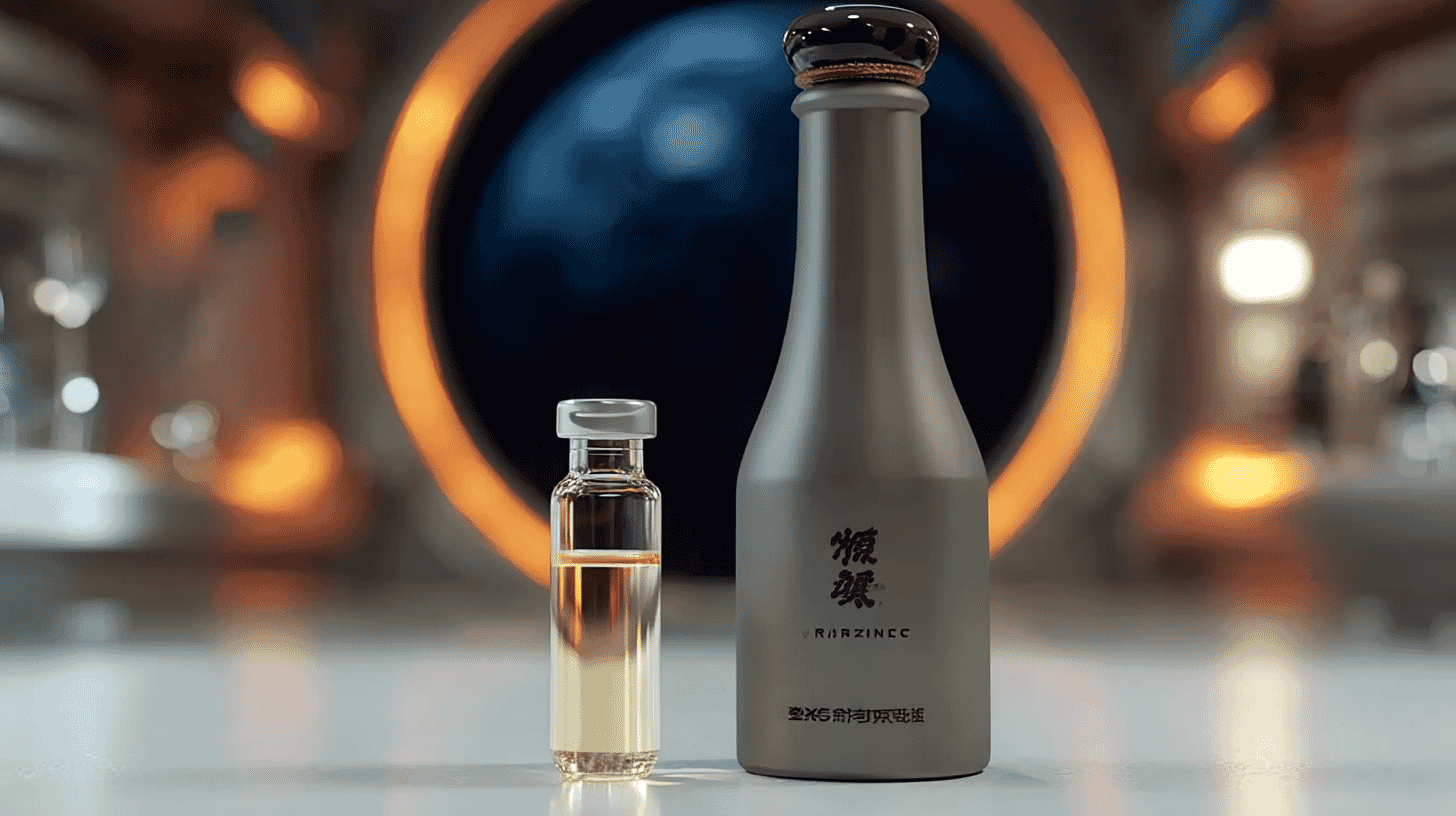
Sake was brewed aboard the International Space Station in November 2025. Yamaguchi's premium sake maker Dassai and Japanese engineering giant Mitsubishi Heavy Industries fermented it inside a chamber simulating lunar gravity, the first time in human history anyone has done it off Earth.
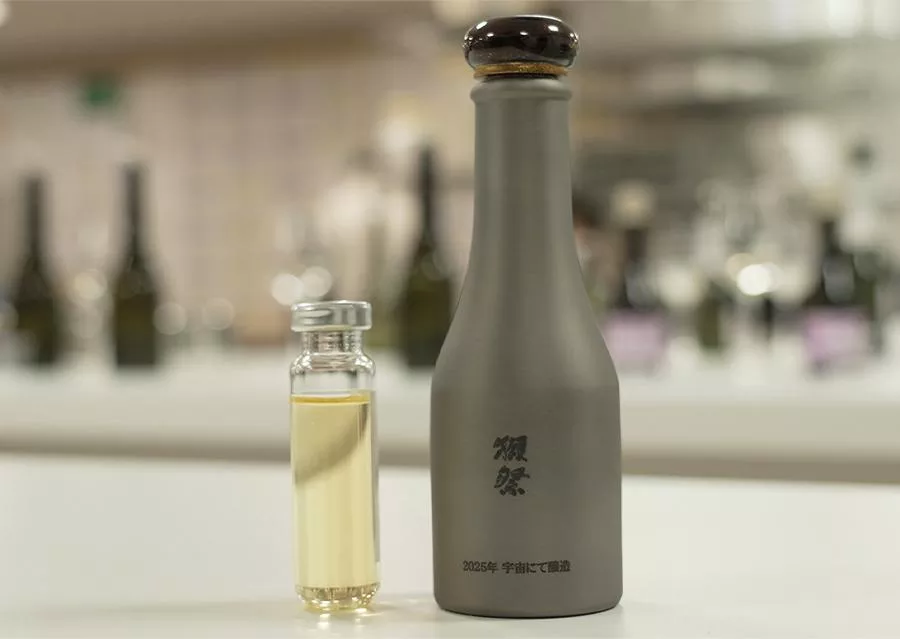
The mash came home and yielded 116ml of finished sake. Dassai bottled 100ml of it in titanium, priced it at 110 million yen (about $700,000, tax included), and sold it. This isn't a food story. It's about Japanese craftsmanship meeting space engineering, with a stated goal of building a sake brewery on the Moon by 2050.
A World First, Announced April 28
On April 28, 2026, Dassai Inc. (headquartered in Iwakuni, Yamaguchi Prefecture) and Mitsubishi Heavy Industries (Tokyo) announced the successful completion of the first phase of the Dassai MOON Project, an initiative aimed at producing sake on the lunar surface.
www.mhi.com
Here's what they did. Specialized brewing equipment, jointly developed by Dassai and MHI, was launched to the ISS along with sake ingredients. Inside the Japanese experiment module "Kibo," the team used JAXA's CBEF-L artificial gravity generator to simulate lunar gravity (1/6G), and in that environment confirmed for the first time in human history that sake fermentation can occur in space. After the brewing on Kibo was completed, the mash was returned to Earth and finished into actual drinkable sake at Dassai's Yamaguchi headquarters in March 2026.
Lab analysis of the returned mash revealed an alcohol content of 12 percent, short of the 15 percent the team had targeted before launch. It still stands as experimental proof that sake can be made under lunar gravity using a process comparable to ground-based brewing.
That said, orbital data showed that fermentation progressed more slowly than under Earth gravity. Differences in gravity may influence fermentation rate, and the precise mechanism is now subject to further research.
The Mission Timeline: From Tanegashima to a Tohoku University Lab
The Dassai MOON Project's concept was born in 2021, at a lecture event hosted by the Nagoya Chamber of Commerce. It started with a single line from Dassai chairman Hiroshi Sakurai: if humans ever migrate to the Moon, we want to brew sake there too. The project officially launched in 2024.
On October 26, 2025, the brewing equipment and ingredients lifted off from the Tanegashima Space Center aboard Japan's H3 Rocket No. 7, paired with the maiden flight of HTV-X No. 1, a brand-new Japanese-built unmanned cargo vehicle. On November 25, Japanese astronaut Kimiya Yui kicked off the brewing test inside Kibo. Two weeks later, on December 8, the test ended and the sample was moved to the ISS freezer.
The sample splashed down off the US coast on February 27, 2026, was recovered, and arrived at Dassai's Iwakuni headquarters on March 13. "Dassai MOON: Space-Brewed" was finished on March 24.
The leftover sake lees (kasu) will undergo detailed analysis at Tohoku University's Higashitani Laboratory. Researchers will examine genetic changes in the yeast and look for differences from terrestrial fermentation. That question connects straight to how humans will produce food during long-duration stays on the Moon or Mars.
Why MHI Is Building Sake Equipment
This raises an obvious question. MHI, founded in 1884, is one of Japan's largest industrial conglomerates, spanning energy, smart infrastructure, aerospace, and defense. Why is it building sake fermentation equipment?
The answer: Japan doesn't have many companies capable of building precision machinery that works in space.
Equipment going to the ISS has to survive launch vibrations and acceleration, function correctly in microgravity, be safely operable by astronauts, and not endanger the surrounding environment if anything goes wrong. MHI has spent decades developing exactly this kind of expertise, through the H-IIA and H3 launch vehicles, the HTV "Kounotori" cargo spacecraft, and now HTV-X.
The space brewing rig integrates a stirring mechanism that promotes fermentation under simulated lunar gravity, plus sensors to continuously monitor temperature and alcohol concentration. The toughest engineering problem was automating something that, in a traditional brewery, runs on intuition. Sake fermentation involves multiple parallel fermentation, an unusual process in which rice starch is converted to sugar and sugar to alcohol at the same time. Replicating this in a sealed space chamber, safely, took intense collaboration.
NASA safety review was another major hurdle. Every byproduct of fermentation had to be catalogued and proven safe, with no gas leaks and no liquid escapes that could affect the ISS environment. Reconciling brewery common sense with space-engineering common sense took years.
A $700,000 Bottle Isn't Really for Drinking
The mash returned from space weighed roughly 260g. Pressing it yielded only 116ml of sake. Dassai bottled 100ml of that in a custom titanium bottle, offered it at 110 million yen (about $700,000, tax included), and it sold.
The bottle isn't meant to be drunk. It's a symbolic artifact, a proof of challenge. Proceeds are earmarked for donation to Japan's space development efforts, and the remaining mash goes to Tohoku University as analytical samples.
For comparison, a regular bottle of Dassai's flagship Migaki Niwari Sanbu, or Dassai 23, sells for around 30,000 yen (about $190) per 1.8L. The space-brewed 100ml is priced at literally millions of times more per milliliter. At that price, you could buy a Tokyo apartment with the same money.
The project logo was designed by manga artist Chuya Koyama, creator of "Space Brothers" (Uchu Kyodai), one of Japan's most beloved space-themed manga. A perfect match for a project about humans drinking sake on the Moon.
What "All Japan" Actually Meant Here
Dassai and MHI set themselves a hidden second mission: complete this entirely with Japanese technology.
The collaborators list reads like a cross-section of Japan's technical economy. JAXA. JAMSS (Japan Manned Space Systems). Space BD. DigitalBlast. Takasago Electric Industry. The Aichi Industrial Science Technology Center. Interface Co. Kobo Okura. Satake (rice processing). Nippon Express (transport). Japan Airlines. Tohoku University. The H3 rocket and HTV-X are both Japanese-built. The astronaut who ran the experiment is Japanese.
Space ventures, small traditional workshops, research institutions, logistics companies: a cross-industry coalition delivered a single world first. Japan's space industry doesn't compete with SpaceX as a single titan. It competes as collective intelligence, layered across sectors. That collective approach is the unsung star of this mission.
The Brewery That Made Dassai Is a 12-Story Building
So what kind of brewery brews Dassai? The maker is Dassai Inc., which changed its corporate name from Asahi Shuzo Co., Ltd. in June 2025. It sits in the rural mountains of Iwakuni, Yamaguchi Prefecture, about 50 minutes by car from central Iwakuni along the clear Nishiki River. There, in the middle of a valley, you suddenly see a 12-story tower. That's the Dassai headquarters brewery, rebuilt in 2015.
White walls, tiled roof, dark earthen floor, wooden barrels: the traditional brewery image does not apply here. Each floor holds a different stage of production. Rice is polished on the upper floors and moves downward through washing, steaming, koji-making, fermentation, pressing, and bottling.
Another defining feature: there's no traditional toji (master brewer). Most sake breweries rely on a seasonal team of artisans led by a toji to oversee the brew. Dassai skips that model entirely. A workforce of roughly 330, including about 250 full-time staff, brews year-round. Every tank's temperature, sugar content, and alcohol percentage gets measured and graphed. Intuition and experience have been replaced by numbers and reproducibility.
Dassai also makes only Junmai Daiginjo, sake brewed from rice polished to 50 percent or less. The flagship Migaki Niwari Sanbu uses rice polished down to 23 percent of its original size, with 77 percent shaved away. Sales hit a record 21.3 billion yen (about $138 million) in the fiscal year ending September 2025. In 2023, Dassai opened a US brewery in Hyde Park, New York, putting it at the front line of overseas sake branding.
Brewery Tours: A Practical Guide for International Visitors
Dassai's headquarters brewery welcomes international visitors. Since April 2024, it has run daily reservation-based tours, with English guidance available.
| Item | Details |
|---|---|
| Address | 2167-4 Osogoe, Suto-cho, Iwakuni City, Yamaguchi |
| Access | About 15 min by taxi from JR Suo-Takamori Station; ~50 min by car from central Iwakuni |
| Schedule | 2 sessions per day (10:00 AM / 2:00 PM), max 5 people per session |
| Fee | ¥1,000 per person (includes white coat and souvenir); +¥500 for tasting |
| Reservation | Via official site; opens 2 months ahead, closes 2 days before |
| Age | Junior high school age (13+) and up |
| Duration | About 1 hour including tasting |
Reception is at the Dassai Store Honsha-gura across the river from the brewery, a renovated old farmhouse redesigned by architect Kengo Kuma. The tour starts with a full change into white coat, hat, and mask, followed by an air shower to remove dust. From there, you walk floor by floor through rice washing, steaming, koji-making, fermentation, pressing, and analysis. Optional tastings let you compare three flagships side by side: Migaki Niwari Sanbu (Dassai 23), Migaki Sanwari Kubu (Dassai 39), and Junmai Daiginjo 45. Drivers cannot taste under Japan's drink-driving laws, so public transport or a taxi is the way to go.
Iwakuni is a five-brewery town. Beyond Dassai, you'll find Gangi, Gokyo, Kinkan Kuromatsu, and Kinsuzume, all locally renowned brands. Pair a brewery tour with a visit to Kintaikyo, the five-arched wooden bridge first built in 1673 and rebuilt several times since, and you have a full-day sake-and-heritage itinerary.
A Lunar Brewery, Targeted for 2050
The Dassai MOON Project's ultimate goal is unambiguous: build a brewery on the lunar surface by 2050.
There's hard logic behind this. Shipping bottled sake between the Moon and Earth at any reasonable scale will be impossible. If humans live long-term on the Moon and want sake, the only viable path is shipping ingredients up and brewing locally. The key resource is water. Ice at the Moon's south pole, melted, can serve as brewing water. With minerals from lunar regolith, plus rice, koji, and yeast from Earth, fermentation can be controlled in situ, bringing some cultural richness to off-world life.
The technology applies far beyond sake. If multiple parallel fermentation can be successfully run in space, it opens the door for beer, wine, bread, cheese, miso, and soy sauce. Behind the romantic goal of brewing sake on the Moon sits a practical one: build the food-fermentation infrastructure for long-duration spaceflight while there is still time and Earth-based capacity to do it.
A Question for International Readers
Sake is, on the surface, a simple drink: rice, koji, water, yeast. But behind it sits over a thousand years of fermentation know-how and patient artisan labor. Pairing that with cutting-edge space engineering to pull off a human first is about as Japanese as an engineering project gets.
Dassai's brewery in Iwakuni accepts international visitors with English guidance. Next time you travel to Japan, after Tokyo or Kyoto, consider standing inside the workshop where the craft happens. Cross the wooden Kintaikyo bridge, head into the mountains, walk through a 12-story brewery. That's a different kind of Japan trip.
What about your country? Are any wineries, breweries, or distilleries seriously planning to operate in space? Does the idea of brewing alcohol on the Moon feel natural in your culture, or absurd? We'd love to hear how this lands where you are.
References
- https://www.mhi.com/jp/news/260428.html
- https://dassai.com/moon/
- https://www.mhi.com/news/25100901.html
- https://dassai.com/tour/
- https://dassai.com/thestage/en/moon/
- https://newatlas.com/space/brewing-space-sake-moon/
- https://dailygalaxy.com/2025/10/one-small-brew-for-man-japan-will-make-sake-on-the-moon-to-humanize-life-in-space/
- https://yamaguchi-tourism.jp/feature/shuzo
- https://travel.navitime.com/ja/area/jp/guide/NTJmat0852/






Global Discussion
15 comments