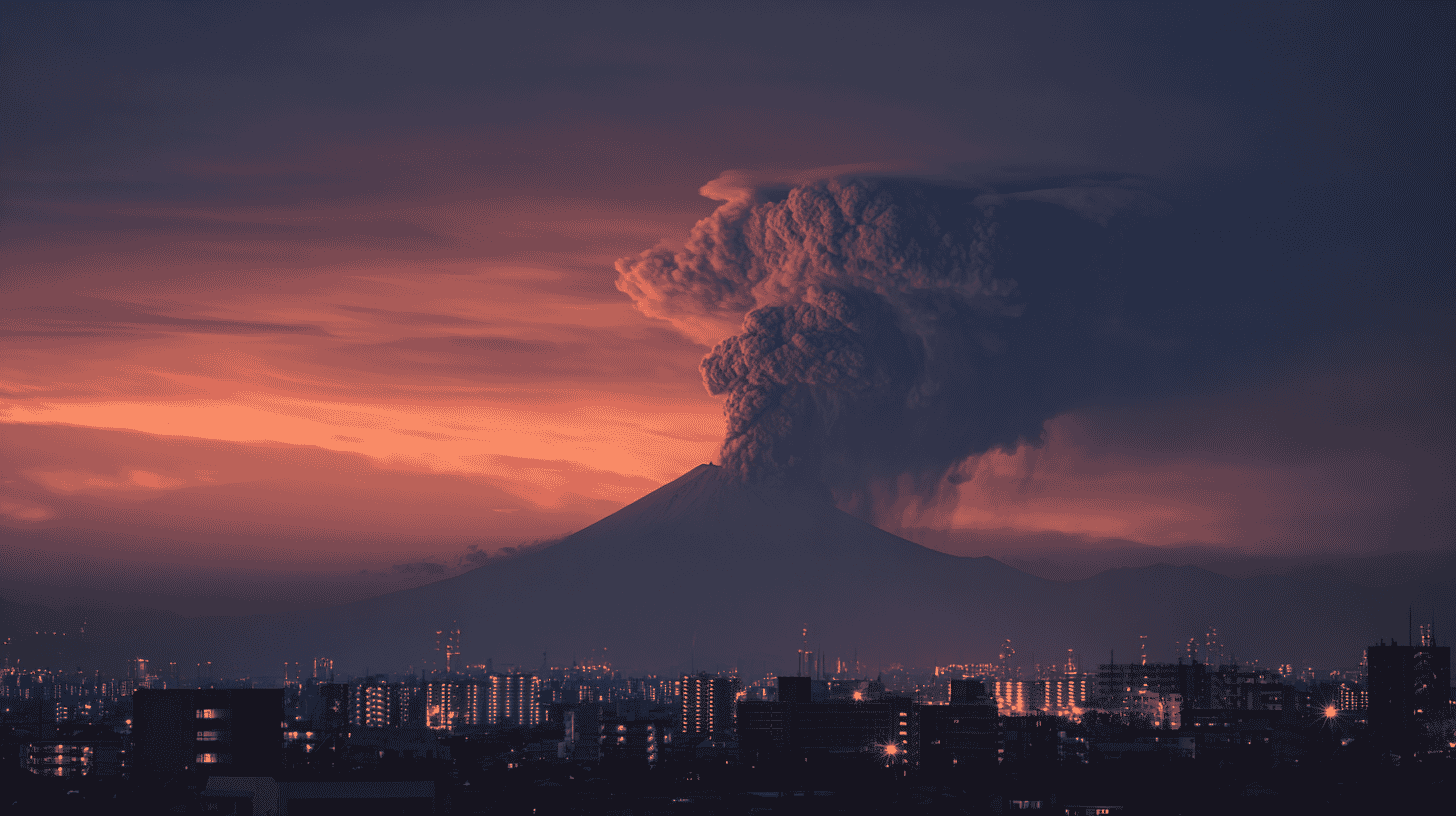
Mount Fuji, Japan's most iconic landmark, is in "eruption standby" mode. That's the stark warning from Hiroki Kamata, a professor emeritus at Kyoto University and one of Japan's foremost volcanologists. He says a Nankai Trough megaquake, expected within the next decade, could trigger Fuji's first eruption in over 300 years. An NHK Special that aired in April 2026 dramatized the nightmare scenario: volcanic ash plunging Tokyo into a blackout within hours.
What "Eruption Standby" Means
Professor Kamata's assessment isn't speculation, it's grounded in observable geological data. When the magnitude 9.0 Great East Japan Earthquake struck in March 2011, the massive shaking destabilized the magma chamber sitting roughly 20 kilometers beneath Mount Fuji.
Japan has 111 officially designated active volcanoes. After the 2011 earthquake, underground seismic activity increased beneath 20 of them. Some, like Mount Hakone and Mount Kusatsu-Shirane, actually erupted. On March 15, 2011, just four days after the tsunami, a magnitude 6.4 earthquake struck directly beneath Fuji at a depth of 14 kilometers, potentially cracking rock above the magma chamber and making an eruption path easier.
Kamata describes Fuji as a geologically "young" volcano, comparable to an elementary school student in terms of its life cycle. In volcanological terms, it's still growing and will inevitably erupt again.
300 Years of Silence: A Ticking Clock
Looking at Fuji's eruption history over the past 5,600 years, the mountain has erupted roughly once every 30 years on average, with intervals sometimes as short as 50 to 100 years. The last eruption, the Hoei eruption of 1707, happened 319 years ago. This means Fuji has been accumulating magma for more than three times its typical interval.
This unusually long dormancy doesn't mean the volcano has gone quiet for good. On the contrary, volcanologists warn it likely means a massive amount of magma has built up underground. If released all at once, the resulting eruption could match or exceed the scale of the 1707 event.
The Nankai Trough Connection
The most alarming part of Kamata's analysis is the historical link between major earthquakes and Fuji eruptions. The Nankai Trough megaquake, predicted to occur around 2035 (±5 years) with a potential magnitude of 9.1, could be the trigger.
There is a direct precedent. In 1707, the Hoei Earthquake (magnitude 8.6) struck along the Nankai, Tonankai, and Tokai segments simultaneously. Exactly 49 days later, Mount Fuji erupted for the first time in 200 years. This wasn't a coincidence, the earthquake's violent shaking destabilized the magma chamber.
Globally, the pattern holds. Of the eight M9-class earthquakes recorded since the 20th century, nearly all were followed by major volcanic eruptions near the epicenter within a few years.
The geological connection is direct: the Suruga Trough, the eastern edge of the Nankai Trough, extends inland via the Fujikawa-kako Fault Zone, which runs directly beneath Mount Fuji. A megaquake along this fault system would physically shake the magma chamber.
NHK's "Gray Nightmare": What Ashfall Could Do to Tokyo
In April 2026, NHK aired a two-part special titled "Mount Fuji Mega-Eruption: The Gray Nightmare Approaches." Directed by filmmaker Takashi Miike and starring Atsushi Ito, the program combined drama with documentary to visualize the worst-case scenario.
Based on a government report published in 2025, here is what simulations predict:
Within two hours of eruption, volcanic ash reaches central Tokyo. Within three hours, large-scale power outages begin. Just 0.5 millimeters of ash accumulation stops all train operations. At 10 centimeters, most vehicles cannot move. An estimated 400,000 households lose electricity, and communications go down. Supply chains collapse, and relief supplies may not arrive for over two weeks.
During the 1707 Hoei eruption, 10 centimeters of ash fell on what is now Yokohama, and 5 centimeters on Edo (present-day Tokyo), the ash kept falling for roughly two weeks. The Japanese Cabinet Office estimates an eruption on that scale would cause approximately ¥2.5 trillion ($15.7 billion) in damage. However, many volcanologists consider this a significant underestimate. If a Nankai Trough earthquake and Fuji eruption occur in tandem, total damage could reach tens of trillions of yen.
As the NHK program illustrated, volcanic ash isn't soft powder, it's made of tiny glass-like shards that damage eyes, clog engines, and short-circuit electrical equipment. Modern Tokyo, entirely dependent on electricity and digital infrastructure, would essentially be knocked back to pre-industrial conditions.
Sakurajima: A Daily Reminder
Japan's volcanic reality is not theoretical. On April 11, 2026, Sakurajima volcano in Kagoshima erupted explosively for the first time this year. The eruption column reached 3,400 meters above the crater, and volcanic bombs were thrown as far as 600 to 1,000 meters from the vent. The volcano remains at Alert Level 3 (restricted entry).
For residents of Kagoshima, volcanic ash is part of daily life, they carry ash-proof umbrellas and check wind direction every morning. But for most people in the Tokyo metropolitan area, the idea of ash falling from the sky remains abstract. The NHK Special aimed to change that perception.
Global Parallels: Pompeii and Iceland
Volcanic disasters are a global concern. The eruption of Mount Vesuvius in 79 AD buried Pompeii in a single day. Some experts have drawn parallels, warning that if a Nankai Trough megaquake triggers a Fuji eruption, it could be recorded as a disaster of comparable historical magnitude.
Iceland offers a more contemporary example. Since 2021, the Reykjanes Peninsula has experienced 12 eruptions, the first volcanic activity in the region in 800 years. The town of Grindavík has been repeatedly evacuated, and volcanologists believe this could mark the beginning of an eruptive period lasting decades or even centuries.
Japan occupies just 0.25% of the world's land area but hosts about 10% of the world's active volcanoes and experiences roughly 20% of all global earthquakes. The fact that a capital-region earthquake, the Nankai Trough megaquake, and a Fuji eruption are all simultaneously in "standby" mode has led earth scientists to declare that Japan has entered an era of "great geological upheaval" (daichi hendō no jidai).
What You Can Do Now
Professor Kamata emphasizes that preparation must happen before the eruption, not after ash starts falling. NHK launched a nationwide "Volcano Hazard Map" in spring 2026, covering 49 continuously monitored volcanoes. Recommended personal preparations include 14 face masks (one per day for two weeks), protective goggles, cleaning supplies, and at least one week's supply of water (21 liters per person) and food.
Japan has long enjoyed the benefits of living on volcanic land, world-class hot springs, fertile soil, and stunning landscapes. But those benefits come with inherent risk. As the experts warn, the question is not if Mount Fuji will erupt, but when.
Does your country have active volcanoes? What kind of disaster preparedness measures are in place? We'd love to hear how volcanic risk is handled where you live.
References
- https://www.jiji.com/jc/v8?id=202410hkfuji, Jiji.com: Interview with Prof. Hiroki Kamata
- https://www.web.nhk/tv/an/special/pl/series-tep-2NY2QQLPM3/ep/8ZPMMKV3VY, NHK Special "Mount Fuji Mega-Eruption"
- https://news.yahoo.co.jp/articles/07aa562c52318b4957c025658909bf88a3ce0c8a, Yahoo! News: Fuji eruption simulation
- https://news.web.nhk/newsweb/na/nb-5050034709, NHK: Sakurajima's first explosive eruption of 2026






Global Discussion
15 comments