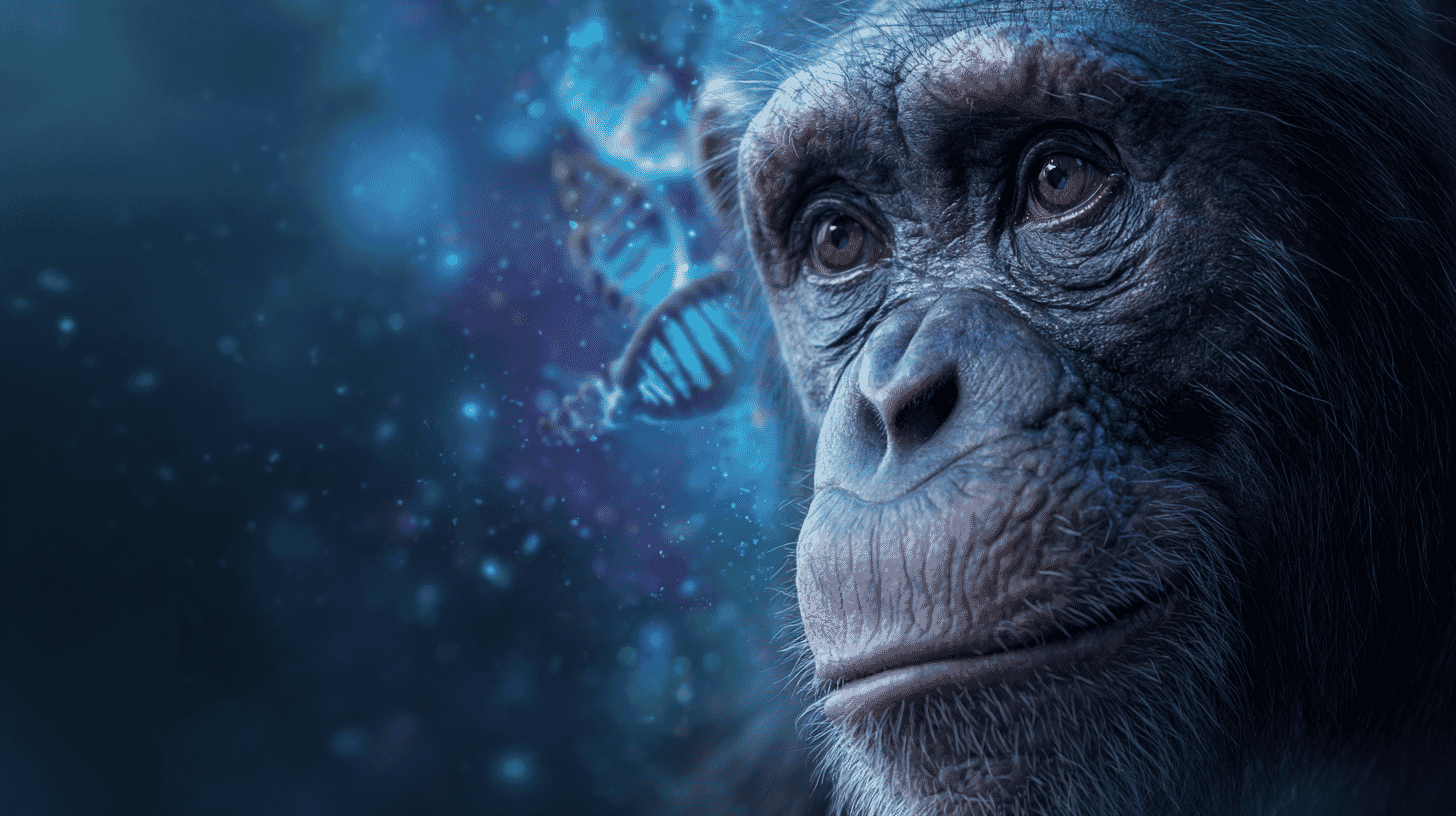
🧬 Why are human legs longer than our arms, while chimpanzees have the opposite proportions? Japanese researchers are chasing that evolutionary puzzle using iPS cells made from apes. For the first time anywhere, a team from Kyoto and Hiroshima Universities has grown the precursor cells of limbs from bonobo, chimpanzee, and gibbon stem cells.
The Idea: Turn an Entire Zoo into Stem Cells
A research group centered on Kyoto University's Center for the Evolutionary Origins of Human Behavior and Hiroshima University, with Nagoya University and the Graduate University for Advanced Studies also taking part, has reported a notable advance in primate evolution research and biodiversity conservation. It is part of an initiative they call the "Whole-Zoo iPS Cell Project," which aims to bank cells from animals living in zoos and research facilities across Japan and preserve them as iPS cells (induced pluripotent stem cells) for long-term study.
For readers new to the term, iPS cells are ordinary cells, such as skin or blood cells, that have been "reprogrammed" by introducing a few specific genes, returning them to a versatile state capable of becoming almost any cell type in the body. The technology was pioneered by Professor Shinya Yamanaka at Kyoto University, who first created iPS cells from mouse cells in 2006 and from human cells in 2007, work that earned the 2012 Nobel Prize in Physiology or Medicine. Originally aimed at human regenerative medicine and drug discovery, the same technology is now finding a fresh use as a tool for reading the story of animal evolution.
In this study, the team created iPS cells from two great apes, the bonobo and chimpanzee, and from the gibbon, a small ape. They then achieved the world's first differentiation of those cells into limb bud mesoderm cells, the embryonic precursors of arms and legs. The findings appear in two international journals, BMC Genomics and Frontiers in Cell and Developmental Biology.
Our Closest Cousins and Our Most Ancient Relatives
The three species sit at very different points on the primate family tree, which is exactly what makes them useful together.
Bonobos and chimpanzees are humans' closest living relatives among the great apes. They share roughly 98.7% of their genome with us and split from our common ancestor about 6 to 7 million years ago. Gibbons, by contrast, are the earliest branch of the ape superfamily (Hominoidea) to diverge from the human lineage, an estimated 15 to 20 million years ago.
So bonobos and chimpanzees are our "closest cousins," while gibbons are our "most ancient relatives" within the ape family. Comparing all three with humans lets researchers trace the path of primate evolution across a very long stretch of time.
A Zoo-University Partnership Made It Possible
The cells came from zoos and research facilities around Japan.
For the bonobos and chimpanzees, researchers used surplus blood drawn during routine health checkups of animals living at the Kumamoto Sanctuary of Kyoto University's Wildlife Research Center in Uki, Kumamoto Prefecture. For the gibbons, the team worked with the Japan Monkey Centre in Inuyama, the Toyohashi Zoo and Botanical Park, the Higashiyama Zoo and Botanical Gardens in Nagoya, and the Great Ape Information Network (GAIN), culturing fibroblast cells from skin tissue of gibbons that had died of natural causes.
In every case, the reprogramming factors were delivered using methods that leave no foreign genetic material in the genome (stealth RNA vectors in the bonobo work), so the original genetic information stays intact. The team ultimately established iPS cells from two bonobos, one chimpanzee, and three gibbons (one white-handed gibbon and two siamangs).
Gene Activity That Mirrors the Family Tree
The researchers compared gene expression in the new iPS cell lines with those from humans, gorillas, orangutans, rhesus macaques, and crab-eating macaques.
A clear pattern emerged: the activity of genes in the iPS cells reflected the known branching order of primate evolution, from monkeys to small apes to great apes to humans. The team also identified gene expression signatures unique to each species.
That means evolutionary relationships can now be checked not only against fossils and skeletons but at the level of living cells, early evidence that iPS cells can serve as a new instrument for evolutionary biology.
A World First: Growing the "Seeds" of Ape Limbs
The study's headline result was the world's first creation of limb bud mesoderm cells from bonobo, chimpanzee, and gibbon iPS cells.
These cells are the embryonic starting point for the bones of the arms and legs, the equivalent of the first page in a blueprint for building a limb.
What makes this interesting is the striking variation in limb proportions across primates. In monkeys, the arms and legs are about the same length. In apes such as chimpanzees and gibbons, the arms are noticeably longer than the legs, an adaptation for swinging from branch to branch. In humans the relationship flips: our legs are longer than our arms, a reflection of our move toward upright walking.
This reversal of arm-to-leg ratios is one of the most visible physical changes in primate evolution. With the experimental system established here, scientists may finally be able to investigate which genetic mechanisms drive those differences, and how they shifted over evolutionary time, at the cellular level.
A "Living Genetic Library" for Endangered Species
The project carries a second major purpose: preserving the genetic resources of rare animals.
Bonobos are listed as Endangered (EN) on the IUCN Red List. Only about 30% of their range has been surveyed, so no reliable total exists, but the surveyed areas point to a minimum of 15,000 to 20,000 individuals, with numbers falling. Many gibbon species are also in danger as their forest habitats shrink across Southeast Asia.
Because iPS cells can in principle be multiplied without limit, a single line can preserve an animal's genetic information almost indefinitely. Even after an individual has died, scientists can still generate various tissue cells from its stored cells for future research.
A Potential Shift in Zoo Veterinary Medicine
The team's third goal is improving veterinary care for zoo animals.
With rare species, the small number of individuals makes disease research and treatment development difficult. Using iPS cells, researchers can build disease models for specific species and assess how drugs work, and how toxic they might be, across species and individuals. Great apes, for instance, are known to be prone to heart disease, yet treatment research has had to lean on human data. If heart muscle cells could be derived from ape iPS cells, species-specific drug testing might become possible.
The Widening Reach of Yamanaka's Technology
Since Professor Yamanaka's breakthroughs with mouse cells in 2006 and human cells in 2007, iPS technology has spread well beyond its original scope. Japan performed the world's first transplant of iPS-derived retinal cells in 2014, and clinical work on Parkinson's disease, spinal cord injury, and other conditions continues to advance.
The team plans to bank cells from more animals, work toward identifying the genetic switches that set arm and leg length, and pursue disease research alongside zoo veterinarians.
What about your country?
How is stem cell technology being used for wildlife conservation or evolutionary research where you live? We'd love to hear your take.






Global Discussion
15 comments