🚁 100 kilometers per hour. That is highway speed for a car, and barely a third of what the fastest American air taxis can do. So why did a Japanese startup just send out a press release celebrating it? Because for the kind of flying car SkyDrive is building, flying fast and staying steady is the genuinely hard part. Pulling it off says a lot about a bet that cuts against the grain of the entire industry.
A milestone off the coast of Yamaguchi
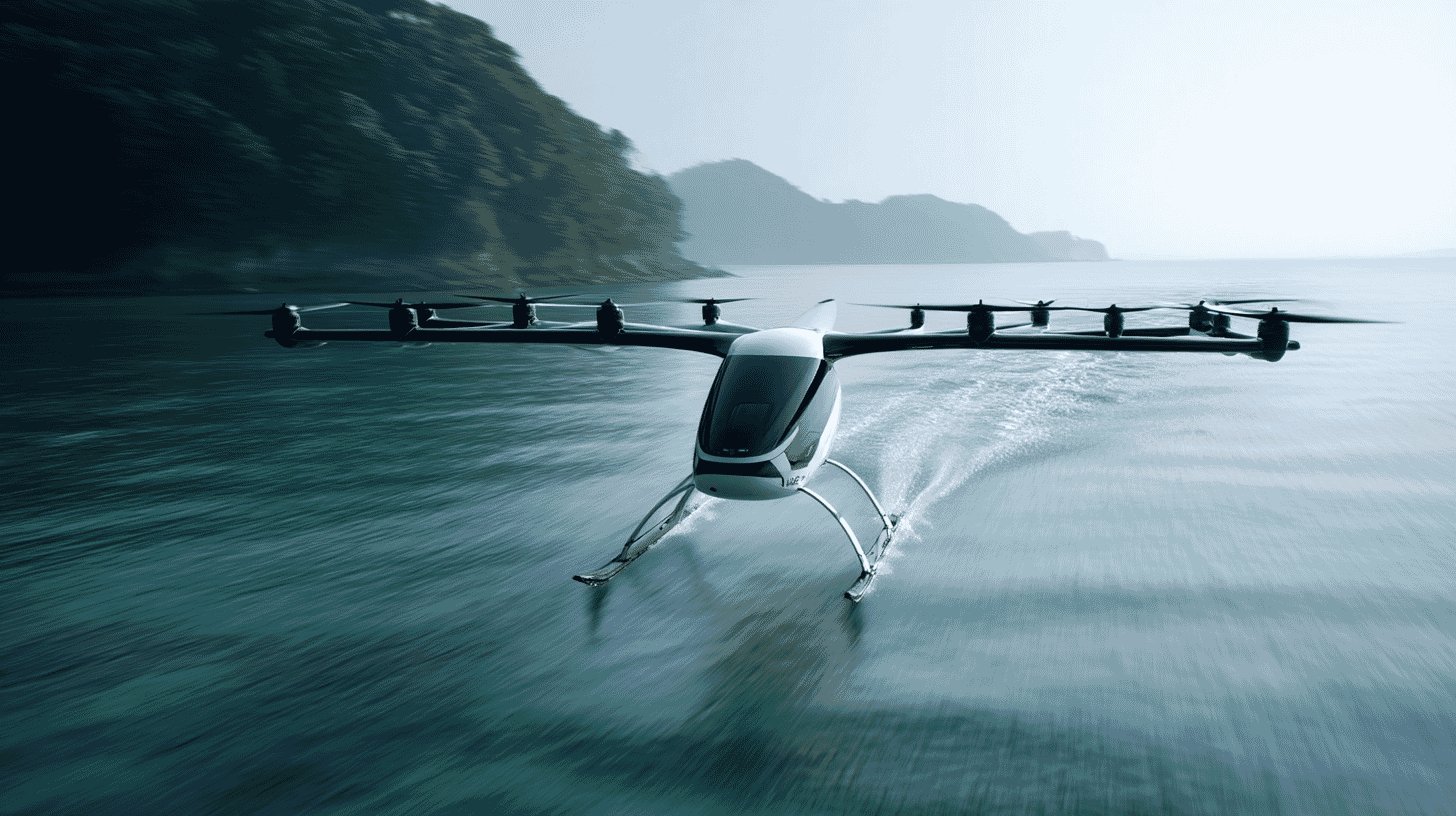
On June 24, SkyDrive, based in Toyota City in Aichi Prefecture, announced that its development aircraft, the SKYDRIVE (model SD-05), had flown stably forward at 100 km/h. That is the cruising speed the company expects to use once the aircraft enters commercial service.
The test ran at SkyDrive's flight range in Yamaguchi Prefecture, on the southwestern tip of Japan's main island. The site has a roughly three-kilometer stretch over shallow coastal water where fishing boats cannot go, which gives engineers a clear, uninterrupted run long enough to push the aircraft to full speed.
What SkyDrive verified was not just the number on a dial. The company says the airframe, its controls, the propulsion units, the flight-control software and the onboard equipment all behaved the way its design models had predicted. That match between simulation and reality is the whole reason a high-speed test exists. As an aircraft speeds up, the forces on it shift sharply, and no amount of wind-tunnel work or computer modeling fully settles whether the design holds. You have to fly it.
SkyDrive has flown its aircraft several hundred times and logged wind-tunnel data with Japan's space agency, JAXA. This run confirmed that the groundwork holds up at real cruising speed.
Why "slow" is the whole strategy
Here is the part that confuses people. Joby Aviation's S4, the leading American air taxi, tops out around 320 km/h. Next to that, 100 km/h can look like a rounding error.
It is not a shortfall. It is a design decision.
SkyDrive's SD-05 is a multirotor, sometimes called a multicopter. It lifts and flies using 12 electric rotors and nothing else: no fixed wings, no tilting mechanisms, no separate set of propellers for forward flight. Think of an oversized passenger drone rather than a small airplane. The whole machine seats three (one pilot and two passengers), weighs around 1.5 tonnes at takeoff, and has a range of roughly 15 kilometers, with a planned extension toward 40.
That wingless simplicity is the bet. A multirotor can lift off and land almost anywhere flat, needs far less complex hardware, and should be cheaper to build and maintain. The cost is speed and range: without wings to generate lift in forward flight, the rotors do all the work, and physics caps how fast and far the aircraft can go.
It also makes high-speed flight surprisingly tricky. To move forward, the entire aircraft tilts and the rotors push against the oncoming air, which loads the structure and the control system in ways a winged design avoids. That is exactly why SkyDrive framed the 100 km/h run as more than a speed number. The company called it proof that a compact multirotor, a configuration with very little flight history behind it, can hold steady at practical cruising speed and works as a real way to move people.
Broadly, today's flying cars fall into three families. Multirotors like SkyDrive and EHang keep it simple and short-range. Lift-plus-cruise designs, such as Archer's Midnight, add dedicated forward propellers for more reach. Vectored-thrust aircraft like Joby's S4 tilt their rotors from vertical to horizontal, squeezing out the most speed and distance at the price of mechanical complexity. SkyDrive deliberately planted itself at the simplest, smallest end.
What the rest of the world is flying
The global race has already sorted its winners and casualties, and it has been brutal.
China is in front and pulling away. EHang received the world's first eVTOL type certificate from Chinese regulators back in 2023, followed by a production certificate and an operating certificate, and in March 2025 it added an air operator certificate, after which tickets for short sightseeing hops went on sale in Guangzhou and Hefei. Its EH216-S is a two-seat multirotor with no pilot at all, flown autonomously, with rides priced around 300 yuan, roughly 42 dollars. In the same airframe family as SkyDrive, in other words, a Chinese company is already carrying paying passengers.
The American leaders are close but not there. Joby Aviation, backed by nearly 900 million dollars from Toyota, has cleared the second-to-last stage of US certification, flown more than a thousand test flights, and plans to launch first in Dubai in 2026 under that country's faster approval track. Archer Aviation, partnered with Stellantis and United Airlines, is a step behind and eyeing Abu Dhabi. Both still lack the full US type certificate, and skeptics inside the industry argue no American eVTOL will actually hold one before 2027.
Europe is the cautionary tale. Germany's Lilium went bankrupt twice and is being scrapped. Volocopter, another German pioneer, was rescued in a fire sale and pivoted to lightweight aircraft. The lesson the survivors keep repeating: certifying a brand-new category of aircraft costs more money and more years than almost anyone budgeted for, and only companies with deep-pocketed industrial parents are making it through.
Where Japan actually stands
By the clock, SkyDrive is behind. EHang is already operating. Joby and Archer are in the final certification straightaway. SkyDrive is targeting commercial service in 2028 and still working through type certification with Japan's transport ministry.
What it has is a different kind of footing. SkyDrive grew out of a team of former Toyota engineers, and the car industry's manufacturing muscle sits behind it: Suzuki builds the aircraft at a plant in Shizuoka, and Toyota's broader influence runs through the sector, including its stake in Joby. That industrial base is the thing European startups never had, and it is the reason analysts think the surviving players will be the ones tied to big manufacturers.
The compact bet also fits the home market in a specific way. Japanese cities are dense, with little room for the sprawling vertiports a larger aircraft would need. A machine that can lift off from a small pad and hop a few kilometers across a crowded city is a plausible answer to a real problem, even if it never goes fast or far. SkyDrive is not trying to build the fastest flying car. It is trying to build one that a city can actually absorb.
Whether that is the smarter long game or a way to arrive late to a market someone else has already defined is the open question. For now, 100 km/h over a stretch of the Yamaguchi coast is a real step, and an honest one. No hype about revolutionizing transport tomorrow, just a wingless aircraft holding steady at the speed it will need on the day it finally carries passengers.
Update (July 13, 2026): SkyDrive opened its Yamaguchi range to reporters for a high-speed demonstration. Flying the three-seat aircraft by remote control on a Setouchi sightseeing profile, it covered about two kilometers, partly over water, at up to 86 km/h. The company says it is aiming to begin service in Osaka and Oita prefectures around 2028 (Kyodo News, July 13, 2026).
If air taxis launched in your city, would you take a small one that only hops a few kilometers, or wait for something built to fly fast and far? And does the place you live even have room for one to land?
References
- https://news.yahoo.co.jp/articles/74d66551856997d9c741909de8fcc9a80dca9f30
- https://skydrive.co.jp/archives/71091
- https://response.jp/article/2026/06/25/413167.html
- https://monoist.itmedia.co.jp/mn/articles/2606/25/news061.html
- https://evtol.travel/evtol-certification-tracker
- https://news.yahoo.co.jp/articles/160be4e810c770c5d4545ea3cfe7d7ea91cc7274



Global Discussion
0 comments