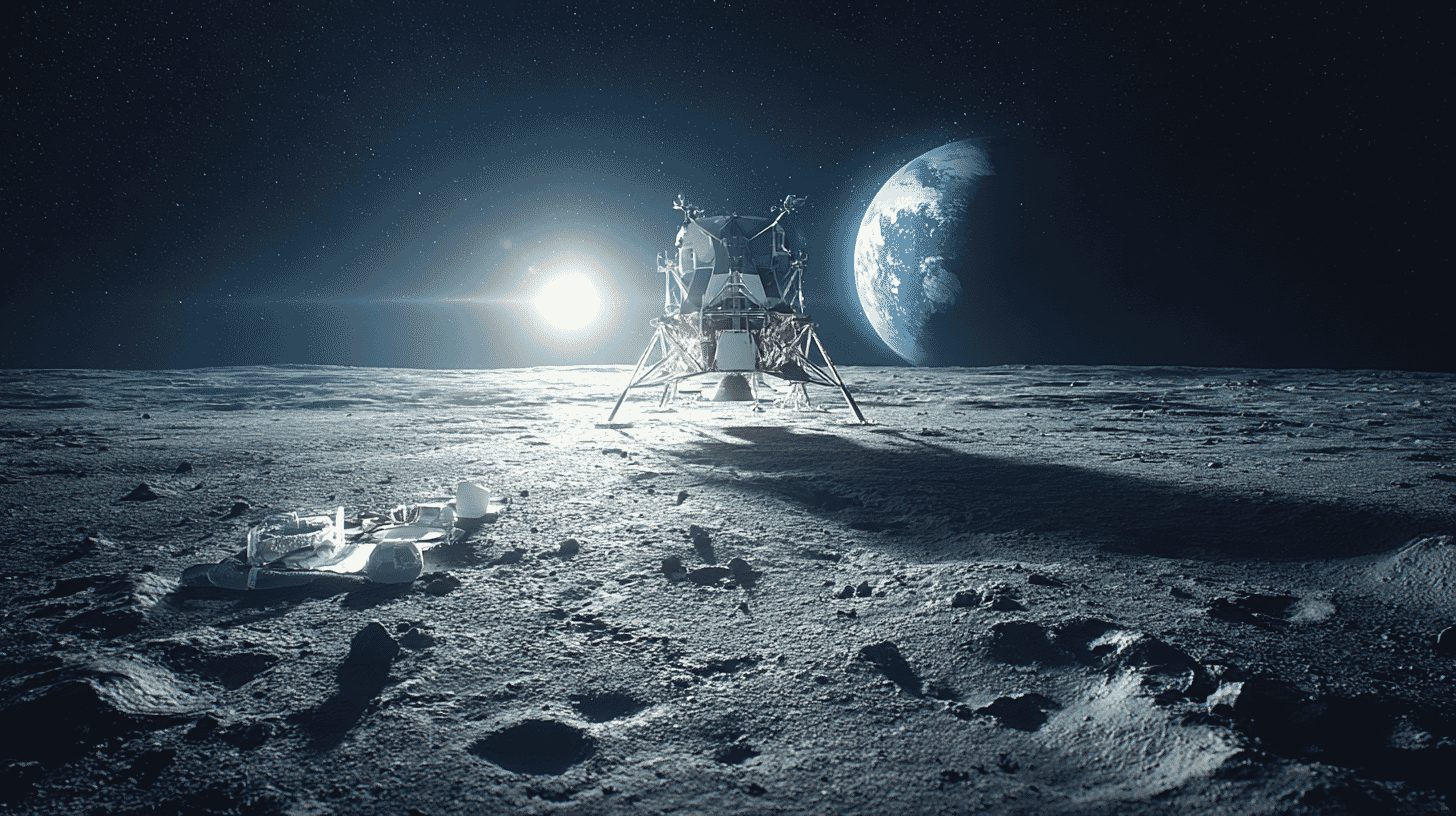
What happens when a company fails to land on the Moon twice? Most would quietly retreat. Japan's ispace did the opposite: it invited MIT professors, NASA veterans, and ESA experts to publicly dissect what went wrong. Here's how "fail fast and learn" is getting a Japanese upgrade.
Two Near-Misses on the Lunar Surface
ispace, a Tokyo-based space startup, has been pursuing a bold vision: building a commercial payload delivery service to the Moon. In April 2023, its Mission 1 lander came agonizingly close before crashing due to a software error that caused a 5km altitude miscalculation. In June 2025, Mission 2's "Resilience" lander suffered a hardware malfunction in its laser rangefinder (LRF). The sensor was supposed to begin measuring altitude by 3km but didn't produce valid measurements until roughly 1 km. By then, the lander was descending too fast to brake, impacting the surface at an estimated 42 meters per second.
Both failures involved altitude measurement systems, but the root causes were different: software in the first case, hardware in the second. What they shared was a design philosophy of using commercial off-the-shelf components to keep costs down.
The Improvement Task Force: An Unprecedented Move
Rather than conducting the usual internal post-mortem, ispace took an unusual step in September 2025: it established an "Improvement Task Force" dominated by external experts.
The task force was co-chaired by Prof. Olivier de Weck, MIT's Apollo Program Professor of Astronautics, and Prof. Naohiko Kohtake of Keio University. The 12-member team included specialists from NASA, JAXA, and ESA alongside four ispace insiders.
CEO Takeshi Hakamada explained the reasoning: "Internal discussions alone are insufficient. We needed objective perspectives on what's truly required to achieve lunar transportation."
After roughly 100 days of work, the task force published its findings on March 27, 2026. The analysis employed CAST (Causal Analysis based on Systems Theory), a methodology designed to identify not just the broken component but the organizational layers where safety controls failed. Rather than assigning blame, CAST aims to generate lessons for the future.
Seven Recommendations Across Three Levels
The task force delivered "7 Recommendations" structured across three organizational levels: operations, system development, and executive decision-making.
Key recommendations included introducing terrain-relative navigation (TRN) to reduce dependence on any single sensor type, expanding resources dedicated to testing, redesigning fault detection, isolation, and recovery (FDIR) protocols, and strengthening enterprise-level risk management.
Notably, the review went beyond technical fixes. The task force found that while LRF performance degradation risk was known, the guidance software had no contingency for systematic failure of both LRF units simultaneously. The risk existed on engineering radars but wasn't elevated to management with sufficient clarity.
In response, ispace is implementing JAXA's SLIM precision landing technology, restructuring its Flight Operations division into a combined "Test and Flight Operations" unit, and creating a new "Technical Risk Assessment Committee" to ensure engineering risks reach executive decision-makers.
The ULTRA Lander: Merging Japan and US Development
The same day, ispace announced another major development: the "ULTRA" lander, merging two previously parallel programs. The Japanese "Series 3 lander" and the US-developed "APEX 1.0" will become a single unified platform. The name comes from Latin, meaning "beyond."
The merger was prompted by engine development delays on the US side. APEX 1.0 had planned to use the "VoidRunner" engine co-developed with Agile Space Industries, but fuel efficiency verification fell behind schedule. Rather than continue splitting resources across two platforms, ispace chose consolidation.
This triggered a complete mission renumbering. The next lunar landing attempt will be the Japan-led "New Mission 3" in 2028, using the ULTRA lander. The NASA CLPS mission (formerly Mission 3) becomes "New Mission 5," now targeting 2030.
ULTRA weighs approximately 1,000 kg (dry mass) and can carry payloads of up to several hundred kilograms, a massive leap from Resilience's 30 kg capacity on Mission 2. The lander incorporates Series 3's structural design with APEX 1.0's propellant tank and communications technology.
Where ispace Stands in the Commercial Lunar Race
The commercial lunar landing landscape has evolved rapidly. In February 2024, Intuitive Machines' Nova-C "Odysseus" became the first private lander to achieve a soft lunar landing, though it tipped over on its side. In March 2025, Firefly Aerospace's Blue Ghost made the first fully successful upright commercial landing under NASA's CLPS program. That same month, Intuitive Machines' second mission "Athena" also reached the surface but again ended up in a non-nominal orientation.
ispace missed being the third private company to land on the Moon, but the company remains firmly in the race. As part of Team Draper, it holds a NASA CLPS contract targeting the challenging lunar far side. Payload contracts total approximately $85 million for Mission 3 and growing, with additional contracts from Taiwan's TASA, the European-based Magna Petra (a $22 million deal for helium-3 exploration), and Japan's Space Strategy Fund.
The competitive field is intensifying. Astrobotic's Peregrine failed on its first attempt but is preparing its larger Griffin lander. Blue Origin's Blue Moon and SpaceX's Starship are also eyeing lunar surface missions. The window for establishing credibility as a reliable commercial lunar transporter is narrowing.
Japan's Version of "Fail Fast and Learn"
In Silicon Valley, "fail fast and learn" is startup gospel. In Japan, where societal pressure around failure runs deep, a company that has failed twice at its core mission continuing to receive government backing (including approximately $130 million through the SBIR program) might seem remarkable.
But ispace's approach isn't simply about resilience or stubbornness. The combination of third-party expert review, CAST systems analysis methodology, and full public disclosure represents something more structured. Rather than treating failure as something to be endured, ispace is treating it as engineering data to be systematically mined.
There's a Japanese proverb: "nana korobi ya oki" (七転び八起き), fall seven times, get up eight. But in ispace's case, each time they fall, a 12-person expert panel conducts a systems-level autopsy before they stand back up. It's a fusion of traditional Japanese perseverance with scientific rigor.
CEO Hakamada has said: "Lunar landing is difficult. Not just anyone can do it. But the important thing is that it's not impossible. We want to push to the limit in figuring out how to overcome that difficulty."
Interestingly, CLPS program participants have collectively demonstrated that Moon landings remain extraordinarily hard even with NASA backing. Roughly half of all lunar landing attempts (by both governments and commercial entities) have ended in failure. In that context, ispace's structured learning approach could genuinely serve as a model for the industry.
In Japan, opinions are divided: some call it a waste of taxpayer money, while others argue this kind of transparent, iterative learning is exactly what Japan's space industry needs.
How does your country handle failure in space development? Would a company that failed twice still receive government support? We'd love to hear your perspective!






Global Discussion
15 comments