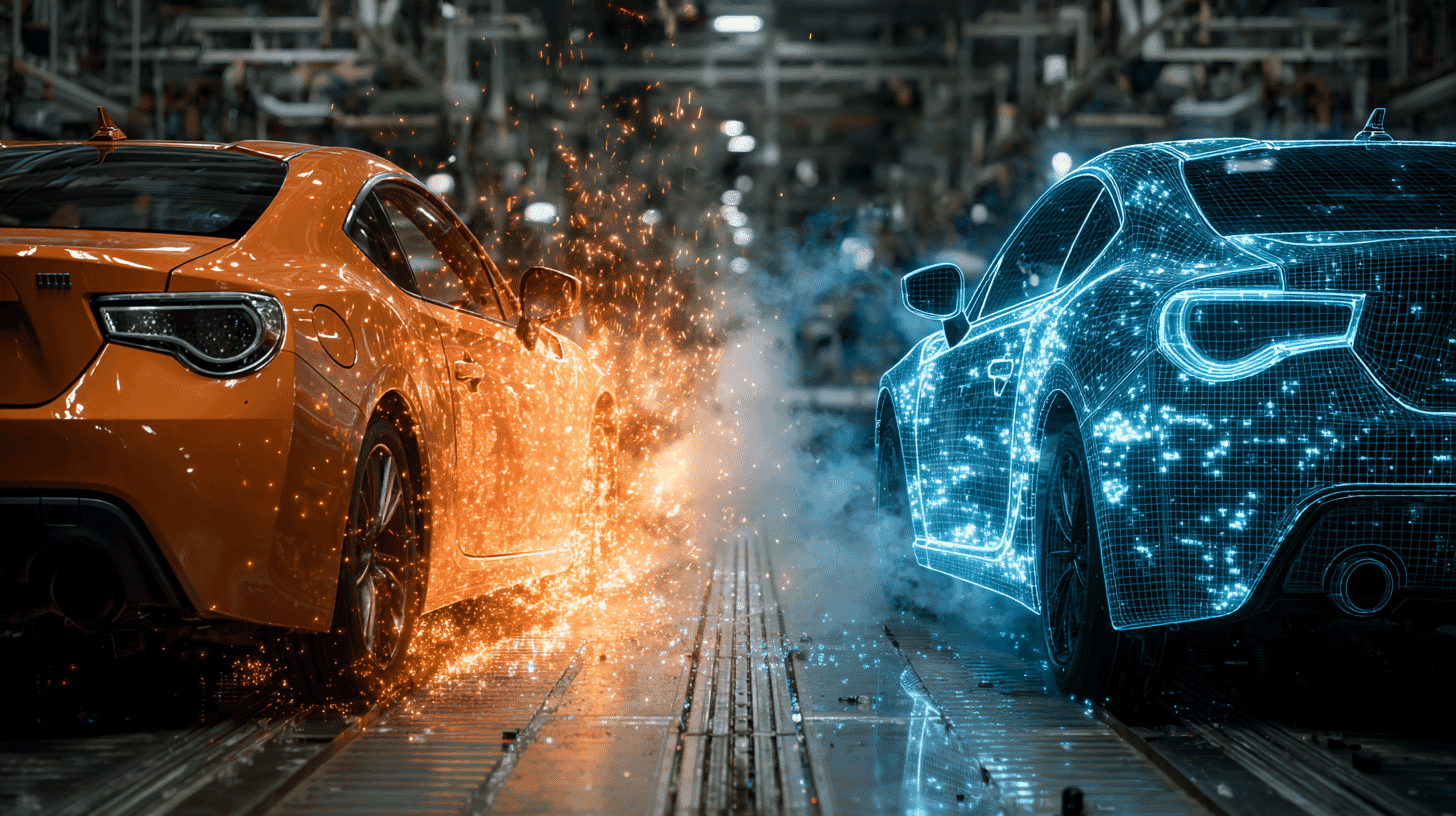
Can a 2,500-person software subsidiary steer a 380,000-employee manufacturing giant into the future?
That's the question behind Woven by Toyota, the software arm quietly tasked with Toyota's most ambitious transformation since it started making cars. With its vehicle software platform "Arene" now shipping in the new RAV4, a $1 billion experimental city opening at the foot of Mt. Fuji, and rivals like Tesla and BYD racing ahead in the software-defined vehicle (SDV) era, Woven by Toyota may be the most important company in the auto industry that most people have never heard of.
What Is an SDV? Think of Your Car as a Giant Smartphone
Think about how your smartphone works. When you bought it, it had certain features. But over time, software updates added new capabilities, improved performance, and fixed bugs. An SDV, Software Defined Vehicle, applies the same idea to your car.
Traditional cars had their features locked in the moment they left the factory. Engine power, safety systems, dashboard functions, all set in hardware. SDVs flip this model. Software becomes the star, defining what your car can do and improving it over time through wireless OTA (Over-The-Air) updates. New safety features, smarter navigation, better entertainment, even improved driving dynamics, all delivered after purchase without visiting a dealership.
The stakes are enormous. The global SDV market is projected to grow from about $213.5 billion in 2024 to $1.23 trillion by 2030. The era when a car's value was measured by its engine and bodywork is giving way to one where software determines which automaker wins.
Who Is Woven by Toyota?
Woven by Toyota, Inc. was born in 2018 as TRI-AD (Toyota Research Institute – Advanced Development), reorganized in 2021 as Woven Planet Holdings, and renamed to its current form in April 2023.
Deliberately headquartered not in Toyota City, Aichi, Toyota's traditional manufacturing heartland, but in Nihonbashi, central Tokyo. With four offices in the U.S. and one in the U.K., the company employs roughly 2,500 people and cultivates a Silicon Valley-style culture fused with Toyota Group manufacturing know-how.
In October 2023, founding CEO James Kuffner, a robotics researcher who came from Google and Waymo, stepped down, replaced by Hajime Kumabe, a Denso veteran who had led J-QuAD DYNAMICS, a joint venture developing autonomous driving control software. This leadership change signaled a shift from "research and early development" to "implementation." After Kuffner built the foundation with a tech-company mindset, the baton passed to Kumabe, who deeply understands supplier collaboration from his Denso years.
Woven's mission spans three pillars: developing the Arene software platform (Toyota's SDV engine), advancing autonomous driving and ADAS technology, and operating Woven City, a one-of-a-kind experimental city for testing mobility tech in real life.
Arene: Toyota's Answer to the Software Platform Wars
Arene is the software platform at the heart of Toyota's SDV strategy. While sometimes called a "vehicle OS," Woven itself prefers the term "software-building platform", a distinction reflecting its broader ambitions.
Arene's core innovation is decoupling software from hardware. In traditional car development, software and hardware were tightly intertwined, requiring unique development for each model. Arene separates them, enabling the same software to run across multiple vehicle types. It's essentially what Android did for smartphones, applied to automobiles.
The platform consists of three layers. Arene SDK (Software Development Kit) modularizes software components and standardizes the entire development lifecycle. Arene Tools accelerate development timelines. Arene Data collects driving data to continuously improve vehicle functions after sale.
The new RAV4 announced in May 2025 became the first vehicle built with Arene. Its voice assistant, center display, and Toyota Safety Sense were all developed on the Arene framework, delivering smartphone-grade natural language voice recognition and a customizable home screen. Toyota plans to extend Arene to next-generation BEVs from 2026 onward. The RAV4 is step one; the full SDV rollout is just beginning.
Woven City: A $1 Billion Living Laboratory at Mt. Fuji's Doorstep
In the town of Susono, Shizuoka Prefecture, on the site of a former Toyota factory, a city unlike anything else on Earth officially opened on September 25, 2025. Woven City occupies 294,000 square meters (about 73 acres), roughly the size of 15 baseball stadiums, at the foot of Mt. Fuji.
The name "Woven" references both Toyota's origins as a loom manufacturer and the interwoven street design by acclaimed Danish architect Bjarke Ingels. The streets are divided into three types: dedicated roads for autonomous e-Palette vehicles, promenades shared by pedestrians and personal mobility devices, and pedestrian-only park pathways. Underground, automated delivery robots move goods through dedicated tunnels.
Toyota Chairman Akio Toyoda has been explicit about Woven City's purpose. "This is not about revenue," he stated. The city exists for "Inventors", partner companies and researchers, to prototype and test new products and services within a real living environment, inventing "the everyday of the future."
Phase 1 opened with about 100 Toyota-affiliated residents and their families. Cross-industry partners include Daikin (air conditioning), Nissin Food Products, UCC coffee, and ENEOS (hydrogen energy). The Phase 1 area will eventually house about 360 people, with the full city scaling to approximately 2,000 residents. A Phase 2 expansion is already planned.
The Competition: Tesla and BYD Are Not Waiting
While Toyota methodically builds its software foundation, rivals are sprinting ahead.
Tesla remains the SDV benchmark. Its vertically integrated software stack delivers frequent OTA updates, and its Full Self-Driving subscription ($99/month, about ¥15,000) pioneered the model of generating ongoing software revenue from vehicles already sold. Tesla's massive fleet data feeds continuous AI training at a scale no traditional automaker matches. However, European sales slumped through 2025-2026, and the so-called "Musk Effect", consumer backlash against CEO Elon Musk's political activities, has eroded brand loyalty in key markets.
BYD is charging from the opposite direction. Its in-house "God's Eye" ADAS now ships across all price points, from the $10,300 Seagull to premium Denza models. With standard 5G connectivity, satellite links, and AI integration, BYD is democratizing SDV features at mass-market prices. In 2025, BYD sold 4,602,436 new energy vehicles worldwide, the most of any maker, of which 2,256,714 were pure battery EVs. The run has not been painless: 2025 net profit fell 19% amid China's price war, domestic sales declined year-on-year for five straight months from July, and chairman Wang Chuanfu conceded that BYD's technological lead was "not sufficiently ahead." Its Flash Charging technology claims 10% to 70% charge in under five minutes, outgunning even Tesla's latest V4 Superchargers on raw power.
Huawei's HarmonyOS automotive platform, Hyundai-Kia's full-lineup SDV transition (now running behind its original 2025 target), and BMW and Mercedes' proprietary architectures add further competitive pressure.
Toyota's Distinctly "Toyota" Approach to SDV
Toyota's strategy stands apart in three ways.
First, safety as the starting point. Toyota defines the purpose of SDV as "eliminating tragic traffic accidents." Not entertainment, not convenience, safety first. Chief Branding Officer Simon Humphries stated bluntly during the RAV4 unveiling: "If you hear SDV and think entertainment, you're wrong. The purpose is traffic accident zero."
Second, applying the Toyota Production System to software. The same "kaizen" (continuous improvement) philosophy that revolutionized manufacturing is being brought to code. In a software world where "move fast and break things" remains common, Toyota's emphasis on quality, reliability, and systematic process is unconventional.
Third, the open-platform vision. Toyota has signaled that Arene could eventually be offered to other automakers and third parties, similar to how Android serves the smartphone ecosystem. If realized, this could reshape the entire automotive software landscape, though it would also benefit competitors.
Challenges and Outlook: Can a Manufacturer Become a Tech Company?
The challenges are significant.
On R&D spending, Toyota allocated a record ¥1.3 trillion (about $8.7 billion) for fiscal year 2025, with ¥600 billion ($4 billion) earmarked for growth areas including AI and SDV. By comparison, Tesla invested roughly $2 billion in xAI alone and is expanding its Cortex 2 AI training facility at Gigafactory Texas. BYD spends about 6.85% of revenue on R&D.
Speed matters. Tesla pushes OTA updates every few weeks. Toyota's first Arene-equipped vehicle only went on sale in fiscal 2025. Chinese competitors iterate even faster, with BYD and Huawei releasing new software features at a pace traditional automakers struggle to match.
Talent acquisition remains a universal pain point. Attracting Silicon Valley-caliber software engineers to a manufacturing-centric company is something every legacy automaker struggles with. Woven's Tokyo headquarters helps, but 2,500 employees is modest compared to the software armies at Tesla or BYD.
Yet Toyota holds cards no one else can play. The world's largest automaker by volume (over 10 million vehicles annually), with sales networks spanning 180+ countries. Unmatched brand trust built on decades of hardware reliability. And Woven City, a living laboratory no competitor possesses.
The SDV era will be won at the intersection of software speed and hardware reliability. Toyota is betting that Woven by Toyota can bridge both. Whether that bridge is built fast enough is the trillion-dollar question.
How far along is the "smartphoneification" of cars in your country? Is Tesla, BYD, or a local manufacturer leading the charge? We'd love to hear your perspective, share your thoughts in the comments below!








Global Discussion
14 comments