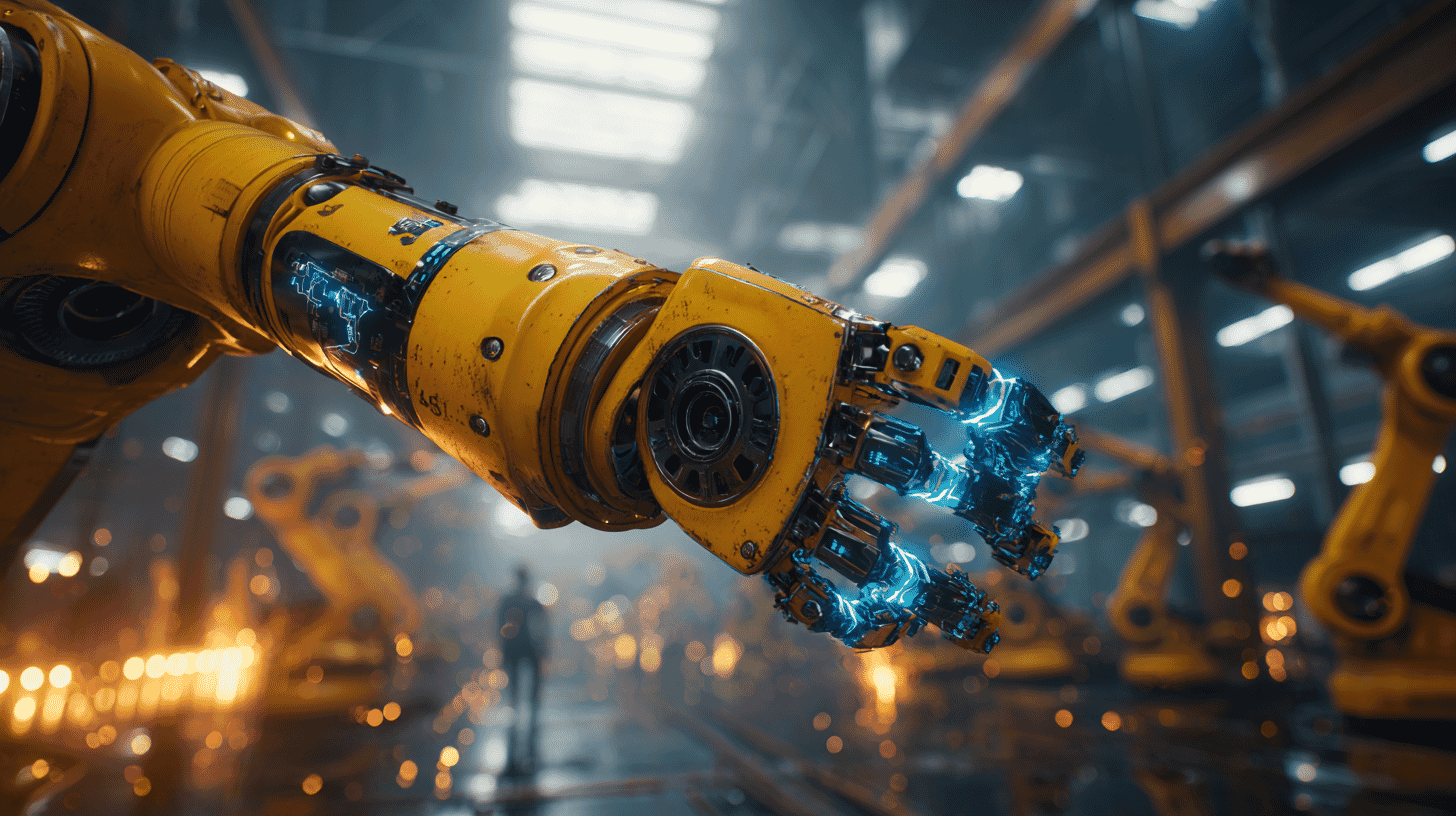
The world's largest industrial robot maker just ended its half-century of isolation. FANUC, the secretive Japanese giant whose yellow arms dominate factories worldwide, has opened its doors to NVIDIA and the global AI community. But it's deliberately steering clear of humanoid robots. Here's why this "boring" strategy might be the smartest move in robotics.
The Day the "Yellow Empire" Opened Its Gates
If you've ever seen a bright yellow robotic arm in a factory, chances are it was made by FANUC. Headquartered at the foot of Mount Fuji, this Japanese giant commands roughly 50% of the global market for CNC (Computer Numerical Control) systems, the "brains" of machine tools, and holds a top-tier position in industrial robots.
For decades, FANUC was famously closed off. Its control software was proprietary. Its programming language was unique. It rarely partnered with outsiders. This fortress mentality was its strength, and its reputation. Industry insiders called it the "closed empire."
Then, in late 2025, FANUC surprised everyone.
The company announced a sweeping partnership with NVIDIA, published its robot control drivers as open source on GitHub, and declared support for Python, the lingua franca of AI development. Overnight, any researcher or startup in the world could program a FANUC robot.
One institutional investor described it as an "unexpectedly massive strategic shift from a company long regarded as closed."
What Is Physical AI?
To understand why this matters, you need to know about "Physical AI": the hottest concept in robotics right now.
Generative AI tools like ChatGPT create text and images in the digital world. Physical AI goes further: it enables machines to perceive the real world through cameras and sensors, make autonomous decisions, and physically move objects.
A robot on a factory floor that tracks a moving part on a conveyor belt, figures out the optimal angle, and tightens a screw, all without human programming, that's Physical AI in action.
NVIDIA CEO Jensen Huang has declared that "Physical AI has arrived, every industrial company will become a robotics company." NVIDIA is no longer just a GPU company; it's positioning itself as the platform provider for robot intelligence.
NVIDIA Isaac Sim: Training Robots in Virtual Factories
At the heart of the FANUC-NVIDIA partnership is Isaac Sim, NVIDIA's robot simulation environment.
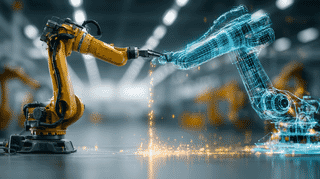
Isaac Sim lets developers build photorealistic virtual factories and train robots through millions of trial-and-error attempts, all in digital space. Testing robots in real factories is expensive, time-consuming, and risky. Virtual training eliminates most of those constraints.
FANUC's entire lineup, from its 3kg collaborative CRX cobots to its massive 2.3-ton heavy-duty arms, is now available as simulation-ready assets in Isaac Sim. FANUC's proprietary simulation tool ROBOGUIDE has been integrated with Isaac Sim, enabling exact replication of real-world robot behavior in virtual space.
This isn't just a software partnership. It's FANUC embedding itself into NVIDIA's ecosystem, a fundamental departure from its go-it-alone tradition.
The ROS 2 Bombshell
The second major shift is FANUC's decision to open-source its ROS 2 (Robot Operating System 2) drivers.
ROS 2 is the most widely used open-source framework for robot development. Universities, startups, and tech giants all build robotic AI applications on it. Traditionally, robot manufacturers kept their control drivers under lock and key, these were the crown jewels of competitive advantage.
FANUC publishing its drivers on GitHub is, in smartphone terms, like Apple open-sourcing iOS. The goal: get the world's best AI developers building on FANUC hardware, creating an ecosystem that makes FANUC robots the platform of choice for Physical AI applications.
A securities analyst commented that the open-platform approach gives FANUC the ability to run whichever AI turns out to be the best, a powerful strategic hedge in an era where the AI winner hasn't been decided yet.
Why FANUC Is Deliberately Ignoring Humanoid Robots
While the world buzzes about humanoid robots, Figure AI's $39 billion valuation, Boston Dynamics deploying Atlas in Hyundai factories, Chinese startups raising hundreds of millions, FANUC is sitting this one out.
Kenichiro Abe, head of FANUC's robot R&D, has stated plainly that humanoid robots have limited industrial applications and that FANUC has no plans to enter the space, not even for non-industrial uses.
The reasoning is practical. FANUC's industrial robots can coordinate up to four arms from a single CPU. One arm can be ceiling-mounted, another designed for heavy loads, another optimized for precision, each tailored to the task. Why constrain yourself to the human body's two-arm, two-leg design?
In a factory, looking human has zero value. In fact, it's a limitation. FANUC has chosen function over form, a distinctly engineering-first philosophy that reflects decades of real-world factory experience.
While humanoid robots generate headlines, their actual ROI in industrial settings remains unproven. FANUC's "wait and watch" stance is a calculated bet that the hype will cool before humanoids become truly competitive in manufacturing.
The Competitive Landscape: FANUC vs. ABB vs. KUKA vs. China
The Physical AI era is reshaping the industrial robot market into its most intense competitive phase ever.
FANUC (Japan): Unique dual dominance in CNC and robotics. The open-platform pivot aims to build a developer ecosystem around FANUC hardware. Investing $90 million in a new U.S. factory by late 2027. Cash reserves exceed $3.3 billion, unmatched financial firepower.
ABB (Switzerland): Strong in software integration and European markets. Also partnering with NVIDIA to bridge the "Sim2Real gap", the difference between how robots perform in simulation versus reality. Known for user-friendly vision systems that connect to virtually any camera in hours.
KUKA (Germany / owned by China's Midea Group): Acquired by Chinese appliance giant Midea in 2016. Maintains a strong presence in European automotive manufacturing while expanding in China. Also integrating with NVIDIA Isaac Sim. Chinese ownership raises trust concerns in some Western markets.
Chinese Challengers: Estun and Inovance are rapidly gaining share in the low-to-mid price range. In humanoids, AGIBOT, Unitree, and others are attracting massive funding. China accounts for about 54% of global industrial robot installations (2024), backed by "Made in China 2025" subsidies. Morgan Stanley data shows 56% of publicly traded humanoid robotics companies are now Chinese.
FANUC's positioning in this landscape is distinctive: "hardware reliability × open AI platform." Rather than chasing the humanoid trend, it's expanding what conventional industrial robots can do by embedding AI, a pragmatic approach rooted in factory reality.
Will Physical AI Kill the Robot Integrator?
A common concern: if AI lets robots teach themselves, will the system integrators (SIers) who deploy and configure robots lose their jobs?
FANUC's Abe says no. "SIers won't become unnecessary. As the areas we want to automate keep growing, Physical AI is meant to expand into regions where there are no SIers and fields where the technology doesn't exist yet. It compensates for labor shortages."
In other words, Physical AI doesn't shrink the pie: it makes the pie bigger. Robots aren't replacing people; they're filling gaps where people aren't available. This is a characteristically Japanese FA (Factory Automation) perspective: automation as a solution to labor shortages, not a replacement for workers.
The Boring Strategy That Might Win
FANUC's approach can be summed up as "substance over spectacle." No flashy humanoid demos. No billion-dollar moonshots. Instead, a disciplined focus on making existing industrial robots smarter, more adaptable, and more accessible through AI and open platforms.
The shift from a half-century of closed-door policy to open source is genuinely risky. Opening up means competitors can study FANUC's technology. But staying closed in the Physical AI era means being left behind. FANUC's solution: open the gates, but compete on the manufacturing quality inside the fortress walls.
In Japan, the debate over how legacy manufacturers should adapt to the AI era is heating up. How is your country's manufacturing sector responding to robots and AI? Is factory automation advancing where you live? Share your perspective in the comments, we'd love to hear how this looks from your part of the world!
References
- https://www.fanuc.co.jp/ja/product/new_product/2025/202512_robot_physicalai.html
- https://nvidianews.nvidia.com/news/nvidia-and-global-robotics-leaders-take-physical-ai-to-the-real-world
- https://xtech.nikkei.com/atcl/nxt/column/18/03550/032600002/
- https://business.nikkei.com/atcl/gen/19/00155/121700264/
- https://robotstart.info/article/2025/12/05/381472.html






Global Discussion
15 comments