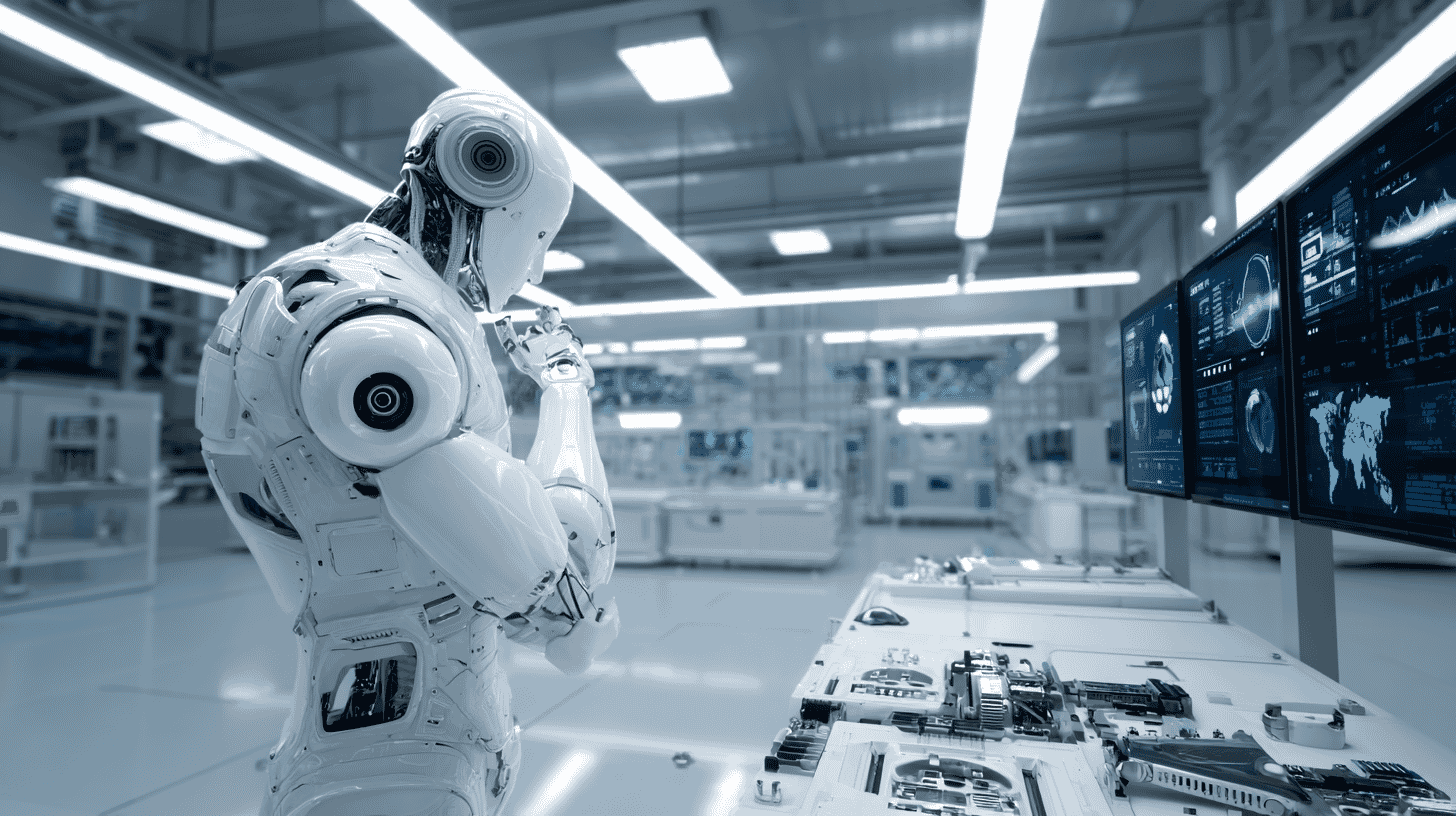
While Tesla pushes toward mass production of Optimus and Chinese startups pour billions into humanoid factories, four Japanese companies made a different bet. Instead of building robots, they are building a data factory to teach them. From July 2026, 50 humanoid robots and about 100 human operators will work side by side in Japan's first private data collection center.
Why Four Unlikely Companies Teamed Up
On March 26, 2026, an unlikely alliance of four Japanese companies announced the formation of J-HRTI (Japan Humanoid Robot Training & Implementation), a consortium dedicated to accelerating the deployment of humanoid robots in real industrial settings.
The founding members are Yamazen, one of Japan's largest industrial machinery trading companies; Tsumura, a major pharmaceutical manufacturer known for traditional Kampo medicine; Rheon Automatic Machinery, a food processing equipment maker; and INSOL-HIGH, a Tokyo-based startup developing the "REAaL" platform for humanoid robot deployment.
At first glance, a machinery trader, a medicine company, and a food equipment maker teaming up on robots seems odd. But they share a critical problem: Japan's deepening labor shortage. A Yamazen survey of 1,100 managers across 11 manufacturing sectors found that 44.2% are open to adopting humanoid robots, with "solving labor shortages" cited as the top motivation at 63.2%.
"Across every industry in Japan, the shrinking workforce is an urgent crisis," said Munekiyo Isobe, CEO of INSOL-HIGH, at the press conference. "AI-powered robots are the essential solution."
Why Data Is the Real Bottleneck
Traditional industrial robots run on pre-programmed instructions, with an engineer coding every motion in advance. Humanoid robots are fundamentally different. They learn through "imitation learning," where human operators physically demonstrate tasks while sensors capture every movement. The robot's AI then trains on this massive dataset to replicate the motions autonomously.
Think of it like self-driving cars: just as autonomous vehicles need millions of miles of driving data, humanoid robots need enormous volumes of "physical data": recordings of real-world manipulation, walking, lifting, and assembling.
That data is scarce worldwide. In the U.S. and China, tech giants are building their own data factories, but at enormous cost and risk. J-HRTI's approach is to pool resources across multiple companies, creating a shared data infrastructure that no single company could afford alone.
Japan's First Private-Sector Data Collection Center
The centerpiece of J-HRTI is the "Physical AI & Robot Data Collection Center," a roughly 15,000-square-foot (1,400 m²) facility being built in the coastal area of Chiba Prefecture, east of Tokyo. Up to 50 humanoid robots will operate simultaneously, supported by approximately 100 full-time staff including operators and annotators (specialists who label and verify training data).
The facility is divided into three zones. In the "Robot Area," each robot is paired one-to-one with a human operator who demonstrates industrial tasks, lifting, carrying, sorting, while the robot's sensors record every detail. The "Annotation Area" is where humans review the collected data, filtering out errors and selecting high-quality training sets. The "Test Area" simulates real factory conditions for final validation before deployment.
"This is the first time in Japan that a data collection center for robotics has been established entirely by private-sector companies," Isobe emphasized. He noted that having a dedicated center allows for rapid iteration, feedback from actual factory deployments can be quickly fed back into the training pipeline, continuously improving robot performance.
Initially, the consortium will use humanoid robots made by AGiBOT, a Chinese manufacturer, but plans to evaluate other manufacturers and potentially contribute to robot development as the project evolves.
"PX," Japan's New Word for the Robot Era
J-HRTI is also introducing a new concept: PX, or Physical AI Transformation. Just as DX (Digital Transformation) describes the shift to digital workflows, PX refers to fundamentally redesigning labor structures around physical AI, robots that work in the real world.
This goes beyond simply automating individual tasks. PX envisions rethinking entire business processes from the ground up, designing new workflows where humans and robots collaborate optimally. The consortium has established a "PX Practice Research Group" to train engineers from member companies in identifying which tasks in their factories offer the highest return on investment for robot replacement.
The immediate goal is ambitious: achieve real-world humanoid robot deployment in industrial settings by the end of fiscal year 2026. Initial tasks will focus on relatively simple operations like container handling and material transport, with broader adoption targeted for 2028.
Where Japan Stands in the Global Humanoid Race
The worldwide humanoid robot competition has reached an inflection point in 2026.
In the United States, Figure AI's robots are already working shifts at BMW's Spartanburg plant. Tesla is converting its Fremont Model S/X line to build Optimus, with Elon Musk saying in March 2026 that production of the third-generation robot would start in summer 2026 and eventually reach millions of units a year at a target price of $20,000–$30,000. Figure AI has raised close to $2 billion since 2022, including a Series C of more than $1 billion at a $39 billion valuation in September 2025.
China is moving even faster on the commercialization front. UBTECH is deploying humanoids in BYD and Foxconn factories. AgiBot built China's first mass production hub in Shanghai. In the first nine months of 2025, according to venture database IT Juzi, China's embodied-AI sector drew 610 deals worth 50 billion yuan (about $7 billion), 2.5 times the year-earlier figure. Some analysts suggest China is currently ahead of the U.S. in the early commercialization phase.
Japan's J-HRTI takes a deliberately different path. "This isn't about competing with similar efforts in other countries," Isobe said. Rather than trying to out-manufacture Tesla or out-invest Chinese tech giants, J-HRTI focuses on what Japan does best: the meticulous, quality-obsessed manufacturing culture that has made its factories among the world's most efficient.
This strategy builds on Japan's formidable existing strengths. Japanese companies including FANUC, Yaskawa Electric, and Kawasaki Heavy Industries have historically supplied roughly 45% of the world's industrial robots. Japan also dominates critical components, Nabtesco and Harmonic Drive Systems control the global market for precision reducers, the "joints" that give robots their precise movement.
Japan already builds the robot's body. J-HRTI aims to add value at the software and data layer, teaching robots how to move in Japan's demanding factory environments, then exporting that expertise.
Can Humanoids Really Become the Next Auto Industry?
Isobe's vision is bold: he estimates the humanoid robot market could reach $100 billion in Japan by 2030 and $1.3 trillion globally by 2035. "Humanoid robots could become a new core industry rivaling the automobile sector," he says.
Significant challenges remain. Build costs still sit far above the price points the industry advertises, safety in human-robot collaboration is unresolved, and even the most advanced humanoids today handle little beyond basic pick-and-place work reliably. Gartner forecasts that fewer than 20 companies worldwide will deploy humanoids at scale in their supply chains by 2028.
Yet for Japan, the stakes are existential. The country's working-age population is projected to decline from 75 million in 2020 to just 50 million by 2060, a 30% drop. Manufacturing and logistics, the backbone of Japan's economy, are already struggling to fill positions. Automation isn't just a competitive advantage; it's a matter of economic survival.
Whether J-HRTI succeeds remains to be seen. But in a race dominated by hardware specs and venture capital, Japan's bet on data quality, manufacturing expertise, and cross-industry collaboration offers a distinctly Japanese answer to a global challenge.
In Japan, humanoid robots are widely seen not as threats but as future coworkers needed to sustain an aging society. How is the humanoid robot discussion framed in your country? Are people excited about robots joining factory floors, or worried about what it means for jobs? We'd love to hear your perspective.









Global Discussion
15 comments