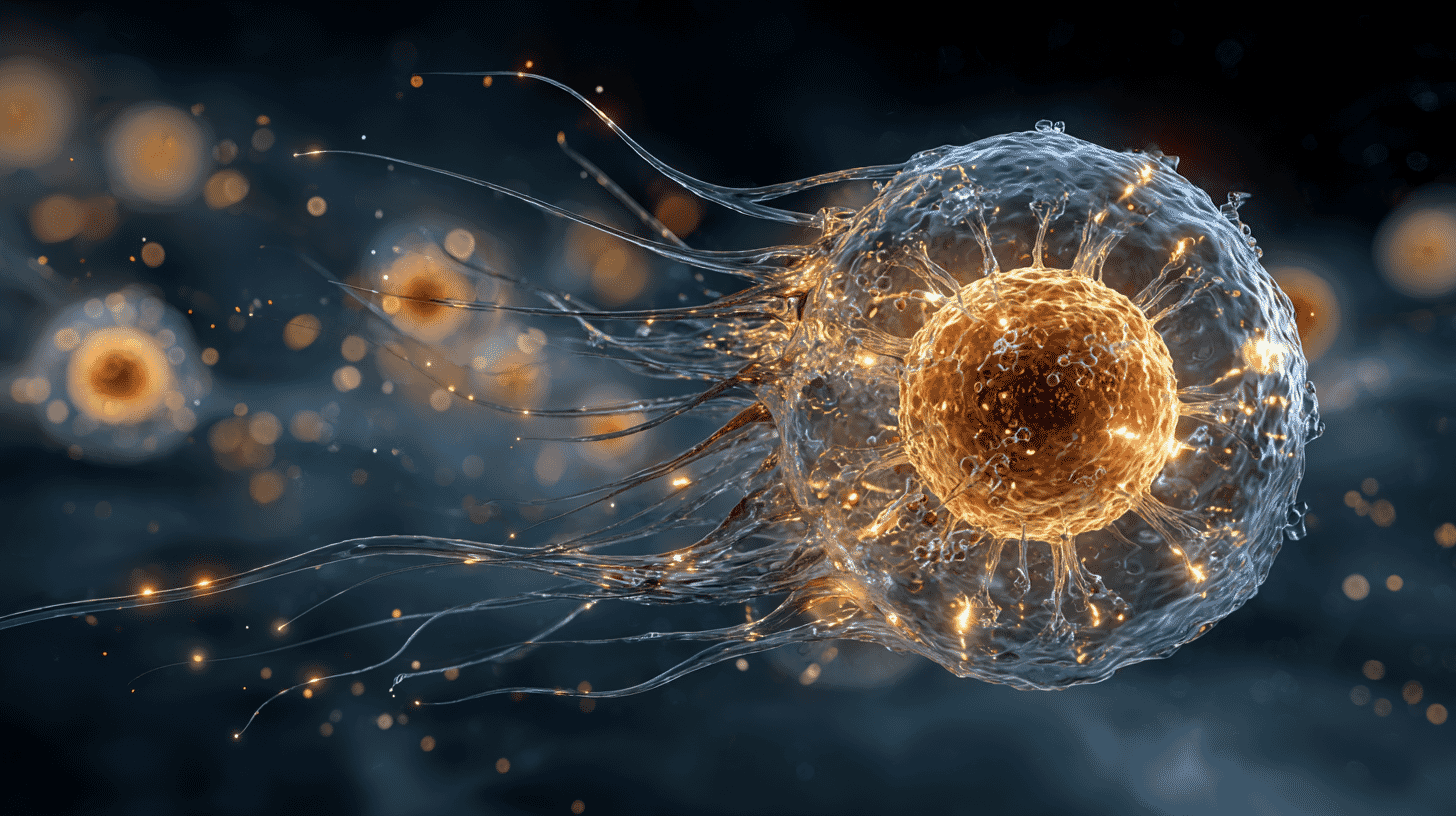
Cancer patients who have gone through round after round of chemotherapy face one cruel problem: their own immune systems are worn out. Could you grow the cancer-fighting immune cells somewhere else instead, from iPS cells?
A team at Kyoto University's Center for iPS Cell Research and Application (CiRA) has produced "helper T cells," the conductors of the immune system, without using mouse feeder cells. It is a step toward getting past the limits of today's CAR-T therapy.
What does it mean to manufacture an "immune conductor"?
Researcher Yohei Kawai and Professor Shin Kaneko of CiRA's Department of Clinical Application have established a technique for inducing CD4 single-positive helper T cells from human iPS cells without feeder cells, the mouse-derived support cells the process has traditionally relied on. The paper appeared in the U.S. journal Molecular Therapy on January 20, 2026, and CiRA published the finding on April 23.
If "helper T cell" doesn't ring a bell, here's a quick primer. In our bodies, the immune system has two main types of T cells: "killer T cells" (CD8+) that directly attack infected or cancerous cells, and "helper T cells" (CD4+) that read the battlefield and direct other immune cells into action. They're roughly the difference between special forces operators and the field commander coordinating them.
Until now, most iPS-derived T cell research worldwide has focused on the killer type. The helper type has stubbornly resisted laboratory production. In earlier work the CiRA team had induced CD4-positive T cells in a 3D artificial thymic organoid, a tissue mimicking the thymus where T cells naturally mature, built on mouse feeder cells. This time they examined the signaling inside that culture system and worked out how to control Notch and TCR signaling in precise stages, which let them drop the feeder cells entirely.
The absence of mouse cells is not a minor detail. It lowers the regulatory bar for eventual clinical application considerably.
Why helper T cells matter so much for cancer treatment
The shortage of functional helper T cells has haunted cancer immunotherapy for years.
CAR-T therapy (chimeric antigen receptor T-cell therapy) has been reshaping blood cancer treatment since the FDA approved Kymriah and then Yescarta in 2017. It works by extracting a patient's own T cells, genetically engineering them into precision tumor hunters, and reinfusing them. In relapsed and refractory blood cancers, response rates have run far above what earlier treatments achieved.
But CAR-T has three serious limits.
1. Patient immune cells are exhausted. Late-stage cancer patients who have cycled through multiple chemotherapies are often in a state called immune exhaustion. Their T cells are depleted and stressed. As MSK researchers have noted, this makes it hard for those cells to multiply and fight effectively, which means manufacturing a usable CAR-T product from them often fails.
2. Manufacturing is slow and astronomically expensive. Each CAR-T treatment is custom-made for one patient, taking two to three weeks during which the disease can progress. Kymriah's U.S. list price is around $475,000 and Yescarta about $373,000. With hospitalization and side-effect management, total cost per patient can exceed $1 million, according to industry reports.
3. Helper function is missing. CAR-T cells specialize in killing. The field-commander role of coordinating other immune cells is largely absent, one reason CAR-T has struggled with solid tumors.
That's exactly the gap CiRA's helper T cells are designed to fill.
Three findings that make CiRA's work stand out
Strong proliferation and cytokine output
The induced CD4+ T cells proliferated strongly and highly expressed the activation-related molecules ThPOK and CD40L. They also secreted essential immune cytokines at higher levels than killer T cells, indicating that the commander function was working as intended.
Triggering dendritic cell maturation
When confronted with cancer cells, the helper T cells drove the maturation of dendritic cells, which act as the immune system's teachers, presenting tumor antigens to other immune cells. Activate the dendritic cells and the wider immune response follows.
Killing capability acquired during proliferation
The helper cells were also shown to acquire direct cancer-killing ability during expansion, giving a cell that combines both helper and killer functions. That was more than the team set out to build.
How Japan, the U.S., and China stack up
The race to produce iPS-derived T cell therapies is now a three-way contest between Japan, the United States, and China.
United States: Memorial Sloan Kettering and "FT819"
Memorial Sloan Kettering Cancer Center (MSK) is where CAR-T was born. The lab of Dr. Michel Sadelain, a global authority on CAR-T, has long worked on next-generation iPS-derived T cell therapies. MSK's partner Fate Therapeutics has run the world's first clinical trial of an iPS-derived CD19-targeting CAR-T product, "FT819," which uses precision genome editing to insert the CAR construct into the TRAC (T cell receptor alpha constant) locus.
Even American teams acknowledge that iPS-derived T cell manufacturing is fundamentally harder than NK (natural killer) cell manufacturing, because it requires recreating thymic developmental processes, positive and negative selection included, at scale.
China: leading by sheer trial volume
Between 2014 and 2024, China registered 206 cell therapy clinical trials, with 51.4% (106 trials) involving T cells, according to a 2025 review. iPS-derived products in trial include "QN-023a," a CD33-targeting NK+CAR product for acute myeloid leukemia. China's edge is regulatory speed and the sheer number of trials it can run in parallel.
Japan: a distinct path through helper T cells
Rather than chasing the US-China killer-cell race, the CiRA team took on a different and arguably harder problem: helper T cells, produced without feeder cells. On the clinical side, Chiba University Hospital is already running an iPS-derived NKT cell trial (jRCT2033200116), and iPS-derived NK and CAR cell products aimed at solid tumors have entered trials in Japan as well.
Why "feeder-free" is a bigger deal than it sounds
To non-specialists, "no mouse cells used" might sound like a footnote. It isn't. It's one of the most significant practical advances in this paper.
iPS-to-T-cell protocols have traditionally required mouse-derived feeder cells as a growth scaffold. Mouse cells can carry viruses that might infect humans, along with unknown proteins: a regulatory headache for any cell product intended for patient infusion. A xeno-free culture system, meaning one free of animal-derived components, clears a major hurdle for clinical translation, commercial manufacturing and global market entry.
How long until it reaches patients?
To be honest, this is still basic research. The published work is mostly functional characterization of the induced helper T cells. Animal preclinical studies and Phase I–III human trials still lie ahead.
That said, Japan's regenerative medicine framework includes a conditional, time-limited approval route. "ReHeart," the iPS-derived cardiomyocyte sheet for severe heart failure developed by Osaka University spinout Cuorips, was endorsed by a health ministry panel on February 19, 2026 and received conditional, time-limited marketing approval on March 6, with a domestic launch planned for autumn 2026. iPS-derived products are starting to reach approval, not just publication.
If iPS-derived helper T cell therapy reaches the clinic within five to ten years, the implications are large. In Japan alone, roughly one million people are newly diagnosed with cancer each year. A bank of immune cells that works even for patients exhausted by chemotherapy would change what can be offered to them.
What's it like in your country?
The frontier of cancer immunotherapy is now a three-way competition: U.S. pharmaceutical capital and clinical sophistication, Chinese trial volume and regulatory speed, and Japanese iPS cell expertise.
How available is CAR-T therapy where you live? Does insurance or your national health system cover it? Or has a different immunotherapy approach become the standard? For patients and their families, the gap between hope and access is often wide, and we'd like to hear how it looks from where you are.








Global Discussion
15 comments