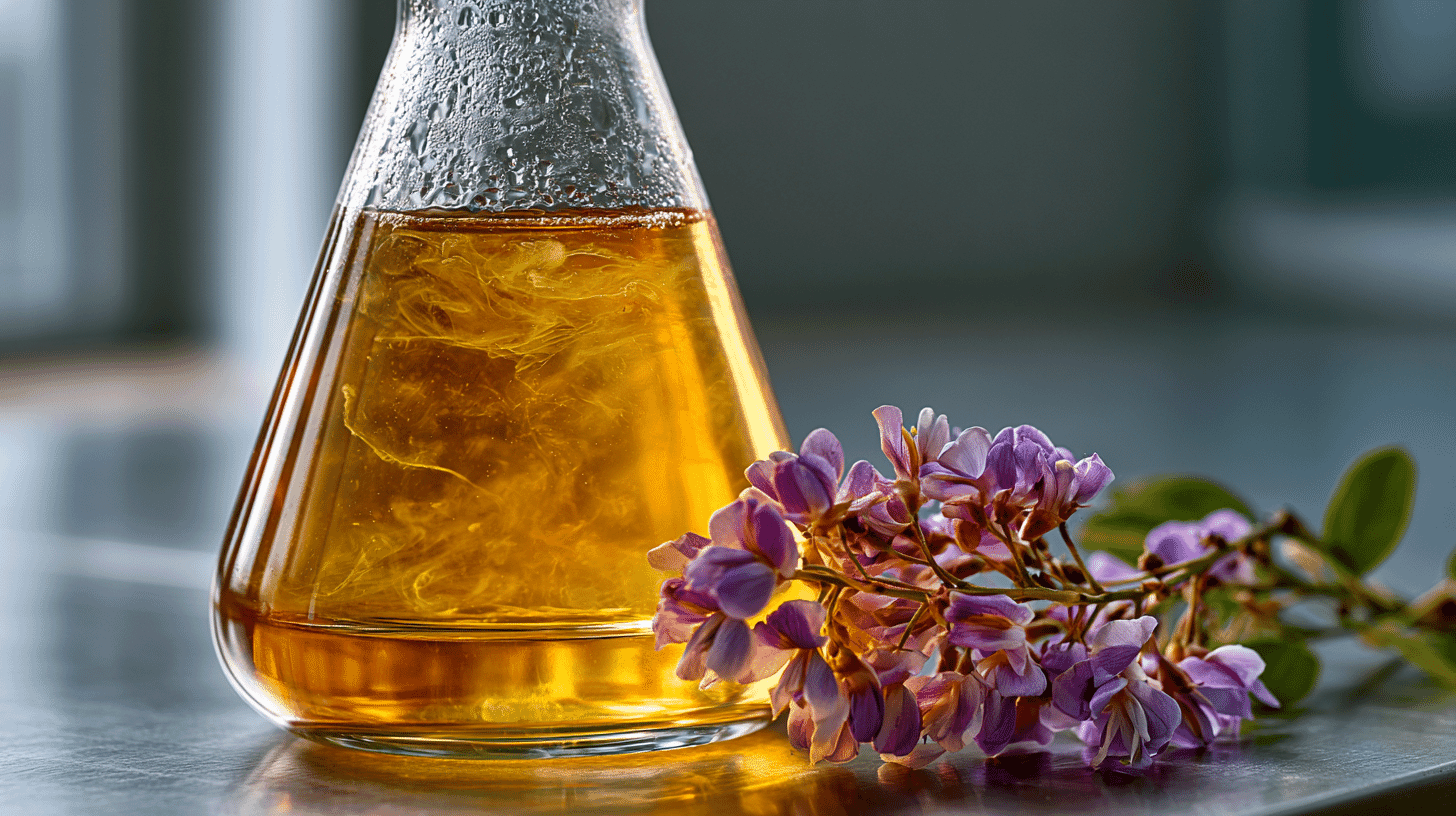
🌿 In the American South, kudzu is practically a curse word: the runaway vine that swallows barns, road signs, and whole hillsides. In Japan, the very same plant's flower is sold quietly in drugstores as a fat-trimming supplement. Now a Japanese research team has gone a step further, teaching baker's yeast to brew the flower's most valuable compound with no kudzu required at all.
A team at the RIKEN Center for Sustainable Resource Science announced on May 20, 2026, that it had mapped the biosynthetic pathway behind tectorigenin, a health-related compound found in kudzu flowers, and shown that ordinary budding yeast can manufacture it in quantity. The finding turns a scarce, import-dependent plant ingredient into something closer to a programmable molecule, and it slots Japan into a global race that has names like Ginkgo Bioworks attached to it.
The weed America hates and Japan values
If you have ever driven through Mississippi, Alabama, or Georgia, you have seen kudzu without knowing its name: a thick green blanket draped over trees, fences, and abandoned buildings. Introduced from Asia at the 1876 Philadelphia Centennial Exposition and later pushed by the U.S. Soil Conservation Service in the 1930s through the 1950s as a fix for soil erosion, it escaped cultivation and earned a grim nickname: "the vine that ate the South." It can grow a foot in a single day, and U.S. authorities spend millions of dollars a year just trying to slow it down.
Here is the twist that makes the story worth telling: kudzu is not an alien invader in Japan. It is native here, and it is woven into everyday life. The Japanese call it kuzu. Its starch becomes kuzumochi, a translucent summer sweet; its root is the active ingredient in kakkonto, the herbal cold remedy sold in nearly every Japanese pharmacy. And the part most Westerners never think about, the flower known as kakka, has its own long history in traditional medicine.
So a plant that the American South would happily eradicate is, in Japan, a resource. That gap is the heart of this research.

Source: JST / RIKEN press release
Tectorigenin: the compound hiding in the flower
Kudzu flowers contain isoflavones, the same broad family of plant compounds found in soybeans. One of them is tectorigenin, which laboratory studies have linked to antioxidant and anti-tumor activity.
In Japan, tectorigenin is not an obscure lab curiosity. Kudzu-flower-derived isoflavones, measured "as tectorigenins," are an officially registered functional-food ingredient. Walk into a Japanese drugstore and you will find tablets making a very specific claim: that they help people who are overweight reduce body weight, belly fat, and waist circumference. Major food companies sell them, typically at daily doses of around 22 to 35 milligrams. It is a real consumer market, not a theoretical one.
Yet for all that commercial use, one basic question had never been answered: how does the kudzu flower actually build tectorigenin in the first place? Chemists could see, from its structure, that it should come from genistein, a common isoflavone, through a couple of chemical tweaks. But nobody had identified the enzymes that do the work. Without that knowledge, the only way to get tectorigenin was to grow kudzu flowers and extract it, a slow and limited supply line.
Turning yeast into a factory
The RIKEN team, research scientist Kai Uchida and team director Masami Yokota Hirai, approached the problem like detectives narrowing a suspect list.
They started with kudzu growing wild on RIKEN's own Yokohama campus, sampling flowers, buds, and leaves. High-performance liquid chromatography on methanol extracts showed that a related compound, tectorigenin-7-O-xylosylglucoside, piled up in the flowers and buds but fell below the detection limit in the leaves. That was the first clue: whatever genes build tectorigenin must switch on in the flowers.
Next they read the plant's gene activity in detail, using RNA sequencing to see which genes were busy where. Past research had shown that adding an oxygen atom to an isoflavone, the chemical step they were hunting for, usually involves a family of enzymes called cytochrome P450s. So the team pulled out the P450 genes that were highly expressed in buds and flowers but not expressed in leaves, and tested them one by one.
The test was elegant. They inserted each candidate gene into budding yeast, Saccharomyces cerevisiae, the same microbe behind bread and beer, and fed the yeast genistein for 24 hours. One gene made the difference: the yeast carrying it converted genistein into 6-hydroxygenistein. That gene was an isoflavone 6-hydroxylase, the first missing enzyme. A second gene, a methyltransferase, finished the job by adding a methyl group and turning the intermediate into tectorigenin itself.
With both genes working together inside the yeast, the team had reconstructed the entire pathway. When they fed the engineered yeast a generous supply of genistein, it produced roughly 40 milligrams of tectorigenin per liter of culture in just three days. And genistein, crucially, is cheap and abundant: it is one of the main isoflavones in the soybean.
In other words: feed yeast a soybean-derived commodity, and out comes a compound that until now had to be coaxed out of kudzu flowers.
Why "no plant raw material" matters
It is tempting to file this under "interesting chemistry" and move on. The supply-chain angle is what makes it strategic.
Plants that are not farmed at scale are a fragile basis for any industry, and kudzu flower is one of them. Supply depends on wild harvesting, weather, and imports, and it can swing with geopolitics or a bad season. Overharvesting of wild medicinal plants is a real and growing concern worldwide. For a country like Japan, which imports a large share of its botanical raw materials, that fragility is an easily overlooked vulnerability.
Producing a compound inside a microbe sidesteps all of that. A fermentation tank does not care about the weather, does not need farmland, and can be scaled up in a factory. The feedstock here, soybean genistein, is a globally traded commodity. The research effectively swaps an unpredictable plant supply chain for an industrial one.
A lineage: from a malaria drug to Ginkgo Bioworks
The kudzu work did not appear out of nowhere. It belongs to a field, variously called synthetic biology or metabolic engineering, built on a simple idea: find the genes a plant uses to make a valuable molecule, move them into a fast-growing microbe, and let the microbe do the manufacturing.
The textbook success story is the malaria drug artemisinin. For years it could only be extracted from sweet wormwood, a plant whose supply and price lurched unpredictably. Then chemist Jay Keasling at the University of California, Berkeley, and the company Amyris engineered yeast to produce a chemical precursor of the drug. In 2013 the pharmaceutical giant Sanofi launched large-scale production based on that work, a landmark moment that proved the approach could move from lab bench to global medicine.
Since then, the field has industrialized. The best-known name is Ginkgo Bioworks, a Boston company whose stated mission is to "make biology easier to engineer." Ginkgo runs what it calls a cell-programming platform, a highly automated operation that designs, builds, and tests engineered organisms for customers across food, agriculture, pharmaceuticals, and chemicals. It has worked with Japan's Sumitomo Chemical since 2021 to develop microbe-made functional chemicals as a lower-carbon alternative to petroleum-based synthesis.
The RIKEN kudzu study is a smaller, academic-scale entry in that same story. It is not a billion-dollar platform. But the underlying move is identical: decode the pathway, then hand it to a microbe.
Where Japan stands, and what is left to do
The research was funded through GteX, a Japanese government program aimed at building up "bio-manufacturing" as a strategic industry, under a project on advanced plant-based biomanufacturing platforms. Japan has genuine strengths to build on here: its fermentation know-how runs deep, from soy sauce and sake to Ajinomoto's global lead in amino acids.
It is worth being clear-eyed about the limits, though. What the RIKEN team demonstrated is bioconversion: the yeast still needs to be fed genistein, rather than building tectorigenin from sugar alone. The 40-milligram-per-liter yield is a laboratory result, not a production figure. Scaling it up will mean choosing the best host microbe and optimizing culture conditions, and the team also suggests a different route entirely: combining plants that accumulate genistein with the genes for the upstream pathway, to engineer organisms that pile up tectorigenin themselves.
But the hard part is arguably already done. The pathway was the locked door, and the two enzyme genes were the key. Once a molecule's biosynthesis is mapped, it stops being something you harvest and starts being something you can design a process around.
There is a certain symmetry to it. A vine that traveled from Japan to America and became a symbol of ecological regret is, back home, being turned into one of the cleaner ideas in modern biotechnology: a humble flower reimagined as a programmable molecule.
In your country, kudzu might be a roadside menace, a half-forgotten erosion experiment, or a plant you have never heard of at all. Would you trust a supplement ingredient brewed by yeast just as much as one extracted from a flower?
References
- JST / RIKEN press release: Decoding tectorigenin biosynthesis in kudzu flowers (May 20, 2026)
- Plant Biotechnology: Identification of an isoflavone 6-hydroxylase involved in tectorigenin biosynthesis in kudzu (Pueraria montana var. lobata) and the efficient production of 6-methoxyisoflavones
- Kudzu in the United States (Wikipedia)
- UC Berkeley: Launch of antimalarial drug a triumph for synthetic biology
- Ginkgo Bioworks: Platform






Global Discussion
4 comments