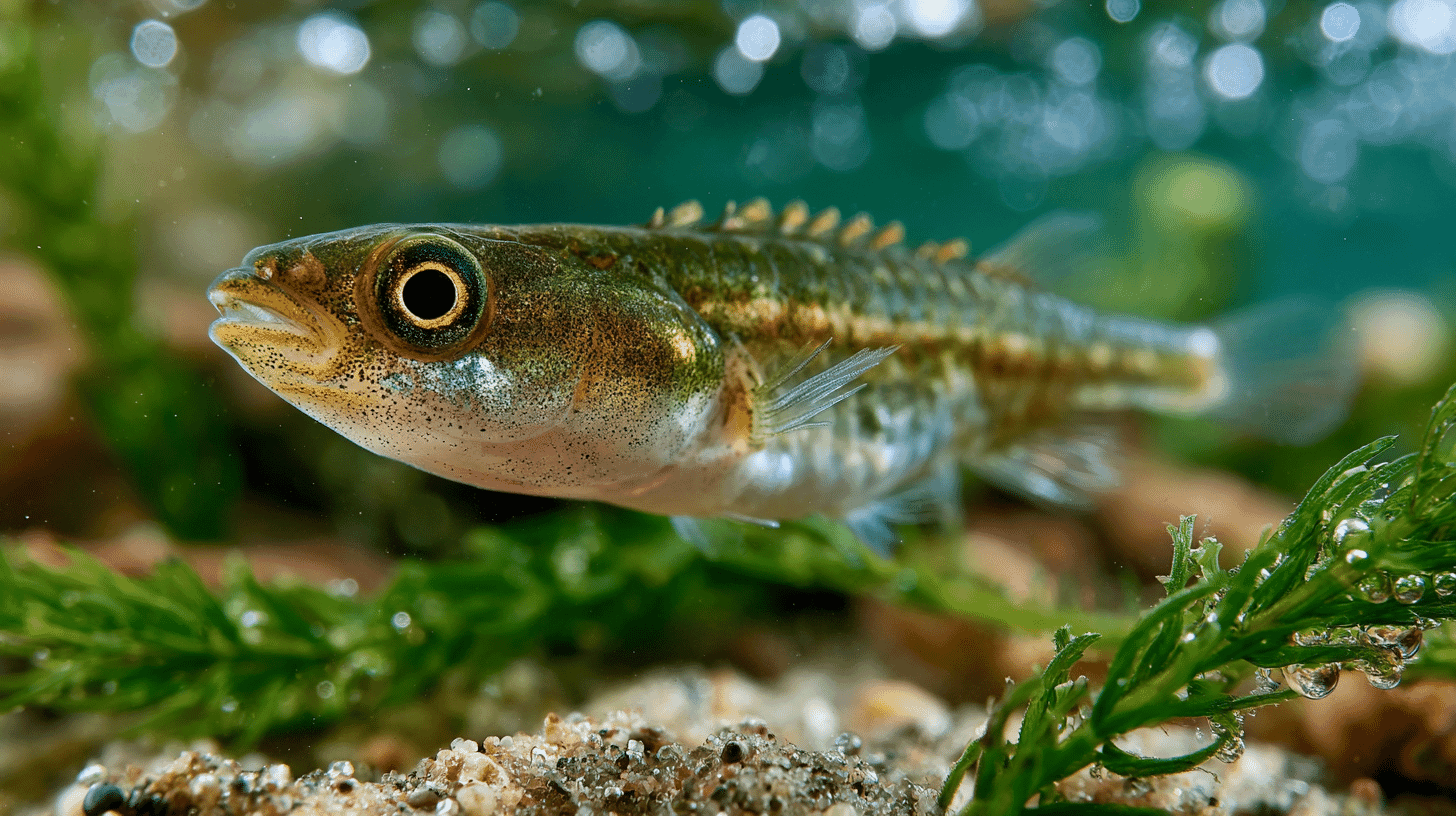
🐟 For more than sixty years, one of Japan's most cherished little fish officially did not exist.
It has an asteroid named after it. It's the official fish of an entire prefecture. It turns up in children's nature guides and even has a protected stretch of river all to itself. And yet, in the ledgers of international science, the Musashi stickleback was a ghost, a creature without a real name. This spring, that finally changed.
The fish that officially didn't exist
If you grew up in Saitama, just north of Tokyo, you probably know the Musashitomiyo. The thumb-sized fish is the prefecture's official symbol, the "city fish" of Kumagaya, and a local point of pride. There's even a main-belt asteroid, minor planet 10776 Musashitomiyo, circling the Sun in its honor. By any everyday measure, this is a famous fish.
So here's the strange part. Until a few weeks ago, scientists had no formal name for it. In the catalogues that taxonomists actually use, it was listed only as Pungitius sp., a placeholder that means, roughly, "a stickleback we haven't pinned down yet." A creature can be beloved, painted on manhole covers, and immortalized in the asteroid belt, and still, in the strict bookkeeping of biology, not count as a real species.
That's because in taxonomy, a species isn't truly "official" until someone formally describes it: gives it a Latin name, lays out exactly how it differs from its relatives, and publishes the whole case in a peer-reviewed journal under international naming rules. The Musashi stickleback had been waiting in that limbo since the 1960s.
Why a famous fish stayed nameless for 60 years
The hold-up wasn't neglect. It was that sticklebacks are genuinely hard.
The Musashi stickleback belongs to a group called the ninespine sticklebacks: small, spiny freshwater fish found in cold waters right across the Northern Hemisphere. The trouble is that the species in this group interbreed easily where their ranges overlap, blurring the lines between them. For decades, the entire genus was a taxonomic knot that researchers kept trying, and failing, to untangle. Was the Saitama fish a full species, a subspecies, or just a local quirk of a more widespread one? Nobody could prove it either way.
It took the slow accumulation of evidence, a comparison across the whole genus plus a close look at subtle differences in the fish's skeleton and body shape, before the answer became clear. The team behind the new study, ichthyologist Tatsuya Matsumoto of the Kagoshima University Museum and Keiichi Matsuura of the National Museum of Nature and Science, worked from specimens held at five institutions, including the National Museum of Nature and Science and the University Museum at the University of Tokyo, alongside living fish supplied by the Saitama Aquarium at Hanyu Suigo Park, and concluded the Musashi stickleback really is distinct from its cousins. The description was published in the journal Ichthyological Research on April 29, 2026, under a brand-new name: Pungitius nakamurai.
An ice-age survivor hiding near Tokyo
Part of what makes this fish so unusual is where it lives, which is to say, somewhere it has no business being.
Ninespine sticklebacks are northern, cold-water animals. Their relatives are scattered across Siberia, northern Europe, and North America, places you'd associate with snow, not the sweltering Kanto plain around Tokyo. The reason a population ended up this far south goes back to the last ice age. When the climate was colder, cold-loving fish ranged much farther down the archipelago. As Japan warmed over thousands of years, those fish retreated into the few places that stayed cool: streams fed by underground springs, where the water holds steady below 20°C even in midsummer and never freezes in winter.
The Musashi stickleback is one of the southernmost survivors of that retreat: a living relic of a colder Japan, marooned in a spring-fed creek a short train ride from one of the world's biggest cities. It needs clear, cold, plant-filled water, and it doesn't get a second chance if that water disappears.
How an accidental lifeline saved a species
For a while, the water very nearly did disappear.
The fish once ranged widely across the Kanto region, in scattered spring-fed waters that included sites around Tokyo. Then came Japan's postwar high-growth era, and one by one the springs that fed its habitats dried up. The Tokyo populations vanished. Today, the entire species clings to roughly two kilometers of the upper Motoarakawa River in Kumagaya, and even that survives only because of a quirk of history.
When the springs failed in the mid-twentieth century, the river's source was replaced by pumped groundwater, today around 7,000 tonnes a day. The facility that became the fish's protection center began life in the 1950s as a prefectural trout-farming station, and by some accounts the early effort to keep water flowing drew skepticism: why pump groundwater just to sustain a small stream? Yet without that artificial lifeline, the Musashi stickleback would almost certainly have vanished from the planet decades ago. A species ended up surviving on a water supply it was never the point of.
That reprieve is fragile. The Musashi stickleback is listed as Critically Endangered on Japan's national Red List, the highest risk category. Local volunteers, a citizens' group in Kumagaya that has been at it for around three decades, clear weeds, patrol the banks, and have bred tens of thousands of fish over the years. Even so, the numbers are jittery: official surveys counted roughly 15,700 fish in 2005, but only around 2,345 a decade later. The river runs through a residential neighborhood, and keeping a relic of the ice age alive between people's backyards is a daily effort.
A name that closes a 60-year circle
There's a quiet grace note in the new name. Pungitius nakamurai honors the late Morizumi Nakamura of the National Museum of Nature and Science, the ichthyologist who first reported this fish back in 1963. The scientist who first noticed it never got to see it formally recognized; now, more than sixty years on, the species carries his name. The circle closes across a generation.
And the fish itself is worth the wait. Like its relatives, the male Musashi stickleback is a remarkably devoted father. In spring he gathers scraps of water plants and glues them together with a secretion from his own body, building a round nest about the size of a golf ball, bird-like, tucked into the base of a reed. He courts passing females with a zigzag dance, coaxes them to lay eggs inside, then guards the nest and fans fresh water over the eggs until the young hatch and swim off on their own.
Getting a formal name is more than a bookkeeping fix. A described species is far easier to enroll in conservation laws and protection programs than a nameless "Pungitius sp." For a fish down to its last couple of kilometers of river, official existence could be the difference that keeps it around.
In Japan, a fish that everyone already loved spent six decades waiting for science to admit it was real. It makes you wonder what's living quietly near you: overlooked, half-known, or only now being recognized for what it truly is. Does your country have a creature like that, hiding in plain sight?








Global Discussion
3 comments