
🦠 As far as its genes show, it makes no food and no energy of its own. It has 189 protein-coding genes, and almost every one whose job can be identified serves a single purpose: copying its DNA and reading it back into proteins. A Japanese-led team has now formally described this microbe, Candidatus Sukunaarchaeum mirabile, in Current Biology. Its genome is the smallest ever found in an archaeon. The cell itself has never been seen.
When a preprint appeared in May 2025, the microbe went around the world as something on the border between cells and viruses. The abstract of the peer-reviewed paper, published on October 9, 2026, does not mention viruses and places it somewhere else.
What 189 genes are for
The genome runs to about 238,000 base pairs, under half the length of the previous archaeal record. For scale, the team's press release notes that humans carry about 20,000 protein-coding genes. This organism has 189.
Archaea are the third great branch of life, alongside bacteria and eukaryotes (plants, animals, fungi). Under a microscope they look like bacteria, but the machinery they use to copy and read their genes is closer to ours.
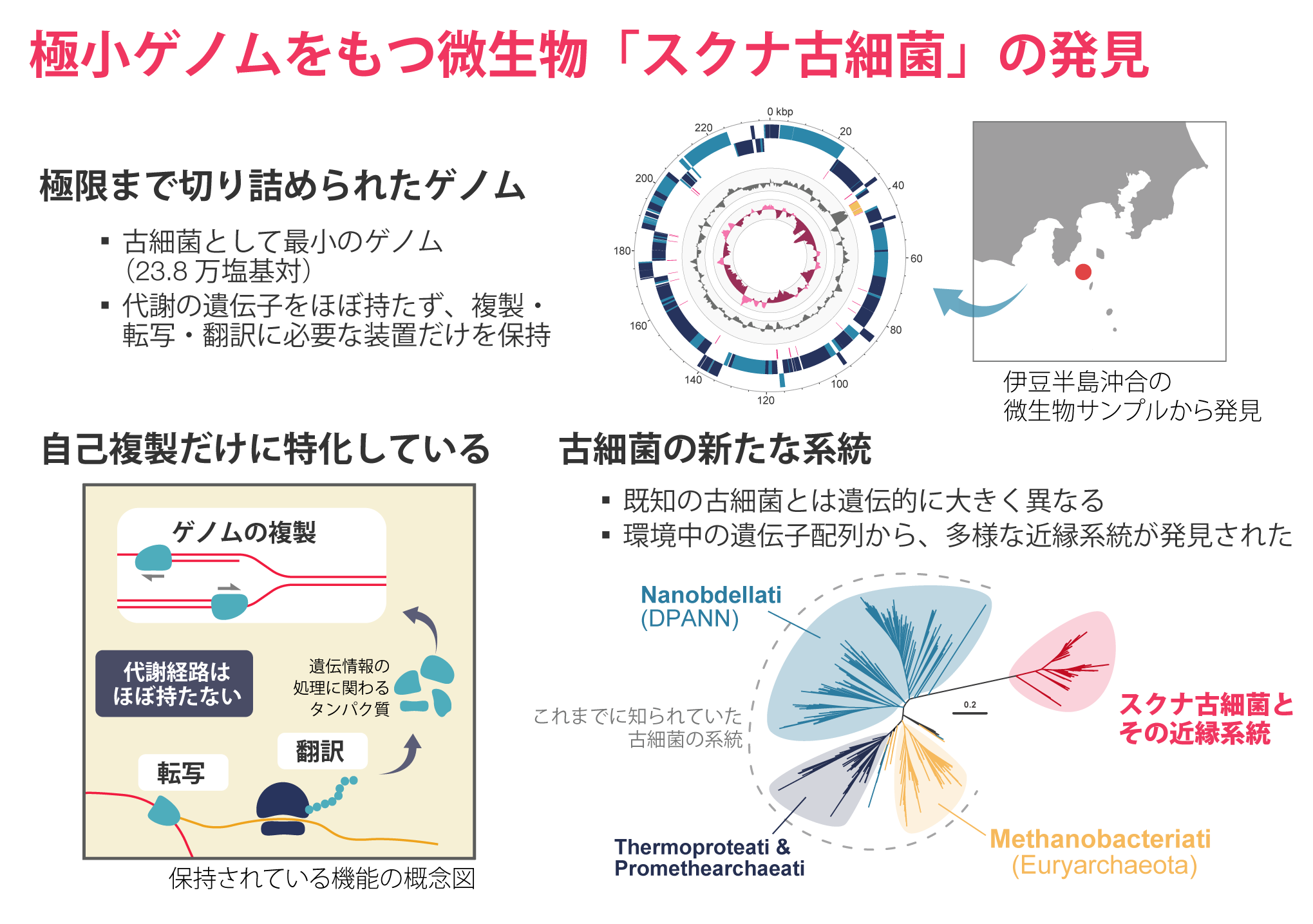
Source: University of Tsukuba and partners, joint press release (October 9, 2026)
It lacks virtually every recognizable metabolic pathway. What remains is the machinery that copies DNA, transcribes it into RNA, and translates that RNA into protein on ribosomes.
According to the 2025 preprint, only five proteins fall outside that core. Four are parts of transporters, which move material in and out of a cell. The fifth resembles an enzyme, but its function is unclear. Another 57 proteins have no known function at all. The published abstract adds that about a quarter of the genome codes for giant membrane proteins whose job is unknown.
A tiny god and a lucky find
According to the full Japanese press release, the team named it after Sukuna-biko-na, a famously tiny deity in Japanese mythology, because the genome is so small. The species name, mirabile, is Latin for "marvelous."
The organism turned up by accident. The team, led by Takuro Nakayama of the University of Tsukuba's Center for Computational Sciences, was sequencing the DNA inside single plankton cells collected off Shimoda, at the southern tip of the Izu Peninsula in Shizuoka Prefecture. According to the preprint, one cell of the dinoflagellate Citharistes regius, a single-celled marine alga, held a small circle of DNA that matched nothing known. Different sequencing methods and assembly programs rebuilt the same closed circle, which persuaded the team it was a complete genome.
That does not make the alga its host. The University of Nottingham, whose researchers co-authored the study, states that the team has neither observed the organism directly nor identified its host.
The only hints about the cell are indirect. In the global Tara Oceans plankton dataset, related sequences turned up most often in the 5 to 20 micrometer size fraction. A typical archaeon is about 1 micrometer across, so the preprint reads this as a sign that these microbes rarely float free and stay close to larger cells. But C. regius is about 40 to 50 micrometers long, bigger than that range, and the preprint cites the mismatch as one reason the host is hard to pin down. As of October 2026, the team plans to identify the host and observe the cell directly.
"Smallest" needs a qualifier
The University of Nottingham's English release opens by calling it "the smallest genome ever found." Its own later text, and the paper, say only that it is under half the length of the previous archaeal record.
Smaller genomes already exist. In 2006, a team led by Japan's RIKEN institute reported in Science that Carsonella ruddii, a bacterium living inside sap-feeding insects called psyllids, has a genome of just 159,662 base pairs. At the time, it was the smallest bacterial genome yet described.
The two kept different things. Insect endosymbionts like Carsonella tend to hold on to the genes that make nutrients for their hosts. Meanwhile they lose parts of the machinery for copying and expressing their own genes, and the host is thought to cover the gap. The 2006 authors likewise found Carsonella missing many genes thought essential for life and argued it had moved toward organelle-like status.
Sukunaarchaeum did the reverse. It threw away nearly everything a host could use and kept the machinery for copying and expressing its own genes. The Japanese press release calls this a different evolutionary path from that of insect symbionts.
The previous archaeal record holder, Nanoarchaeum equitans, described in 2003, has a genome of 490,885 base pairs and depends on another archaeon, Ignicoccus, to live. According to the preprint, it keeps a little more metabolism than Sukunaarchaeum.
From "between a cell and a virus" to a second endpoint
The preprint appeared on bioRxiv on May 2, 2025. Its abstract said the organism blurs the working boundary between the simplest cells and viruses. The idea spread, and on August 19, 2025, the science magazine Nautilus described it as suspended somewhere between archaea and viruses.
In November 2025, Quanta Magazine noted that some coverage had even suggested the microbe was evolving into a virus. Nakayama pushed back in that interview: "There is a fundamental gap between Sukunaarchaeum and viruses." Sukunaarchaeum has its own ribosomes. Viruses have none and can only multiply by using the host's.
The published abstract in Current Biology does not mention viruses at all. Instead, it sets Sukunaarchaeum against mutualistic endosymbionts like Carsonella and describes a "second, distinct endpoint" of cellular reduction. At one endpoint sits the symbiont that keeps feeding its host and loses its independence. At the other sits a cell that keeps its independence and gives its host, as far as anyone can tell, nothing. The abstract suggests this informational core may mark a practical floor: the least a cell can keep and still copy and express its own genome.
In the Nottingham release, co-author Thorsten Allers said: "The key to defining life is whether something can replicate itself." By that test, Sukunaarchaeum passes.
What is still unknown
The host is unconfirmed. Those giant membrane proteins resemble host-invasion proteins in parasitic archaea, so the team suspects a parasite.
Even "almost no metabolism" carries an asterisk. Puri López-García, a microbial ecologist at France's CNRS who was not involved, told Quanta Magazine there is a slim chance that some of the unidentified genes are metabolic genes changed beyond recognition.
The family tree is unresolved as well. The published abstract says the organism cannot be placed in any recognized archaeal phylum, and its exact branching point remains open. In the preprint, two analysis methods placed it next to two different groups, both with weak support.
It probably has plenty of relatives, though. Ocean sequence data hold many related sequences, pointing to a whole overlooked group of these microbes. Sukunaarchaeum may simply be the first one anyone happened to find.
What is the least something needs to count as alive? The ability to copy itself, a metabolism, or something else? Where would you draw the line?
References
- https://www.ccs.tsukuba.ac.jp/release261009/
- https://www.tsukuba.ac.jp/journal/pdf/p20261010000000.pdf
- https://doi.org/10.1016/j.cub.2026.09.042
- https://doi.org/10.1101/2025.05.02.651781
- https://www.eurekalert.org/news-releases/1146958
- https://nautil.us/a-rogue-new-life-form-1232095
- https://www.quantamagazine.org/a-cell-so-minimal-that-it-challenges-definitions-of-life-20251124/
- https://www.riken.jp/medialibrary/riken/pr/press/2006/20061013_1/20061013_1.pdf
- https://www.ncbi.nlm.nih.gov/pmc/articles/PMC240731/







Global Discussion
4 comments