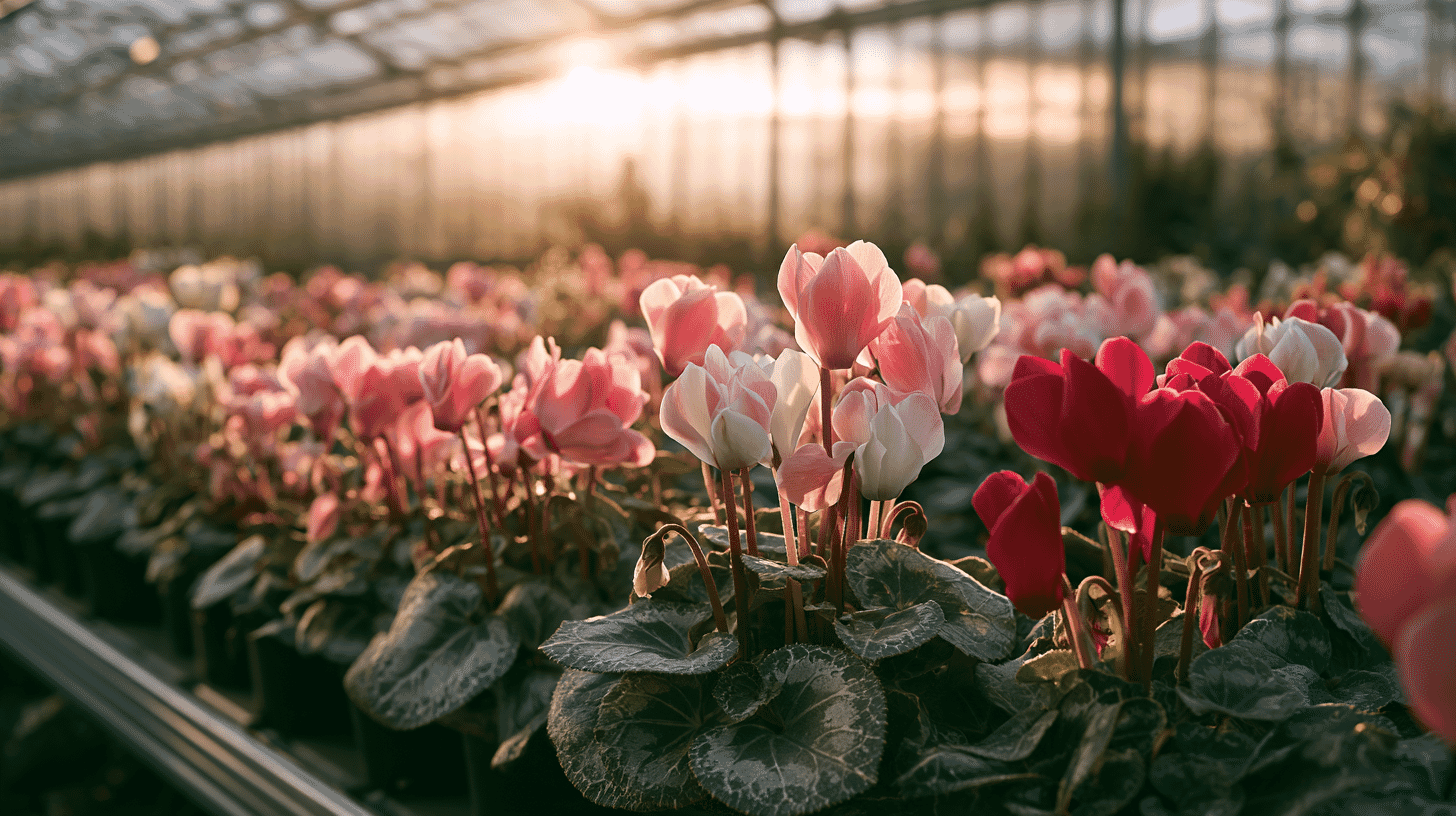
🌸 In 1975, a ballad called Shikuramen no Kahori ("The Scent of Cyclamen") won the grand prize at the Japan Record Awards. The cyclamen sold in shops back then had only a faint smell. Japanese researchers have now read the plant's genome: about 1.48 billion base pairs, 83% of them repeats. The genes they now hope to pin down include the ones behind scent.
Why 83% repeats made this genome hard to read
On October 13, 2026, a team from Saitama Institute of Technology, the Kazusa DNA Research Institute, Kyushu University and Kagawa University published the genome of Cyclamen persicum in the journal DNA Research. This wild species is the ancestor of the potted cyclamen sold today, and the team says this is the first high-quality genome of it.
Reading a genome is a bit like rebuilding a shredded book. Machines read short stretches of DNA, and software stitches them back together where they overlap. That breaks down when the same passage appears over and over, because a scrap of repeated text could belong almost anywhere. In the cyclamen, 82.9% of the assembly turned out to be repeats. One family alone, the LTR retrotransposons, stretches of "jumping DNA" that copy and paste themselves, makes up 42.1% of the genome.
Breeding history added another layer. Garden cyclamen are a mix of diploids, with two sets of chromosomes, and tetraploids, with four. The tetraploids common among older varieties have tangled genomes, which is why a reference genome kept getting put off. So the team chose a diploid C. persicum, a plant from Kagawa University's collection according to the Mainichi Shimbun, and used high-fidelity (HiFi) long-read sequencing, which reads stretches long enough to span many repeats at once.
The result is 1.48 billion base pairs in 126 pieces, scored 98.1% complete on a standard benchmark. Eight of those pieces carry telomeres, the protective caps at chromosome tips, at both ends, which suggests they are close to whole chromosomes. C. persicum has 48 chromosomes in each cell, in sets of 24, so the map is not finished end to end. The team counted 40,223 protein-coding genes.
The "Persian" flower that doesn't grow in Iran
The species name holds a small puzzle. Persicum is Latin for "Persian," and the plant was named in 1768 by the botanist Philip Miller. Yet according to the Royal Botanic Gardens, Kew, it grows wild from Algeria to the eastern Mediterranean: Tunisia, Cyprus, the East Aegean islands, Greece, Crete, Lebanon and Syria, Palestine and Turkey. Iran is not on the list.
According to a 2018 study, of the 23 species in the genus, C. persicum is the only one that breeders have worked on intensively. Nearly every cyclamen in a florist's window descends from it.
Putting the scent back took 21 years
Cyclamen were bred for color and shape, not smell. A 2018 review by Hiroshi Ishizaka of Saitama Prefecture's agricultural research center notes that most cultivars give off a weak woody or powdery odor, and that scent was never treated as a breeding goal. The Mainichi Shimbun is blunter: when the 1975 song was a hit, the cultivars of the day had a weak smell that was even compared to dust. Wild C. persicum can be fragrant, a separate 2018 study points out, but few cultivars are.
The answer lay in another species. Cyclamen purpurascens, a small wild cyclamen, is the most fragrant in the genus according to Ishizaka's review, with a sweet scent like rose, hyacinth or lily of the valley. The catch is that the two species barely cross. C. persicum has 48 chromosomes and C. purpurascens has 34, and ordinary pollination almost never works. Researchers had to rescue the developing embryos and raise them in culture. The hybrids that survived carried 41 chromosomes and were completely sterile, because the two sets could not pair up. Doubling them to 82 gave every chromosome a partner, and the plants became fertile again.
Saitama Prefecture's timeline gives the dates. Crossing began in 1987. By 1996 there were two scented lines that could be grown from seed. The first varieties, Uruwashi-no-Kaori and Kokou-no-Kaori, were registered in 2008, 21 years after the first cross. Kaori-no-Mai followed in 2010, then Tennyo-no-Mai in 2016 and Miyabi-no-Mai in 2017. Those last two came from ion-beam irradiation, which shook loose new flower colors. The prefecture describes the scent as something like rose and hyacinth combined.
According to the Mainichi Shimbun, Yusuke Akita, the professor who started the genome collaboration, had earlier worked on using radiation to change cyclamen flower color without losing the scent.
What the genome is for: double flowers, ruffles and scent
According to the press release, a reference genome makes it easier to pin down the genes behind double flowers, ruffled petal edges, color, scent and the growth of the tuber where the plant stores its energy. Results from earlier studies, scattered until now, can be laid onto one shared map. The stated goal is to get past the limits of trial-and-error crossing and breed more attractive, tougher cyclamen efficiently.
For basic science, the team compared cyclamen with five other flowering plants and found 430 gene families that turned up only in cyclamen and 363 that it shared only with a primrose relative, Primula kwangtungensis. Cyclamen and primroses belong to the same plant family yet look nothing alike. Akita told the Mainichi that new varieties are the easier payoff to explain, but that, as a scientist, he finds this evolutionary question more interesting.
A genome will not hand anyone a scent gene. Until now, though, Akita told the Mainichi, finding a cyclamen gene meant borrowing data from related plants and checking candidates one at a time, slow work done largely by feel. Breeders now have a map of the plant itself to search.
Japan ships 12.1 million pots a year, and the heat is cutting in
Agriculture ministry figures for the 2025 crop show 12.1 million pots of cyclamen shipped from 142 hectares, about 8% of Japan's 155 million potted plants. Shipments fell by 1.4 million pots, or 10%, from the previous year. The ministry puts it down to a smaller growing area plus poor growth in the summer heat. Aichi supplies the largest share at 12%, followed by Nagano at 11%, Gunma and Chiba at 7% each and Fukushima at 6%.
The flower that waited 21 years for its scent may get its next trait sooner. Where you live, do the cyclamen in shops smell of anything, and would you choose one that did?
References
- https://www.sit.ac.jp/news/261013_hana/
- https://www.sit.ac.jp/media/202610135.pdf
- https://www.kazusa.or.jp/news/261013/
- https://doi.org/10.1093/dnares/dsag015
- https://www.jstage.jst.go.jp/article/jsbbs/68/1/68_17117/_article
- https://hortsci.agriculturejournals.cz/artkey/hor-201804-0004_interspecific-variation-of-scent-characteristics-in-the-cyclamen-genus-and-the-utility-of-the-variation.php
- https://www.pref.saitama.lg.jp/a0904/hokosikuramen/index.html
- https://www.maff.go.jp/j/tokei/kouhyou/sakumotu/sakkyou_kaki/pdf/sakutuke_kaki_25.pdf
- https://powo.science.kew.org/taxon/urn:lsid:ipni.org:names:700765-1
- https://news.yahoo.co.jp/articles/d91f944fb15c7c24dde4a66843aeade9d479f062
- https://www.daily.co.jp/gossip/record/recotai.shtml








Global Discussion
4 comments