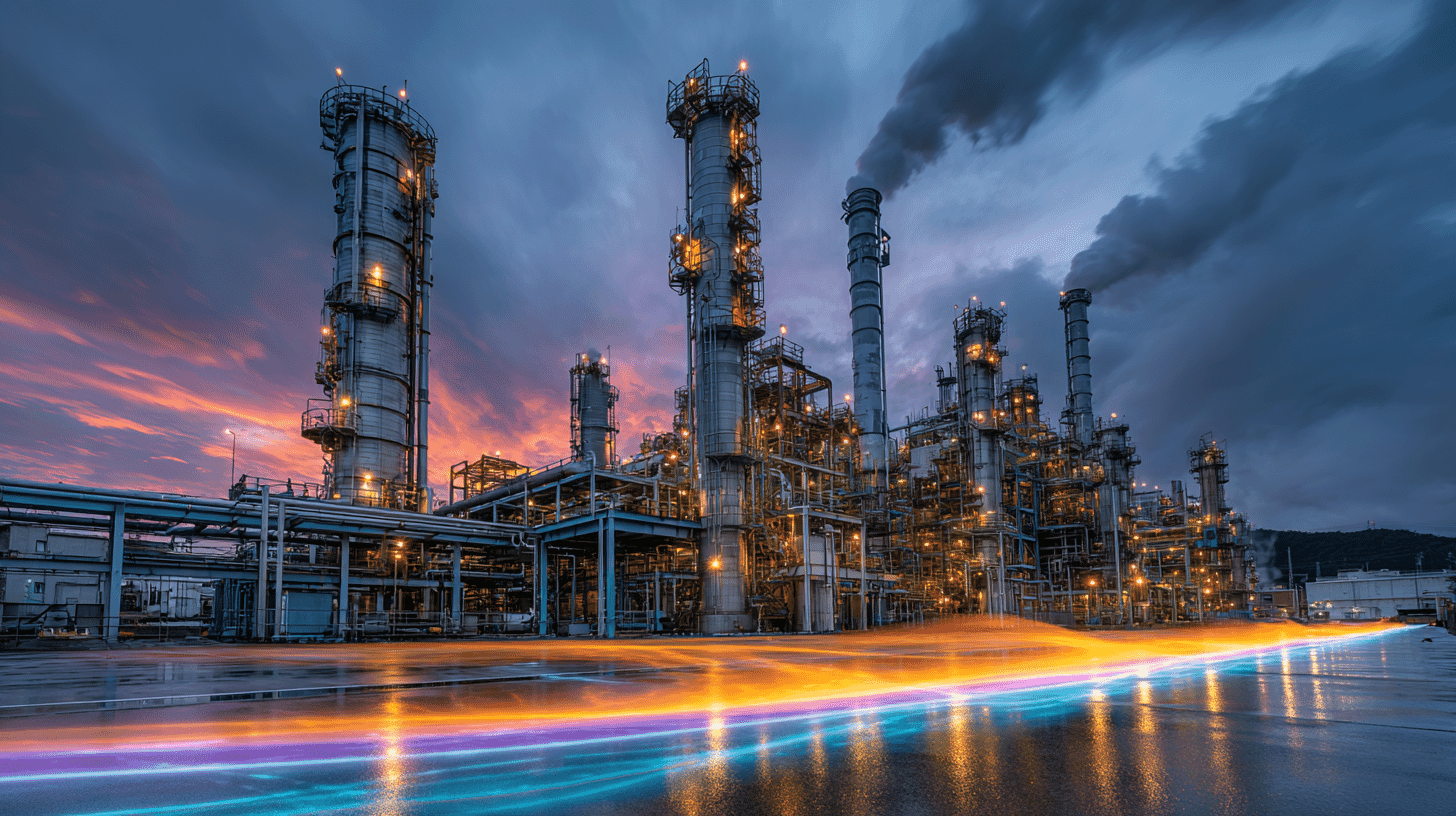
By 2030, the plastic in your trash bag could account for 100% of the feedstock behind a major ammonia plant. Japan's chemical major Resonac (formerly Showa Denko) is dropping natural gas reforming entirely at its Kawasaki works and switching its 120,000-ton-per-year ammonia operation to hydrogen derived solely from waste plastic. The site is the world's only gasification chemical recycling plant with more than two decades of continuous commercial operation.
What was announced: zeroing out the natural-gas hydrogen
On October 6, 2025, Japanese chemical major Resonac (formerly Showa Denko) announced its decision to develop and introduce a new process that switches the feedstock for its ammonia business at the Kawasaki Works (Kanagawa Prefecture) to hydrogen derived solely from waste plastic. The new equipment is scheduled to begin operation in April 2030.
Currently, ammonia production at Kawasaki uses two parallel hydrogen streams. One comes from gasification of post-consumer plastic collected from households and companies (the "KPR-derived" hydrogen). The other comes from reforming city gas, that is, methane. Today the split runs at roughly 60-70% plastic-derived hydrogen to 30-40% gas-derived. When the plant started up in 2003 the plastic share was below half; process optimisation pushed it up over two decades.
Today's announcement zeroes out the latter, fossil-derived hydrogen, and replaces it entirely with plastic-derived hydrogen. This is why Resonac frames the move as "decarbonizing Japan's domestic ammonia production."
What KPR is: the last gasification chemical recycler standing
The site at the heart of this story is the Kawasaki Plastic Recycling (KPR) plant, located in the industrial belt along Tokyo Bay in Kawasaki City. The then-Showa Denko brought it online in 2003, and it has been running for more than 20 years. Here is the striking fact that industry insiders rarely highlight outside Japan: across the entire world, KPR is the only gasification chemical recycling plant that has sustained long-term commercial operation. Many companies have attempted similar approaches, but the technical and economic hurdles have proven so steep that almost none have made it to commercial scale.
The mechanism is straightforward in concept. Container-and-packaging plastic collected by Japanese municipalities, and industrial plastic waste from companies, is first compacted into cylindrical pellets, then broken down at the molecular level in a two-stage gasification furnace (low-temperature followed by high-temperature). The output is a synthesis gas of hydrogen and carbon dioxide. After cleaning, the hydrogen feeds ammonia production while the CO2 is captured and sent to a Resonac group company, Resonac Gas Products, where it becomes dry ice and the liquefied carbonic acid gas used in carbonated drinks.
A key strength of KPR is that it can handle chlorine-containing plastics like PVC, mixed plastics that are too contaminated for mechanical recycling, and even seawater-fouled marine plastic debris. Few other recycling pathways can swallow that range of feedstock.
KPR by the numbers: 70,000 tons of waste plastic, 120,000 tons of ammonia
The plant processes about 200 tons of waste plastic per day, or roughly 70,000 tons per year, producing approximately 120,000 tons of ammonia annually. In January 2022, cumulative throughput passed 1 million tons.
About 30% of the resulting ammonia stays inside Resonac to make acrylonitrile (an acrylic-fiber feedstock); the remaining 70% is sold externally. The single largest external customer, rarely mentioned in the energy-transition conversation, is the electric power industry. Thermal power plants use ammonia in their selective catalytic reduction (SCR) systems to scrub nitrogen oxides (NOx) from flue gas. Plastic-derived ammonia has therefore been quietly cutting air pollutants from fossil generation for years.
On environmental performance, a third-party body (the Japan LCA Promotion Organization) has verified that this ammonia delivers more than 80% lower CO2 emissions than ammonia made from fossil feedstock. In 2023, three KPR-derived products (hydrogen, ammonia, and acrylonitrile) earned ISCC PLUS certification, the international sustainability standard, a first in Japan for products made from post-consumer plastic.
A "plastic circular" model alongside Japan's "urban mining"
Japan's "urban mining" concept, recovering gold and rare metals from used electronics, has gained international recognition. The Resonac initiative is best understood as the chemical-domain counterpart: just as electronic devices contain dormant precious metals, the plastic in your trash bag contains dormant hydrogen. Pulling that hydrogen out and feeding it back into the chemical industry is what plastic circularity actually means in practice.
Globally, the plastic recycling rate sits at roughly 9%. Japan reports an "effective utilisation" rate close to 90%, but around 60% of that is thermal recovery, incineration with energy recapture, which European standards do not count as recycling. Strip that out and material plus chemical recycling comes to about 25%. Gasification chemical recycling like KPR's, which breaks the polymer down to molecules and rebuilds it into feedstock, sits on the material side of that line, which is why it has drawn international attention. In 2023, a 43-person delegation from 14 IPEF (Indo-Pacific Economic Framework) member countries toured the KPR plant.
April 2030, and Japan's first "price-gap support" award
The April 2030 startup target reflects the lead time needed to design, build, and commission the new process. A second key piece also fell into place. On September 30, 2025, the project became the first in Japan to be certified for the "Price-Gap-Focused Support" scheme ("Kakaku-sa Shien") run by METI (the Ministry of Economy, Trade and Industry) under the country's hydrogen society promotion law.
Price-gap support compensates suppliers of low-carbon hydrogen and ammonia for the cost gap between their products and conventional fossil-fuel-derived alternatives. Because low-carbon products inevitably cost more to produce, they struggle on price in commodity markets; the scheme has the government bridge that gap for a fixed period to push the transition forward. A noteworthy feature of this particular award: Resonac applied jointly with the buyer, Nippon Shokubai, a chemical maker that uses the ammonia downstream. The buyer is on the hook to keep purchasing the volume; the seller is on the hook to keep producing it.
Separately, since 2024, the Kawasaki site has been running pilot trials that add end-of-life clothing (in partnership with Itochu) to the plastic feedstock. The vision: produce acrylonitrile from used clothes and ship it back to fiber makers, closing a "fiber-to-fiber" loop.
International comparison: EU CCfD, US IRA 45V, and Japan
Policy support for low-carbon hydrogen and ammonia has become a global competitive arena. Here is how the major schemes stack up.
Europe: CCfD (Carbon Contracts for Difference)
Germany leads. A pilot round in October 2024 produced contracts worth up to €2.8 billion with 15 companies. The second round, run under the renamed "CO2 Contracts for Difference" banner, offers up to €5 billion (around $5.3 billion) in 15-year contracts, with carbon capture and hydrogen technologies added to the eligible list alongside steel, cement, and chemicals. The producer locks in a "strike price" per ton of CO2 abated, and the government pays the difference between that strike price and the actual EU ETS carbon market price. When the carbon market price is lower than expected, government support is larger; when it exceeds the strike price, the producer pays back. The state effectively absorbs long-term carbon-price risk.
United States: IRA Section 45V Clean Hydrogen Production Tax Credit
Enacted in 2022, with final regulations published in January 2025. The credit pays up to $3.00 per kilogram of clean hydrogen for ten years, on a four-tier sliding scale tied to lifecycle GHG emissions. To win the full credit, the production process must emit no more than 0.45 kg of CO2-equivalent per kg of hydrogen. That uncertainty has since been resolved, and not in the industry's favour: the reconciliation law signed in July 2025, known as the One Big Beautiful Bill Act, cut off eligibility for facilities that begin construction on or after January 1, 2028, pulling the deadline forward five years from 2033 and compressing developers' decision windows.
Japan: Price-Gap Support (a CCfD-style scheme)
The Japanese scheme that just certified Resonac compensates the price gap between low-carbon hydrogen / ammonia and conventional fuels. Conceptually it sits close to the European CCfD. Two distinguishing features: it requires a joint application from supplier and buyer, and its eligible product list is narrowly drawn (low-carbon hydrogen, ammonia, synthetic fuels, synthetic methane).
Pulling the three together: Japan's scheme is bilateral and project-specific, with long-term commitments tied to named producers and named buyers. The US approach is a universal tax credit, where anyone meeting the criteria gets paid. Europe runs a carbon-market-linked hybrid, where subsidy size moves with the ETS price. Each model has trade-offs.
Why nobody else has done it, and what still limits it
The fact that KPR is the only long-running commercial gasification recycling plant in the world raises an obvious question: why hasn't anyone else followed? According to people involved with the plant, the early years were brutal. The high-temperature gasifier would shut down every two to four weeks. Stray metals and lithium-ion batteries that slipped through plastic sorting caused fires and equipment failures. Twenty years of accumulated operational know-how is now the moat, and it is not one competitors can replicate quickly.
There are real limits, too. Japan generated 7.69 million tons of plastic waste in 2023, according to the Plastic Waste Management Institute. KPR's 70,000-ton processing capacity is a sliver of that. Even after the 100% switch, the plant's ammonia output covers only a few percent of Japan's domestic ammonia demand. Scaling the model is essential if circular processing is to make a meaningful dent. Resonac has begun licensing the technology overseas as of 2024.
There is also a critique from international environmental NGOs: turning plastic waste into a fuel that is then burned (when ammonia is co-fired in coal power plants) does not really close the loop, because combustion still releases CO2. From that viewpoint, looping the ammonia back into chemicals (acrylonitrile) is closer to true circularity than burning it for power.
The definition of "garbage" is shifting
What the announcement really poses is a question about how a society sees plastic: is post-consumer plastic garbage to be incinerated, or feedstock for chemicals? KPR has run for two decades on the back of a household sorting habit that most countries do not have. Sorting culture and advanced chemistry have to arrive together, which is what makes the model hard to export wholesale.
So how is your country approaching the same question? Is the used plastic from your home or office incinerated and landfilled, or is it being turned back into chemicals and energy?
References
- https://www.resonac.com/jp/news/2025/10/06/3631.html
- https://www.shokubai.co.jp/ja/news/2025100623151/
- https://www.resonac.com/jp/sustainability/environment/lca.html
- https://monoist.itmedia.co.jp/mn/articles/2402/07/news030.html
- https://sgforum.impress.co.jp/article/5630
- https://igaspedia.com/2025/10/07/resonac-kpr-support-focusing-on-the-price-gap/
- https://chemicaldaily.com/archives/476512
- https://home.treasury.gov/news/press-releases/jy2768
- https://www.iea.org/policies/17538-carbon-contracts-for-difference-ccfd-program-for-energy-intensive-industries





Global Discussion
15 comments