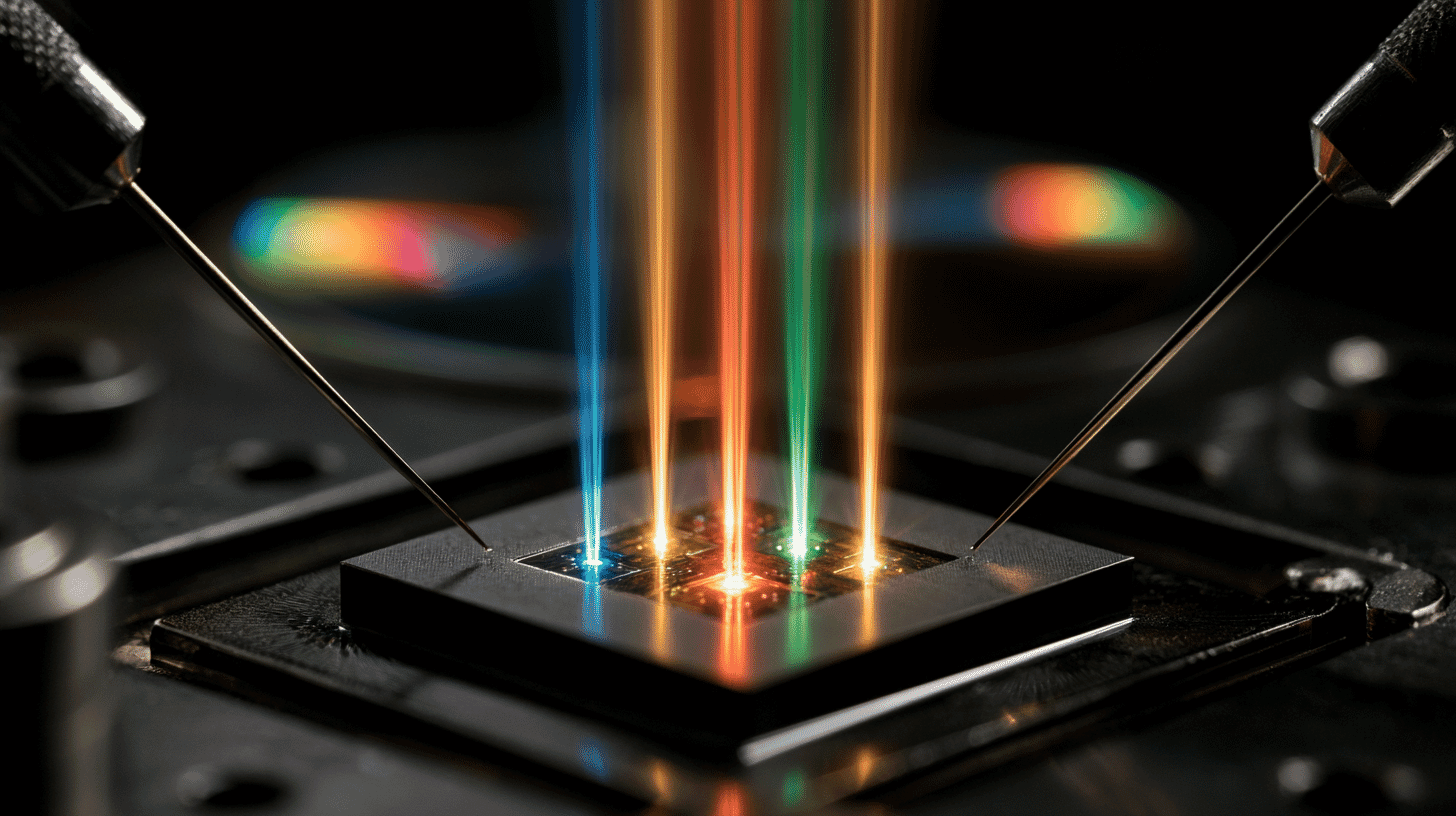
💡 Semiconductor LEDs come with two rules everyone has learned to work around. One emitting layer gives you one color. And when you push more current through it, that color drifts. Researchers at the University of Osaka and Ritsumeikan University have now built a single material that bends both rules at once: blue, green, yellow and red, out of the same layer, from the same spot.
The result was announced on July 22, 2026. The paper appeared in the American journal Applied Physics Letters, where the editors flagged it as an Editor's Pick.
Turn up the current, and the color drifts
If you have followed micro LED displays at all, you know the pitch. Tiny inorganic LEDs, one per pixel, each generating its own light. They are bright, efficient and high-resolution. The hard part has always been manufacturing.
The piece of that hard part which gets least attention is color stability. Green and red LEDs built from indium gallium nitride (InGaN), the mainstream today, change color as the current goes up. Since a display sets brightness by changing how hard each pixel is driven, a wavelength that moves with drive level means the color depends on how bright the pixel happens to be. Not unsolvable, but working around it should cost you compensation in the driver and calibration on the line.
The Osaka and Ritsumeikan device does not behave that way. When the researchers swept the current and recorded spectra, the peaks failed to move by even 0.6 nanometers, the smallest shift their instrument could resolve. The current densities ran from 0.64 to 3.8 A/cm².
Millions of chips, placed one at a time
The second rule is the structural one. A conventional semiconductor LED emits one color per emitting layer, so building a full-color display has meant stacking several layers or laying separate red, green and blue chips side by side. The industry's older method for the latter is pick-and-place: individual chips positioned onto the substrate one after another. Since red, green and blue together make one pixel, the chip count runs to three times the pixel count. Even a small microdisplay gets into the millions.
Monolithic integration, which means growing and patterning red, green and blue on one substrate in a single flow, is the way out everyone is chasing. This work is a different door into it.
A detour through the rare earths
The team's route runs through rare earth elements. In a rare-earth-doped semiconductor, the light does not come from the host material's band gap at all. It comes from electrons moving between levels inside the dopant ion itself.
For the triply charged terbium ion, those are transitions within the 4f shell, which sits inside the atom and is shielded by the outer electrons. The practical consequence is that the emission wavelength barely cares what the surroundings are doing. Think of a windowless room: the color of the lamp inside does not change with the weather outside. Terbium is also unusual in emitting four colors at once, at roughly 490 nm blue, 550 nm green, 580 nm yellow and 620 nm red.
This idea is not new. Yasufumi Fujiwara, the Ritsumeikan professor who collaborated on the work, has been building this field since the early 1980s and named it semiconductor intracenter photonics. His group develops GaN red LEDs that run on the 4f-shell transitions of europium, and in March 2026 he received the Japan Society of Applied Physics award named after Isamu Akasaki, the blue LED researcher who shared the 2014 Nobel Prize in Physics. He is also CTO of IntraPhoton, a Ritsumeikan spinout founded in 2025 in Kusatsu, Shiga, which is commercializing that europium work.
So the terbium result sits on top of a minority position one lab has argued for more than forty years. What is new is four colors at once, from one layer.
The more aluminum, the brighter it gets
The engineering core of the paper is not the terbium. It is the host.
The team grew terbium into aluminum gallium nitride (AlGaN) using MOVPE, the growth method nitride LED manufacturing already relies on. Then they found that raising the aluminum fraction, to values like 62% or 68%, moves energy to the terbium ions more efficiently and pushes the external quantum efficiency up, by as much as 10.3 times against the lowest-aluminum device in the study. Two supporting findings came with it: growing on an aluminum nitride base layer reduces the lattice mismatch with the substrate and improves crystal quality, and the crystal around each terbium atom carries compressive strain that shifts the terbium into a state which radiates more readily.
The 10.3 figure is a device-to-device ratio; absolute efficiency numbers have not been published. The 62% and 68% values are examples, not an optimum or a threshold. And nowhere does the release call this a world first. The language is about a new kind of visible-light LED and a new route worth taking.
The commercial argument that matters is the growth method. MOVPE is already running in nitride LED production lines.
Pulling RGB out of one spot with a filter
Four colors from one place is only useful for a display if you can separate them again. The team passed the output through color filters and pulled red, green and blue selectively out of the same emitting region.
That is a real demonstration and also a partial one. A color filter separates by discarding the light it does not pass, so this route spends efficiency on color separation. The bigger issue is ratio. Right now the four colors come out together, in whatever proportion the physics gives you, and driving a pixel means setting that proportion deliberately, one color at a time. The release points at optical resonators added after growth as the eventual answer, which as of July 2026 is a stated direction rather than a demonstrated method.
What is still missing
Efficiency, ratio control, and everything between a lab device and a production line. Associate professor Shuhei Ichikawa of Osaka University's Graduate School of Engineering, who led the work, says what he wants next is to "improve the efficiency and control the intensity of each color." The university also names new white-light sources as a target, alongside compact panels for smart glasses and wearables.
Meanwhile the rest of the field is not waiting. TrendForce puts serious commercialization of full-color LEDoS displays in the 2027 to 2028 window. Sweden's Polar Light Technologies has worked on monolithic full color since 2014, using an InGaN pyramidal structure, and is aiming at products by 2028. France's CEA-Leti has reported perovskite color conversion layers that can be made thinner than quantum dot equivalents. Neither route uses rare earths. IntraPhoton claims its europium red LED holds a linewidth under 1 nm and temperature stability of 0.001 nm per kelvin, against wavelength spread of 10 to 20 nm and current-driven shift for InGaN red. Those are the company's own figures, so read them as a position in an argument.
Everyone else is asking how to put three colors next to each other well enough. What terbium brings is a different question: whether you need three colors at all.
The device all of this is aimed at is a pair of glasses you would wear down the street, light enough that nobody notices. Japan's contribution to that came out of a lab that spent more than forty years on an unfashionable idea. Where is the equivalent work happening where you live?
References
- https://www.ritsumei.ac.jp/file.jsp?id=700266&f=.pdf
- https://www.asiaresearchnews.com/content/one-led-four-stable-colors
- https://optronics-media.com/news/20260723/111113/
- https://eetimes.itmedia.co.jp/ee/articles/2607/27/news026.html
- https://doi.org/10.1063/5.0331734
- https://prtimes.jp/main/html/rd/p/000000008.000169309.html
- https://www.trendforce.com/news/2026/04/07/news-two-key-breakthroughs-advance-full-color-micro-led-microdisplays/



Global Discussion
4 comments