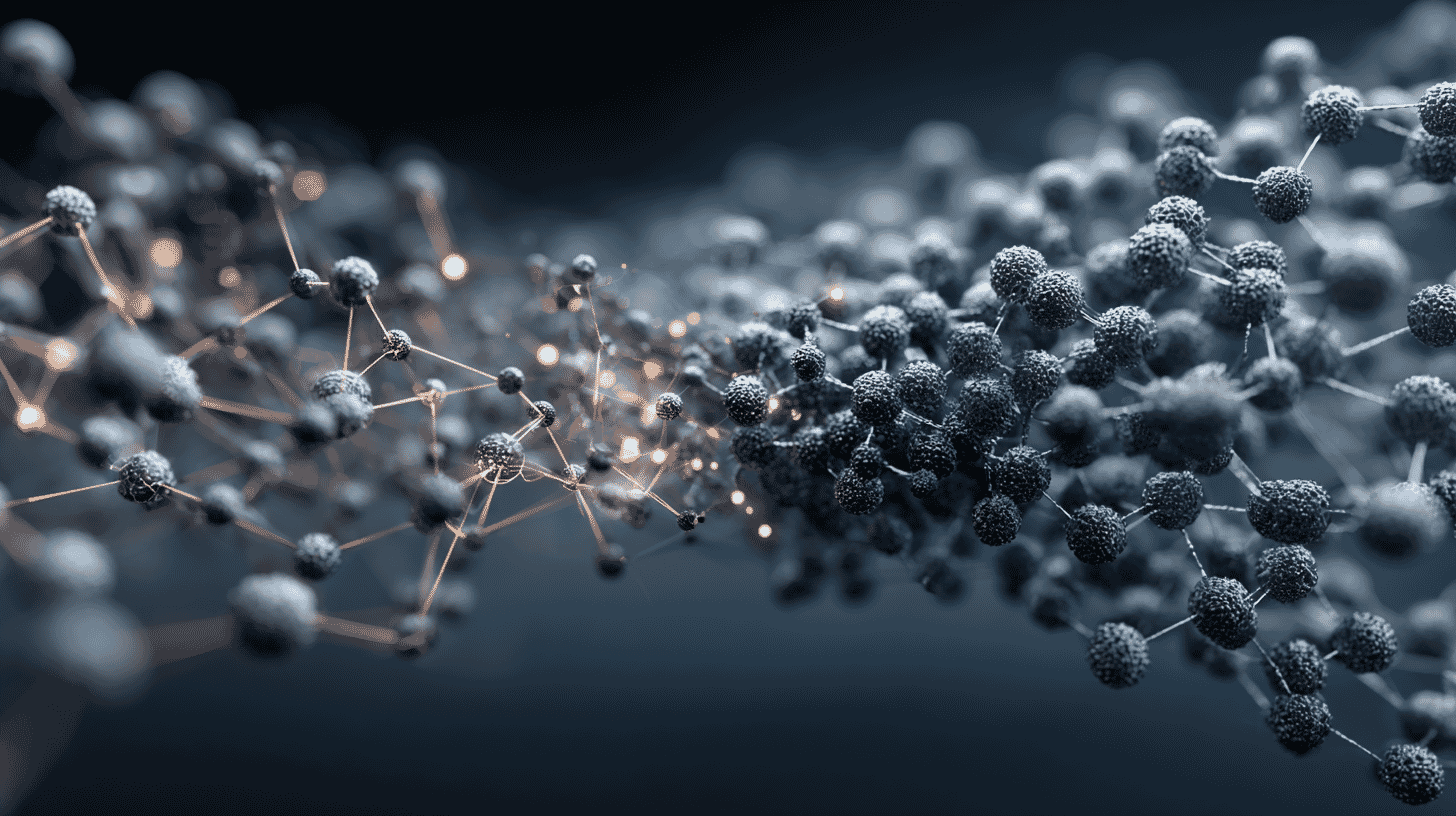
🔬 Discovering a new material can swallow years of trial and error: mix the elements, cast a sample, measure it, then start over. Machine learning was supposed to shortcut all that, and to a point, it has. But there's a catch the marketing rarely mentions. The most capable AI models need thousands of examples to learn from, and frontier materials research often has only a few dozen. A team at Tokyo's Waseda University, working with Fujitsu, has now shown that a quantum algorithm can break that deadlock, predicting the behavior of some of the most complex alloys known to science from barely 100 experiments.
The work was published in the journal Scientific Reports on April 20, 2026, with Waseda announcing it on May 1.
When "just collect more data" isn't an option
For the past decade, the fashionable phrase in materials research has been materials informatics: using data and machine learning to find promising materials faster than the old build-it-and-test-it grind. When there's a generous pile of data to learn from, it works beautifully.
The trouble is that genuinely new materials almost never come with a generous pile of data. A research team chasing an unexplored alloy might have results from a few dozen to a few hundred samples, and that's it. Feed that to a powerful model and you hit a familiar wall: the model memorizes the handful of examples it was given and then flops the moment it sees something unfamiliar, a failure mode called overfitting.
The hardest version of the problem is the one that matters most. Researchers usually aren't trying to recreate a material that already exists; they want something better than anything on the shelf. That means predicting properties outside the range of the training data, what scientists call extrapolation, and conventional models are notoriously shaky at it. The very situations where a good prediction would be most valuable are the ones where ordinary machine learning is least trustworthy.
The test case: alloys made of five metals or more
To see whether a quantum approach could do better, the Waseda–Fujitsu group, led by Professor Tomoyuki Yamamoto, aimed at one of the gnarliest targets in modern metallurgy: the high-entropy alloy, or HEA.
Traditional alloys are built around one dominant metal with smaller amounts of others mixed in; think of steel as mostly iron. High-entropy alloys throw that recipe out. They blend five or more metals in roughly equal proportions, and the result can be a so-called cocktail effect, where the combination produces properties no single ingredient could deliver: extreme hardness, heat resistance, durability under punishing conditions.
That promise comes with a brutal catch for anyone trying to model them. With five or more elements free to vary, the number of possible compositions explodes, and the atomic-level interactions are tangled enough that classical simulation struggles to keep up. HEAs are, in a sense, the perfect stress test for a small-data prediction method.
The team focused on predicting Vickers hardness, a standard measure of how hard a material is, obtained by pressing a diamond tip into the surface and measuring the dent.
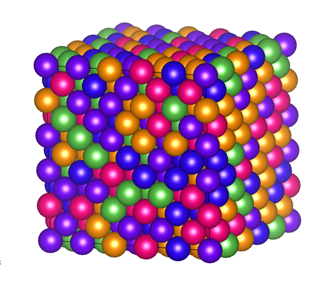
Source: Waseda University press release
Why a quantum method helps when data is scarce
The algorithm at the center of the study is quantum circuit learning (QCL). It belongs to a category called quantum-classical hybrids: a quantum circuit handles part of the computation while an ordinary computer handles the optimization, going back and forth until the model is trained. Crucially, QCL is designed to run on the messy, error-prone quantum machines that exist today, the so-called NISQ (noisy intermediate-scale quantum) generation, rather than waiting for a flawless quantum computer that doesn't exist yet.
Two properties make it a good fit for the small-data problem. First, a quantum circuit can juggle an exponentially large set of mathematical building blocks relative to its number of qubits, giving it high expressive power. Second, and this is the less obvious part, the mathematics of quantum operations imposes a built-in constraint (unitarity) that appears to discourage overfitting, so the model can stay flexible without memorizing its way into nonsense.
The team also made a deliberate design choice that widens the method's usefulness. Instead of feeding the model detailed crystal-structure data, which isn't always available early in a project, they used 24 numbers that can be calculated straight from a material's chemical composition, quantities like mixing entropy and enthalpy, then compressed those into 10 dimensions before training. In plain terms: you only need to know what you're planning to mix, not to have already made and measured it.
The payoff showed up exactly where it counts. Compared against conventional linear and nonlinear models, QCL produced the smallest error on extrapolation: predicting alloys harder than anything in its training set. It held its accuracy in sparse, poorly mapped regions of the data where ordinary models tend to collapse. And it did all this with only around 100 data points.
There's a quiet bit of national pride buried in the method itself. QCL was not invented for this study. It was first proposed in 2018 by Kosuke Mitarai, Makoto Negoro and Masahiro Kitagawa at Osaka University with Keisuke Fujii, then at Kyoto University, making it, in origin, a Japanese algorithm now being put to industrial use by another Japanese team.
Where this sits in a crowded quantum race
Quantum machine learning for materials is a busy field, and Japan is not running it alone. IBM offers quantum machine-learning tools through its Qiskit software and cloud-accessible processors; Google's Quantum AI division pushes its own hardware and algorithms; and a separate line of research uses quantum annealing, the approach behind D-Wave's machines, to tackle alloy design. A study published in npj Computational Materials in early 2026, for instance, used quantum-annealed machine learning to help discover a tough, corrosion-resistant high-entropy alloy.
The Waseda–Fujitsu work sits on the gate-based, variational side of that landscape rather than the annealing side, and its distinctive contribution is less about raw horsepower than about a specific, practical pain point: squeezing reliable extrapolation out of tiny datasets. That is a narrow target, but it's a real one, and hitting it is arguably more useful to working materials scientists than another headline about qubit counts.
What changes if the method holds up
High-entropy alloys aren't a laboratory curiosity. They're being eyed for jet-engine components, next-generation nuclear reactors, and chemical plants that operate in conditions that would chew through ordinary metals. Anything that shortens the path from idea to validated material has direct industrial value: less time, less cost, and the chance to reach performance levels that trial-and-error would take years to stumble into.
That said, the team is candid about how far this is from a finished product. Simulating QCL on today's classical computers is slow, so real speed gains depend on quantum hardware maturing. The advantages still need to be confirmed on actual quantum machines rather than simulations. And the method has to prove itself on materials beyond high-entropy alloys before anyone can call it general.
Professor Yamamoto framed it carefully: machine learning has been slower to transform materials science than other fields, partly because good datasets are scarce and partly because the real goal, beating existing performance, is exactly what ordinary models do worst. QCL, he suggested, is a candidate for solving that, and if quantum hardware keeps improving, the way new materials get discovered could change dramatically.
For now, it's a promising result rather than a revolution. But it points at something specific and worth watching: a quantum tool aimed not at the flashy problems, but at the unglamorous bottleneck that has quietly held materials discovery back.
In Japan, quantum computing is increasingly being pointed at down-to-earth industrial problems like this one rather than abstract demonstrations. Is quantum research in your country leaning toward practical applications yet, or still mostly in the lab? We'd love to hear how it looks from where you are.
References
- Waseda University press release: https://www.waseda.jp/inst/research/news/84283
- Scientific Reports paper: https://www.nature.com/articles/s41598-026-43584-8
- Nikkei xTECH: https://xtech.nikkei.com/atcl/nxt/news/24/03226/








Global Discussion
3 comments