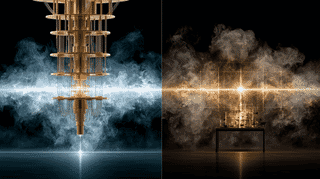
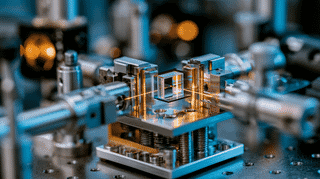
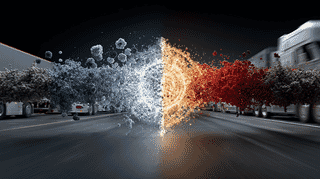
AIST and Tokyo startup OptQC have switched on MoQuren, a photonic quantum computer that needs no refrigerator and no vacuum chamber. What it can do now, and how Japan's bet differs from the US and China.
NTT, the University of Tokyo, RIKEN and OptQC squeezed light to a record 10.1 dB, over 90% of its quantum noise gone. How a 1998 teleportation gamble became the core of Japan's optical quantum computer.
RIKEN unveiled two supercomputers on the same day: RIKYU for AI for Science and ROQUO for quantum-HPC. Both are Japan's first to run GB200 NVL4 and Quantum-X800 InfiniBand. We compare them with US efforts like xAI's Colossus and the DOE Genesis Mission, and China, to read Japan's bet on purpose over scale.
A Japan-US team from Tohoku University and the US NIST built the first working spintronics probabilistic bit (P-bit) on a single silicon substrate using standard chip-fabrication processes. We explain the coin-flip idea, how it differs from quantum computing (room temperature, existing chip lines), and how far it really is from a product.
In 1998, Akira Furusawa achieved the world's first unconditional quantum teleportation at Caltech. For two decades, no one knew what it was for. By 2024, that same trick was running an optical quantum computer on the cloud. From the teleportation misconception to the reframe that turned it into a processor, and the startup OptQC's push for a homegrown machine.
ROHM and Quanmatic put quantum annealing to work on a chip fab's front-end process, lifting output about 3%. Here's why a number that sounds small is actually a big deal on a factory floor.
Kyoto Institute of Technology and JST have demonstrated a spinor condensate at room temperature, a quantum state once confined to cryogenic cold. Here is what it means for light-based quantum devices and Japan's distinct path versus Google and USTC.
Waseda University and Fujitsu used quantum circuit learning (QCL) to predict the hardness of high-entropy alloys from only about 100 data points. We explain how a quantum approach tackles the small-data extrapolation problem that defeats conventional machine learning, where it sits against IBM and Google quantum efforts, and what it could mean for industrial materials discovery.
Yokohama National University spinoff LQUOM has closed a 1.23 billion yen ($7.7M) Series B to build quantum repeaters, the missing piece of the quantum internet. Here is what that means, and how it stacks up against Aliro in the US, USTC in China, and Japan's planned Tokyo-Osaka quantum backbone.
The SI second hasn't changed since 1967. By 2030 it likely will. From Earth's rotation to atomic vibrations to optical transitions: this is the history of how we've defined the second, and a field guide to the candidate atoms and national labs racing to define it next.
PM Sanae Takaichi pledged to effectively double research funding and build a 'new technological nation' targeting AI, semiconductors and quantum, and the Japan Growth Strategy carrying those measures was adopted by cabinet on July 21, 2026. We look at the 17 strategic fields and 62 priority technologies against the reality of Japan's 3.44% R&D-to-GDP ratio and its falling PhD numbers.
Tokyo-based Orbray has produced the world's largest 30mm square (111) freestanding diamond single-crystal substrate, leaping from the previous few-millimeter limit. The twin-suppression breakthrough, published in Applied Physics Express, unlocks NV-center quantum sensors and next-generation power semiconductors.
Tokyo deep-tech startup H.I.Council has performed the world's first 108-qubit FeMoCo calculation on IBM's Heron r2 processor. While achieving chemical accuracy via classical methods, the team discovered a quantitative hardware limit they call the 'coherence wall' — a constructive finding for quantum hardware development.
RIKEN and Osaka University have launched cloud access to Ei-II, a domestically developed 144-qubit superconducting quantum computer. Doubling the previous 64-qubit Ei, the 28x28mm chip enables quantum calculations beyond classical simulation. We compare it with IBM and Google systems and examine Japan's quantum roadmap.
TOPPAN Holdings, Japan's NICT, and Canada's ISARA have demonstrated a seamless migration path from current cryptography to post-quantum cryptography in certificate authority systems, without service disruption. The breakthrough addresses the looming quantum computing threat to existing encryption, targeting real-world deployment in healthcare, finance, and government by 2030.
Japan's METI raises the subsidy cap for quantum technology business demonstrations to ¥2 billion ($13M) per project, a tenfold increase. With ¥15 billion earmarked for business applications out of a quantum budget exceeding ¥100 billion, Japan pushes to industrialize quantum computing in logistics, drug discovery, and beyond.
Fujitsu and Osaka University developed STAR Architecture ver. 3 and molecular model optimization to cut quantum computing resources to between 1/15 and 1/80 of conventional FTQC needs. Calculations for drug-critical Cytochrome P450 fall from 740,000 to 40,000 qubits and complete in 9 days. Comparison with IBM, Google, and IonQ's quantum drug discovery efforts included.
Osaka University startup QuEL has demonstrated 24-hour stable operation of its quantum bit control device QuEL-1 SE, achieving amplitude standard deviation of 0.15% and phase standard deviation of 0.39°. Published in Review of Scientific Instruments, this breakthrough in device-level temperature control clears fault-tolerant thresholds crucial for scaling quantum computers toward the million-qubit era.
Osaka University's QIQB and Fixstars achieved the world's largest quantum chemistry circuit simulation using 1,024 NVIDIA H100 GPUs on Japan's ABCI-Q supercomputer. Breaking the previous 40-qubit barrier, they simulated H₂O with 42 spin orbitals and Fe₂S₂ with 41 qubits — accelerating quantum algorithm development before fault-tolerant quantum computers arrive.
Quemix CEO Yuichiro Matsushita achieved a world-first in quantum chemistry simulation on Japan's Fugaku supercomputer. This report explores how researcher autonomy drove the breakthrough, Quemix's partnerships with Honda and Asahi Kasei, and Japan's growing quantum startup ecosystem including QunaSys and Fixstars Amplify.