
🖥️ On the same June morning, Japan's national research institute switched on two new supercomputers. They run the same GPUs and sit in the same building in Kobe. Yet they are aimed at two different futures: one to let AI do science itself, the other to wire quantum computers and supercomputers together in everyday operation. As the United States stacks up AI infrastructure at a scale no one else can match, Japan has quietly placed a different bet.
A machine built to let AI chase the laws of nature
On June 19, 2026, RIKEN announced it had settled on a name for its new supercomputer: "RIKYU." The machine is dedicated to AI for Science, meaning using artificial intelligence to do research rather than just crunch numbers faster, and it is being installed at RIKEN's Kobe campus on Port Island.
The name carries a layered meaning. In Japanese, "ri" (理) is the principle or law underlying natural phenomena, and "kyu" (究) means to pursue and master. Put together, RIKYU is the idea of using AI and supercomputing to chase down the laws of nature. It is also a homophone for Sen no Rikyu, the 16th-century tea master, which made it feel familiar. The name was picked from 1,019 public submissions, and the selection committee even included a science-fiction novelist. RIKEN also frames the choice through Rikyu's teaching of "shu-ha-ri." First you faithfully learn what exists (shu, as an AI absorbs prior knowledge), then you break from it to open new knowledge (ha), and finally you leave the old forms behind as humans and AI push into uncharted scientific territory (ri).
The specs are heavy. RIKYU is built from 400 compute nodes carrying NVIDIA GB200 NVL4, or 1,600 Blackwell GPUs in total. It delivers more than 64 petaflops in double precision (FP64) and over 15.5 exaflops in the 8-bit precision (FP8) that AI training and inference lean on. An exaflop is a billion billion operations per second. Operation was slated to begin in July 2026, with final tuning still underway at the time of the announcement.
But RIKYU's real ambition is not speed. RIKEN's "AI for Science" means something broader than fast computation. It hands AI the upstream parts of research, such as generating hypotheses, designing experiments, analyzing data and integrating knowledge, so that humans and machines make discoveries together. At the center sits the idea of "science foundation models," large models trained broadly on a field's scientific knowledge. RIKYU is the platform to build and run them, and paired with the simulation-heavy supercomputer Fugaku, it is meant to support research that neither could carry alone.
The other one is a translator between quantum and classical
A second press release landed the same day, for a machine called "ROQUO." Named after Mount Rokko, the peak that watches over Kobe, it is the compute backbone of a quantum-HPC platform. It is operated by the RIKEN Center for Computational Science (R-CCS) and was built mainly by DTS Corporation as part of a NEDO-commissioned effort called the JHPC-quantum project.
ROQUO's job, in plain terms, is to act as a translator between quantum computers and supercomputers. The Kobe campus is home to the supercomputer Fugaku, IBM's superconducting quantum machine "ibm_kobe" (an IBM Quantum System Two), and Quantinuum's trapped-ion quantum computer "Reimei." ROQUO couples tightly with all of them through the SQC Interface, software developed in the JHPC-quantum project and built on platforms such as NVIDIA CUDA-Q, so that calculations combining quantum processors and GPUs can actually run.

Source: RIKEN
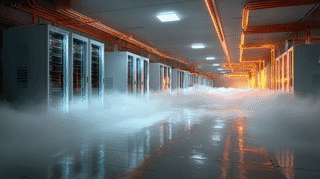
The hardware is 135 GB200 NVL4 nodes, totaling 540 Blackwell GPUs and 270 Grace CPUs. In an HPL benchmark run during commissioning, it clocked a measured 19.80 petaflops in double precision, roughly 94% of the published theoretical peak of more than 21 petaflops in FP64 (and over 5 exaflops in FP8). Less flashy but more telling is the cooling: ROQUO uses "free cooling," running on 32°C warm water that Kobe can supply with nature alone even in midsummer, which RIKEN says cuts total power by more than 20 percent versus comparable systems.
With ROQUO live, the real work begins: quantum-computing simulation on a supercomputer, faster development and benchmarking of quantum algorithms, and new "quantum-plus-GPU" applications such as quantum machine learning. The thinking is to meet computational needs that are hard to reach with Fugaku alone by going hybrid.
Why two machines, same chip, same day
Two machines with different goals arriving on the same day is no coincidence. They share a string of Japanese firsts.
Both are the first full-scale production systems in Japan to use NVIDIA's GB200 NVL4, and RIKEN says ROQUO is among the first anywhere in the world. Where the GB200 NVL72 packs 72 GPUs for large generative-AI training, the NVL4 is a 4-GPU configuration designed with scientific computing (HPC) in mind. It keeps AI muscle while balancing the FP64 performance HPC leans on, plus flexibility of installation and cost, a fit for research platforms juggling very different kinds of work.
They are also the first in Japan to adopt NVIDIA Quantum-X800 InfiniBand, a low-latency fabric running up to 800 gigabits per second per port and up to 3.2 terabits per second between nodes. That network is part of why ROQUO scored as well as it did on HPL.
Most important, the operational know-how from both machines feeds into Fugaku NEXT, Japan's next flagship supercomputer now in development. Aimed at operation around 2030 and designed to lead in the convergence of AI, quantum and HPC, Fugaku NEXT turns RIKYU and ROQUO into proving grounds for that convergence, testbeds whose lessons in running large GPU clusters and energy-saving warm-water cooling become the foundation of the next machine.
Choosing not to win the size war
Step back to the global picture and Japan's position comes into focus.
On raw AI scale, the United States is in a league of its own. Elon Musk's xAI runs "Colossus" in Memphis, a single site reported to hold around 555,000 GPUs at a cost near $18 billion, the largest AI training facility in the world. Microsoft and OpenAI's "Stargate" has stood up a campus in Abilene, Texas with on the order of 450,000 Blackwell GPUs. Both pour gigawatts of privately financed power into training frontier large language models. Against that yardstick, RIKYU's 1,600 GPUs and ROQUO's 540 look tiny.
But the yardstick is the point. The US is also pushing hard on letting AI do science. The Department of Energy's Genesis Mission, launched in November 2025, marshals 17 national laboratories and some 40,000 researchers to build scientific foundation models that automate hypothesis testing and experiment design, strikingly close on paper to what RIKYU is for. The difference is that Japan has built its version into a state-coordinated, purpose-made machine, choosing use case over sheer size.
On quantum-HPC integration, Japan is arguably out front. In a 2026 analysis, the US think tank CSIS judged that American efforts to fuse quantum computing with supercomputing still lag the more coordinated national programs running in Europe and Japan. Chinese internet firms are projected to pour some $70 billion into data centers in 2026; the country runs a distributed AI network spanning 40 cities and leads the world in quantum communications. Yet its work to tightly couple quantum computers and HPC in live operation appears, from public information, comparatively limited. A single platform binding Fugaku, ibm_kobe and Reimei the way ROQUO does is rare anywhere.
So Japan's bet is not to reclaim the lead in GPU counts. It is to build the "application templates" of AI-driven science and operational quantum-HPC into national infrastructure first, then funnel that experience into Fugaku NEXT. On scale, Japan will trail the US and China; whether the strategy pays off depends entirely on the science that now gets done on top of RIKYU and ROQUO.
Is your country betting on building computing infrastructure as big as possible, or on building it narrow and deep?
Update: On 15 July 2026, NVIDIA said both ROQUO and RIKYU had entered service.
References
- https://www.riken.jp/pr/news/2026/20260619_1/index.html
- https://www.riken.jp/pr/news/2026/20260619_2/index.html
- https://www.riken.jp/en/news_pubs/news/2026/20260619_2/index.html
- https://www.csis.org/analysis/pioneering-quantum-supercomputing-integration-us-leadership-next-computing-era
- https://www.energy.gov/articles/energy-department-launches-genesis-mission-transform-american-science-and-innovation





Global Discussion
4 comments