
Quantum physics tends to sound like science fiction until someone raises 1.23 billion yen ($7.7 million) to build it. That is what happened on April 21, 2026, when a small Yokohama startup called LQUOM announced the second close of its Series B. The round was oversubscribed. Three new backers joined: Nissay Capital, MPower Partners, and the semiconductor-equipment maker SCREEN Holdings.
The thing LQUOM is building is harder to describe than to fund. It is a quantum repeater, the missing piece that would let a future "quantum internet" stretch beyond a few dozen kilometers. Almost nobody else in the world has all the parts for one in-house. And the technology, if it actually works at scale, could upgrade the security of every bank, hospital, and government system on Earth.
Let's unpack what is going on, in plain language.
What is a "quantum internet," really?
Start with the boring version. Today's internet sends bits (ones and zeros) as pulses of light through optical fiber or as radio waves through the air. The whole system assumes that an eavesdropper can, in principle, copy any signal they manage to tap into. We get around that by scrambling the data with encryption: math problems so hard that today's computers can't solve them in any reasonable time.
A quantum internet works on a different principle entirely. Instead of sending bits, it sends quantum states, usually carried by individual particles of light called photons. And quantum states have two strange properties that classical bits don't.
First, you can't copy them. This is a hard rule of quantum mechanics called the no-cloning theorem. Try to read the state mid-transit and you destroy it. Any eavesdropper who tries to silently tap the line will leave fingerprints both ends can detect.
Second, two quantum particles can be linked together in something called entanglement. If you create a pair of entangled photons and send one to Tokyo and the other to Osaka, measuring one immediately tells you something about the other. The two are correlated in a way that no classical system can fake. You can use that correlation to share secret keys between two distant places with security guaranteed not by math, but by the laws of physics themselves.
That is the promise of quantum internet: communication that is unhackable not because it's hard to break, but because breaking it would violate physics.
The problem nobody can ignore: photons get tired
Sounds great. So why don't we have it already?
Because photons get tired. Send a photon down a regular optical fiber, and on average about half of them will be lost every 15 kilometers or so. After 100 kilometers you've lost over 99%. After 500 kilometers, you're trying to detect single survivors from a flood of original signal that has effectively vanished.
In normal internet, we solve this with repeaters: devices spaced along the fiber that read the weakened signal, amplify it, and send a fresh copy down the line. That works for classical bits.
It does not work for quantum states. Remember the no-cloning theorem: you cannot read and copy a quantum state without destroying it. A normal repeater would just kill the quantum information it's supposed to relay. To extend a quantum link beyond about 150 kilometers, you need a fundamentally different kind of device.
This is the quantum repeater. Instead of copying the signal, it uses entanglement itself as the relay mechanism. Two entangled pairs are generated on either side of a midpoint, then "swapped" so that the two outer photons become entangled with each other, even though they never directly met. Stack enough of these stations together and you can stretch entanglement, and with it secure quantum keys, across continents.
The catch: a working quantum repeater needs an entangled-photon source, a quantum memory (to hold the photon's state long enough to wait for its partner), and precise frequency stabilization to make different stages of the device talk to each other. Getting all three to work together, in a box, in a room, is the hard part. Most teams in the world have one or two pieces. Almost no one has all three.
LQUOM's bet: own every layer of the box
LQUOM was founded in January 2020 as a spinoff from Yokohama National University's Horikiri Lab. The name stands for Long-distance Quantum Communication. The CEO, Kazuya Niizeki, was born in 1994 in Yokohama, finished his PhD on quantum communication hardware in the same lab, and co-founded the company straight out of graduate school.
The pitch, and what investors keep highlighting, is that LQUOM holds all three core technologies in-house: the entanglement light source, the quantum memory, and the frequency stabilization. Niizeki has led the commercialization of the entanglement source side, and the whole team is now working on the harder integration problem of putting all three together as a deployable quantum repeater.
The first product, the LQ-PS-100, is a cavity-based quantum light source emitting at 606 nm and 1550 nm. The second wavelength matters because 1550 nm is the same band the global telecom industry uses for long-haul fiber. In September 2023, LQUOM and SoftBank ran a 16-kilometer field trial between SoftBank's headquarters and a Tokyo data center, sending entangled photons through real commercial fiber instead of the controlled environment of a laboratory.
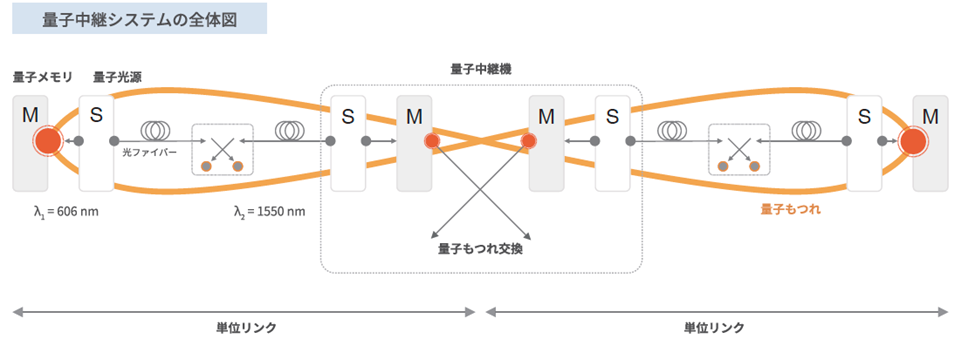
Source: LQUOM press release via PR TIMES
In the press release, MPower Partners' general partner Yumiko Murakami called LQUOM "a globally rare team," one that holds every element needed for a working quantum repeater in-house, leveraging strengths Japan has built up over decades in quantum optics and precision engineering.
The Series B total of ¥1.23 billion ($7.7 million at roughly 159 yen per dollar) is small money in Silicon Valley terms. It is significant for a Japanese deep-tech hardware company, especially one whose product won't be widely deployed for years. The funds, the company says, will go into making the repeater more reliable, expanding field tests at testbeds inside and outside Japan, and building out the partner network. In parallel, LQUOM has been selected for support from NEDO, Japan's public agency for industrial technology development.
Note added after publication: on July 10, 2026, Oxide Corporation, itself an LQUOM investor, said it had shipped a narrow-linewidth continuous-wave laser in the 436 nm band to LQUOM, to generate the wavelength the repeater's quantum memory needs. The supply chain for the individual components is starting to move.
The global race: software in the US, scale in China, hardware in Japan
LQUOM is not alone. The quantum networking race has three obvious players, and each is solving the problem from a different direction.
The US bet is Aliro Quantum, a Boston-based spinoff of Harvard's NarangLab. In February 2026, Aliro closed an oversubscribed $15 million round led by Gutbrain Ventures, with participation from Cisco Investments and Murata's corporate VC arm. Where LQUOM is building the physical box, Aliro is building the management plane: software that sits on top of existing optical fiber, talks to roughly 50 different entanglement and classical networking devices, and lets organizations stand up high-assurance quantum networks without ripping out their current routers and switches. In other words, Aliro is selling the glue (operating system, simulator, orchestration) that will eventually run on top of whoever's hardware wins. It is a smart play if you believe the eventual bottleneck will be integration rather than physics.
The Chinese bet is scale, today. The team led by Pan Jianwei at the University of Science and Technology of China (USTC) has spent two decades building deployed quantum infrastructure. China's flagship link is a 2,032 km QKD backbone between Beijing, Jinan, Hefei, and Shanghai, in service since 2017 after about three and a half years of construction; it runs through 32 trusted relay nodes and 135 individual QKD links. Total Chinese QKD infrastructure now stretches beyond 12,000 km. The catch sits in the phrase "trusted relay node." These are classical waypoints where the quantum state is measured, briefly exists as ordinary data, then gets re-encoded for the next hop. It is a structural security weakness, and eliminating it is exactly what a true quantum repeater would do. USTC has been chasing that goal as well: in early 2026, the same group reported what it billed as the first experimental demonstration of a scalable building block for a quantum repeater, pairing a long-lived ion-trap quantum memory with an efficient ion-to-photon interface.
Japan's bet, on the public-infrastructure side, is the 600-kilometer Tokyo–Nagoya–Osaka–Kobe quantum encryption network. The National Institute of Information and Communications Technology (NICT) is leading construction in partnership with Toshiba, NEC, and major telecom carriers, with the network targeted for completion by March 2027, field testing the same year, and full deployment by 2030. The plan includes specialized repeaters to extend quantum links beyond the typical 150-kilometer ceiling. The initial use cases are exactly the sectors where unbreakable communication actually matters: finance, diplomacy, medical genomics.
The Tokyo–Osaka backbone is where companies like LQUOM matter to the average person. A national quantum network using only trusted relays, China's current approach, buys time but inherits a structural weakness. A national quantum network using true quantum repeaters, Japan's stated aspiration, would not. LQUOM is one of the few companies positioned to actually supply that piece of the puzzle.
What changes if this works
Let's be concrete about who would care, and why.
For banks and financial institutions, the immediate prize is "harvest now, decrypt later" defense. A hostile actor recording today's encrypted traffic can, in theory, decrypt it once they have a sufficiently large quantum computer, perhaps a decade or two from now. Quantum-keyed communications are immune to that attack because the key is created fresh, photon by photon, and the physics of measurement detects any interception.
For hospitals and biotech, the question is genomic data. Sequencing a patient's full genome is now cheap; protecting that data over its 100-year shelf life is not. Quantum encryption is one of the few methods that could plausibly remain unbroken for that timescale.
For governments, the calculation is similar but more pointed. National security agencies are already widely believed to be archiving foreign encrypted traffic in the bet that they will, eventually, be able to read it. Quantum communication is the only known countermeasure that does not depend on the assumption "math problem X is hard."
And there is a second use case that gets less attention: connecting quantum computers to each other. A future fault-tolerant quantum computer of a useful size will likely not be one giant machine; it will be many smaller modules linked together. Linking them requires sending quantum states between them coherently. That, again, needs entanglement distribution, which means quantum repeaters.
The honest version of the timeline
It would be dishonest to say this is about to roll out next year. It is not. The fundamental hardware components (long-lived quantum memories, deterministic entangled photon sources, low-loss frequency conversion) are still hitting one or two of their target specs at a time, rarely all three together. China's USTC demonstrated a working repeater-style memory in 2026, but in a controlled lab over short distances. Japan's NICT has been running the Tokyo QKD Network since 2010 over a few dozen kilometers. The 600-kilometer national network is still a construction target, not a finished system.
The honest position is that LQUOM's Series B does not announce the arrival of the quantum internet. It announces that one of the small number of teams capable of building the missing piece has enough runway to try. The next two or three years are about whether the LQ-PS-100 and its successors can stabilize entanglement over real telecom fiber for hours, then days, then routinely. Whether the company can produce them in numbers. Whether deployment partners (telecoms, governments, banks) actually commit to buying.
Japan has a particular pattern in technologies like this: world-class research and prototype hardware, slower industrialization, occasional loss of the commercial lead to American or Chinese rivals who scale faster. LQUOM is exactly the kind of company that decides which side of that pattern this one falls on.
For now, ¥1.23 billion buys time, attention, and a few more years to find out.
What about your country?
In Japan, "quantum" has become a near-permanent fixture in national R&D budgets, the way "AI" is in the US or "5G" was a few years ago. Banks and telecoms are publicly partnering with deep-tech startups they would not have touched a decade ago. How is it where you live? Is quantum communication treated as a serious near-term infrastructure question, or still as physicists' homework that the rest of us don't need to worry about yet?
Sources
- https://prtimes.jp/main/html/rd/p/000000009.000077760.html
- https://lquom.com/
- https://lquom.com/news/news-525/
- https://lquom.com/news/news-427/
- https://lquom.com/news/news-537/
- https://xtech.nikkei.com/atcl/nxt/column/18/02438/101900025/
- https://morningpitch.com/startups/32200/
- https://www.softbank.jp/en/corp/news/press/sbkk/2023/20230921_01/
- https://thequantuminsider.com/2026/02/18/aliro-raises-15-million-in-oversubscribed-round/
- https://www.aliroquantum.com/company
- https://thequantuminsider.com/2026/02/06/chinese-researchers-clear-hurdles-for-long-distance-quantum-networks/
- https://postquantum.com/quantum-networks/china-quantum-networking-qkd/
- https://thequantuminsider.com/2025/11/26/japan-to-link-major-cities-with-600-km-quantum-encryption-network/
- https://asia.nikkei.com/spotlight/cybersecurity/japan-to-test-600-km-quantum-encryption-network-linking-major-cities
- https://www.nedo.go.jp/activities/startups/company36.html








Global Discussion
3 comments