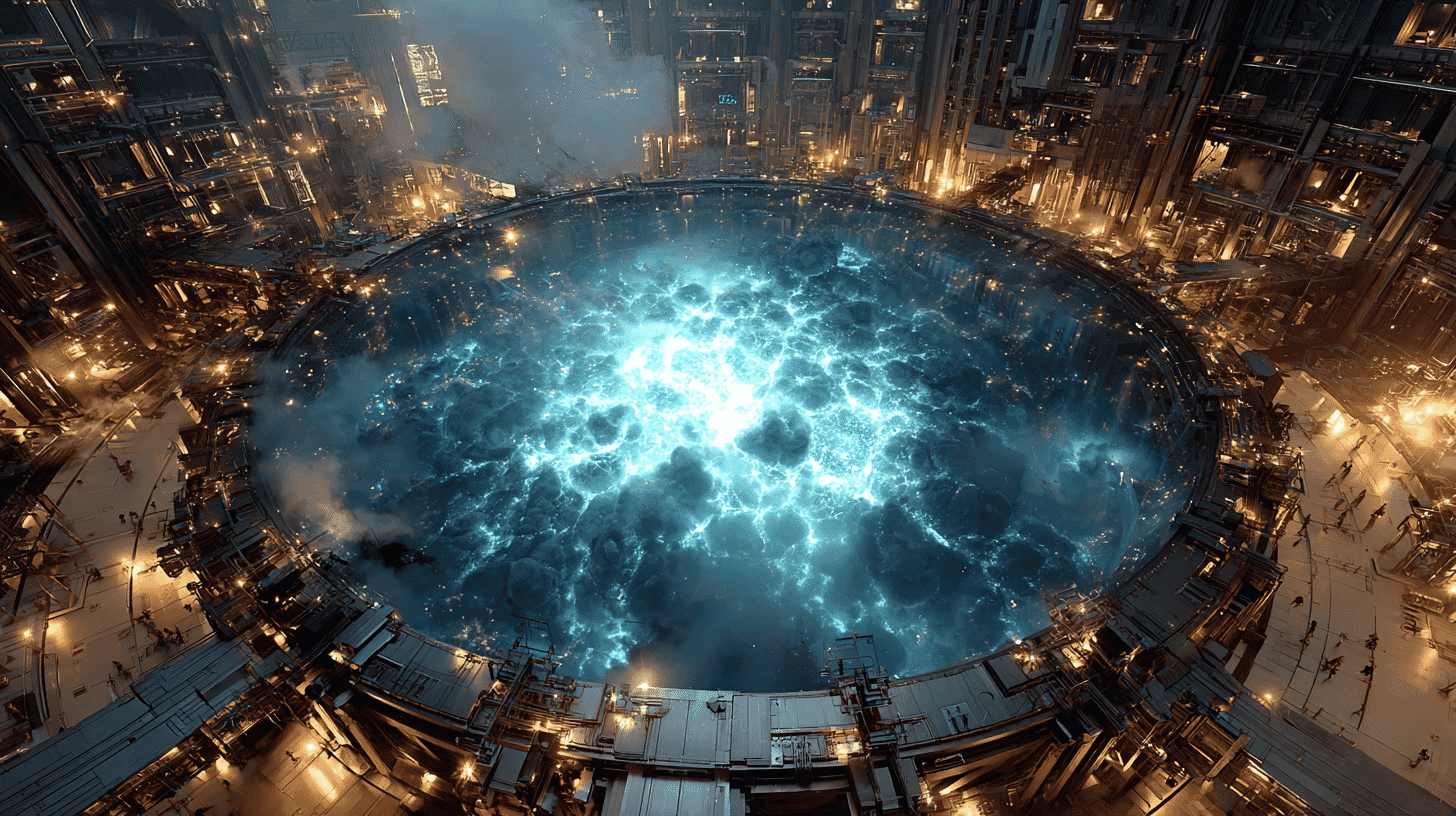
What if the power of the Sun could be harnessed right here on Earth? Japan just made that dream a national priority. The government has officially committed to demonstrating fusion power in the 2030s, and a new industry consortium called FAST plans to begin construction by 2029, backed by up to $4.6 billion over the next decade. Here is what to know about Japan's bold fusion energy bet.
What Is Fusion Power?: Recreating the Sun's Energy on Earth
Fusion power works by forcing light atomic nuclei, typically isotopes of hydrogen, to merge at extreme temperatures, releasing enormous amounts of energy in the process. It's the same reaction that powers the Sun and stars, which is why fusion reactors are sometimes called "artificial suns."
Unlike conventional nuclear power (fission), which splits heavy atoms like uranium, fusion combines light atoms. This fundamental difference gives fusion several game-changing advantages.
First, safety: a fusion reactor cannot melt down. If conditions become unstable, the plasma simply cools and the reaction stops on its own. Second, environmental performance: fusion produces no CO₂ emissions during power generation and creates virtually no long-lived radioactive waste. Third, fuel sustainability: the primary fuel, deuterium, can be extracted from ordinary seawater and is essentially inexhaustible. Just one gram of fusion fuel could theoretically produce energy equivalent to about eight tons of oil.
The catch? Achieving fusion requires sustaining a plasma at temperatures exceeding 100 million degrees Celsius, far hotter than the core of the Sun. Keeping this superheated, wildly unstable plasma contained long enough to produce net energy is the central challenge that researchers worldwide are racing to solve.
Japan's National Strategy: "2030s Demonstration" Made Official
In April 2023, Japan released its first-ever national strategy for fusion energy, the "Fusion Energy Innovation Strategy." Initially, the document left the timeline for demonstration vague, using phrases like "to be clarified at an early stage." But a major revision in June 2025 changed everything.
The updated strategy now explicitly states that Japan aims to achieve fusion power demonstration "ahead of the world in the 2030s." A dedicated task force was established within the Cabinet Office to coordinate policy, budgets, and talent development in a unified manner. The first national strategy in 2023 was driven by Sanae Takaichi, the minister in charge at the time, and fusion has since been treated as a top-tier national priority.
This strategic shift was partly driven by delays in the international ITER project. ITER (International Thermonuclear Experimental Reactor), being built in France with participation from 35 countries including Japan, the US, EU, Russia, China, South Korea, and India, originally aimed to begin research operations in 2025. However, component issues and COVID-19 impacts pushed that target to 2034 or later. In response, individual nations have accelerated their own independent demonstration plans.
On November 27, 2025, the industry-academia consortium "FAST" announced it had completed the basic specification design, the conceptual design, for a prototype fusion reactor. FAST plans to begin construction in 2029 and start power generation demonstration by 2035, with aims to raise up to approximately $4.6 billion over the next decade.
[Update] In 2026, Starlight Engine, the subsidiary set up to carry FAST through to implementation, opened a public call for candidate construction sites for the demonstration reactor. It also closed its first funding round since founding, raising 6.06 billion yen from 17 companies and organizations through a third-party share allocation, with a Kansai Electric Power group fund among the participants. The money goes toward engineering-design-phase R&D, site selection and regulatory work, and supply chain building. (As of August 2026)
The Global Fusion Race: US, China, and UK in Fierce Competition
The race to achieve fusion power has become intensely competitive worldwide.
The United States has set a government target of building and operating a fusion reactor by 2035, while private investment is booming. Commonwealth Fusion Systems (CFS), a spin-off from MIT, has raised over $2 billion and is developing SPARC, a compact tokamak reactor using high-temperature superconducting (HTS) magnets. In 2025, major Japanese corporations invested in CFS, joining the international fusion supply chain. Meanwhile, Helion Energy has already signed a power purchase agreement with Microsoft, signaling how close commercial fusion may be.
China is advancing rapidly through state-led programs. In January 2025, China's superconducting tokamak experimental reactor set a world record by sustaining plasma for 1,066 seconds. The country is building independent experimental facilities and pouring massive funding and human resources into fusion research.
The United Kingdom is pursuing its STEP (Spherical Tokamak for Energy Production) program, targeting commercial-scale fusion demonstration by 2040 as a national project. The UK model features a clear government roadmap with collaborative development between universities, research institutions, and startups.
Globally, cumulative investment in fusion startups exceeded $6.7 billion by 2024. According to PitchBook, venture capital took part in 43 fusion funding rounds in 2025 alone, putting in $2.3 billion. Around 45 companies worldwide are now developing commercial fusion power plants, marking a clear shift from pure research to demonstration and commercialization.
Japan's Technical Advantages: Manufacturing Prowess as a Weapon
Japan brings decades of accumulated expertise to the fusion race.
In the ITER project, Japanese companies supply many of the critical components, including superconducting coils and plasma heating systems at the heart of the reactor. In October 2023, the world's largest operational fusion experiment device, JT-60SA, began full operations in Naka, Ibaraki Prefecture. Built as a joint project between Japan and Europe, this superconducting tokamak serves as a bridge to ITER, gathering crucial data for next-generation plasma research.
Japan also leads the world in "helical" fusion research, a unique approach. The National Institute for Fusion Science (NIFS) in Gifu Prefecture operates the Large Helical Device (LHD), which confines plasma using twisted magnetic fields. Unlike the mainstream tokamak design, the helical approach is theoretically better suited for continuous operation. A startup called Helical Fusion has been founded to commercialize this technology.
In laser fusion (inertial confinement), Osaka University is recognized as a world-class research hub. Startups like EX-Fusion have emerged from this research base, exploring commercial applications of high-powered laser compression techniques.
On the industry side, the Fusion Energy Industry Association of Japan (J-Fusion) was established in March 2024, bringing together over 80 companies including Mitsubishi Heavy Industries, IHI, Mitsui & Co., and NTT. Kyoto Fusioneering, which develops critical peripheral technologies for fusion reactors such as cooling systems, blankets, and heating devices, raised approximately $62 million in its Series C round in September 2025.
In the high-temperature superconducting wire sector, Fujikura possesses world-leading technology and supplies materials to fusion projects globally, including CFS, the UK's STEP project, and domestic startups.
Challenges and Outlook: Can Japan Avoid Its Familiar Trap?
Despite its technological strengths, Japan faces significant challenges.
The most pressing concern is the investment gap. Japan's government fusion budget had been flat for years before a supplementary budget boost to roughly $3 billion in fiscal 2023. But during the same period, the US announced approximately $10 billion and the UK about $8 billion in fusion funding. In private investment, Japanese fusion startups have attracted just over $100 million cumulatively, compared to nearly $7 billion globally.
Japan's intellectual property position has also eroded. In fusion-related patent filings, Japan fell from 1st place globally in 2001 to 4th by 2020, while its research paper output dropped from 2nd to 5th, surpassed by China and the US.
Securing a domestic supply of tritium, one of the key fusion fuels that barely exists in nature, is another urgent priority. Japan currently lacks dedicated production facilities and must rely on international sources.
Still, Japan's decades of manufacturing excellence in superconducting coils, heat-resistant materials, precision machining, and remote maintenance technology are indispensable for building actual fusion reactors. The country's greatest risk is repeating a familiar pattern in Japanese industry: leading in technology while falling behind in commercialization.
If fusion power becomes reality, the position of resource-poor Japan changes at the root. With the national strategy set and FAST looking at construction three years out, the contest shifts to money and people.
How is your country approaching clean energy development? Do you believe fusion will become a reality?
References
- https://www.nikkei.com/article/DGXZQOUA022Z00S5A500C2000000/
- https://www.nikkei.com/article/DGXZQOUC270030X21C25A1000000/
- https://www8.cao.go.jp/cstp/fusion/12kai/12kai.html
- https://www.mri.co.jp/knowledge/column/20260122.html
- https://pps-net.org/column/153205
- https://wired.jp/article/vol58-commercial-nuclear-fusion-powers-up/







Global Discussion
15 comments