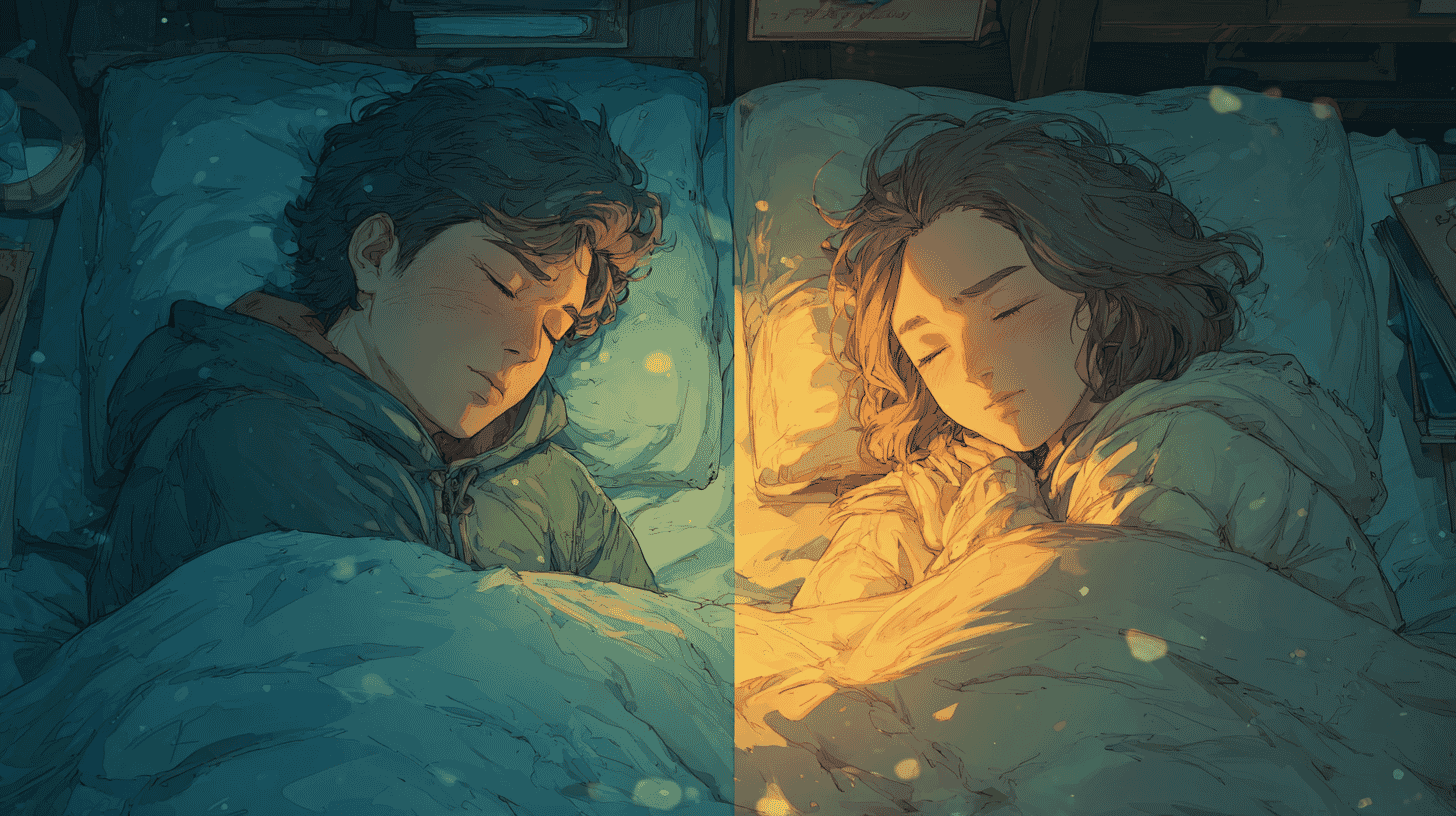
Do you sleep better next to your partner, or on your own? The "sleep divorce" trend is sweeping the globe, with couples choosing separate beds for better rest. Now, a University of Tokyo mouse study has tackled this question scientifically, and the answer turns out to depend on who you are.
What Is "Sleep Divorce"? A Growing Global Trend
"Sleep divorce" is the practice of couples deliberately sleeping in separate beds or bedrooms to improve sleep quality. Despite the dramatic name, it is a practical, positive choice that more and more people are making worldwide.
A 2025 survey by the American Academy of Sleep Medicine found that 31% of U.S. adults have opted for some form of sleep divorce, with the figure climbing to 39% among 35- to 44-year-olds. In the UK, roughly one in five couples now sleep apart regularly, and a similar trend is unfolding across much of the developed world.
Japan is no exception. A survey by Koala Sleep Japan found that over 30% of Japanese couples sleep in separate rooms. With more than 70% of Japanese couples being dual-income, shift work and differing schedules make shared sleep particularly challenging. Japanese culture also has a long tradition of "co-sleeping in a row" (kawa no ji, literally "sleeping like the character 川"), where the whole family shares a room, but this practice is evolving rapidly.
The most common reasons for sleep divorce include snoring, restlessness, different sleep schedules, and conflicting temperature preferences.
The University of Tokyo's Breakthrough Mouse Experiment
Against this backdrop, a research team at the University of Tokyo published a fascinating paper in Scientific Reports in January 2026, asking: How does social connection itself, separate from physical contact, affect sleep quality?
A Novel Approach: "Neighbor Housing"
Previous animal studies comparing group housing and solitary housing could not separate the effects of physical disturbances (fighting, jostling) from the effects of social connection itself.
To solve this, the Tokyo team devised "neighbor housing," placing mice in the same cage but separated by a transparent acrylic divider. The mice could see and smell each other but couldn't physically interact. Think of it as living next door with a glass wall.
After a period in this neighbor housing, mice were moved to solitary housing, and their brain waves were measured to assess sleep quality in detail.
The Surprise: Social Rank Flips the Result
The mice had established social hierarchies: dominant (alpha) and subordinate individuals. During neighbor housing, both groups showed similar sleep durations and REM sleep amounts.
But when switched to sleeping alone, the results diverged dramatically:
- Dominant mice showed improved sleep quality, with deeper non-REM sleep and better REM sleep brainwave patterns
- Subordinate mice experienced the opposite: their sleep quality declined
The researchers interpreted this as follows: for dominant mice, the presence of others kept them in a state of heightened alertness, and solitude allowed them to finally achieve optimal sleep. For subordinate mice, the comfort of having others nearby provided a sense of security, and losing that social connection caused isolation stress that degraded their sleep.
Genetics Matter Too
The team also compared different genetic strains of mice.
In the commonly used B6 strain, subordinate mice showed increased REM sleep after the switch to solitary housing. However, in the F1 strain, which forms stronger, more rigid social hierarchies, no such change was observed. This suggests that even under identical social conditions, your genetic makeup influences how your sleep responds.
What Does This Mean for Humans? Pros and Cons of Co-Sleeping vs. Sleeping Alone
While we can't directly apply mouse results to humans, this research powerfully suggests that the optimal sleep environment differs from person to person. Combined with existing human research, here is a balanced look at the trade-offs.
Benefits of Co-Sleeping
- Security and oxytocin: Physical closeness promotes the release of oxytocin (the "love hormone"), reducing anxiety and helping you relax into sleep
- More sleep overall: A 2022 large-scale study found that frequent bed-sharers slept about 15 minutes more per night and had lower insomnia severity
- Relationship bonding: Before-bed conversations and physical closeness strengthen relationship satisfaction
- Health monitoring: Partners often detect sleep disorders like sleep apnea before the person themselves notices
Drawbacks of Co-Sleeping
- Disruptions from snoring and movement: A 2025 global sleep survey found one in three couples are disturbed by a partner's noise. Women are disproportionately affected, with 20% reporting nightly disruptions versus 11% of men
- Conflicting environmental preferences: Temperature, lighting, mattress firmness, and blanket habits vary widely between individuals
- Mismatched schedules: Morning people and night owls can clash badly when forced to share a sleep schedule
Benefits of Sleeping Alone
- Major sleep quality gains: A SleepFoundation.org survey found 52.9% of sleep divorcees reported improved sleep quality, averaging 37 extra minutes of sleep per night
- Reduced stress: 60% of couples who sleep separately report lower stress levels
- Full customization: You can optimize your room temperature, lighting, noise level, and bedding entirely for yourself
Drawbacks of Sleeping Alone
- Social isolation stress: As the Tokyo study showed, some individuals experience stress when separated, losing the comfort of another's presence
- Intimacy risk: Without deliberate effort to maintain connection, couples may drift apart emotionally
- Housing constraints: Especially in Japan, where living spaces tend to be compact, having a spare bedroom is a luxury many cannot afford
The Bigger Picture
The University of Tokyo's research demonstrates that sleep quality is not simply about "together or alone" but is regulated by a complex interplay of social rank, genetic predisposition, and psychological security.
Translated into human terms, this means there are "people who sleep better with someone nearby" and "people who sleep better with personal space," and science now has evidence to back up both sides.
The key takeaway: don't be trapped by the belief that "couples must share a bed" or that "sleeping apart means a troubled relationship." Instead, find what works best for both your sleep and your partnership. The term "sleep divorce" may sound alarming, but for many, it's actually a "sleep alliance," a deliberate choice that makes both partners happier, healthier, and more rested.
In Japan, the family tradition of sleeping together in a row (kawa no ji) is deeply rooted, but "sleep divorce" is gaining acceptance as a practical solution. What about in your country? Do couples always share a bed, or is sleeping apart becoming more common?









Global Discussion
15 comments