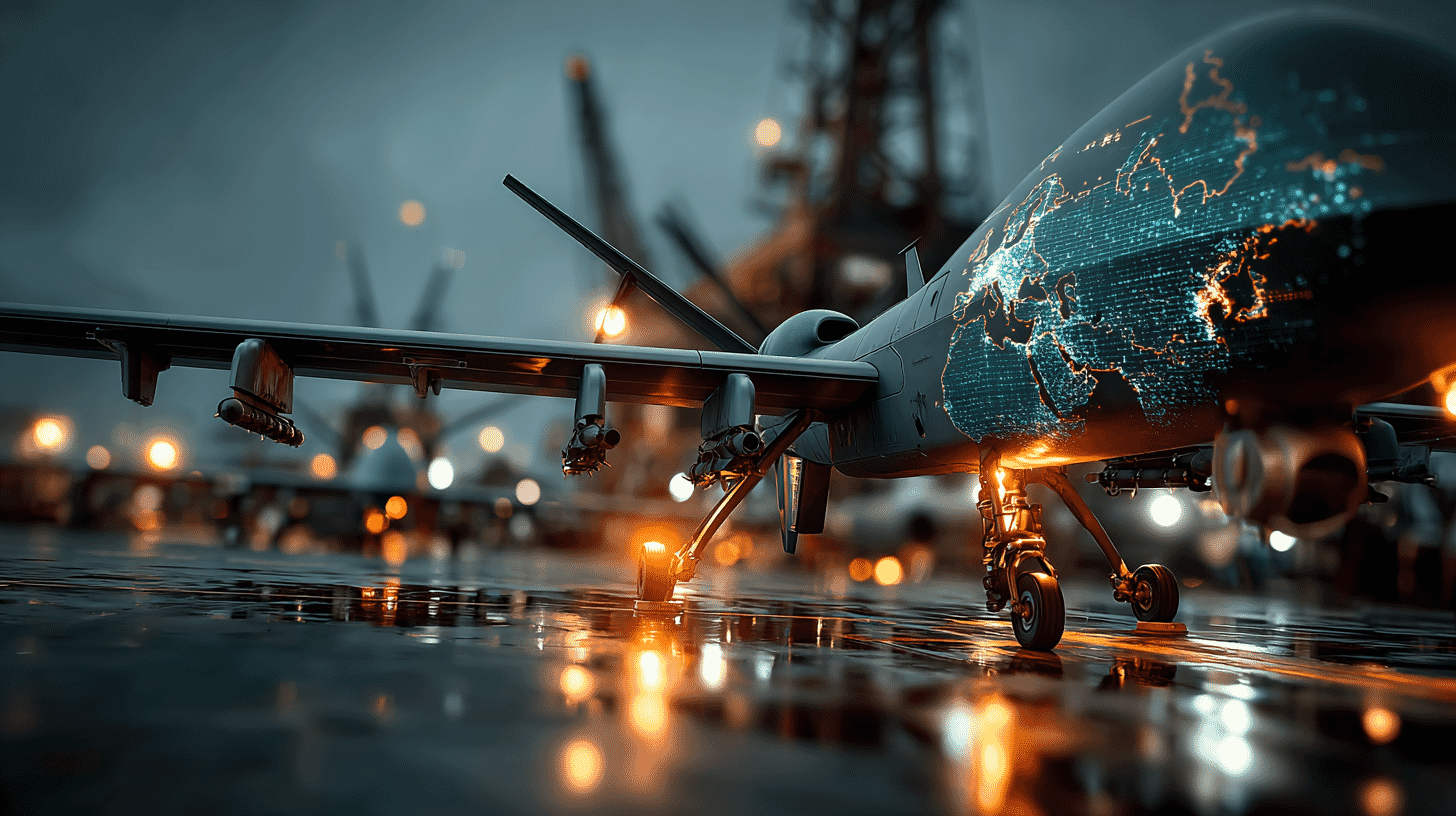
Japan's largest drone company has stepped onto the battlefield, not with weapons drawn but with a business plan. After Ukraine proved that a few thousand dollars of drone can kill a million-dollar tank, Terra Drone declared full-scale entry into the defense equipment market. It is setting up a US subsidiary called Terra Defense and plans everything from FPV attack drones to jet-powered interceptors. This is a startup that built its brand on an aerial mobility revolution, changing direction.
Who Is Terra Drone?
Terra Drone is a Tokyo-based drone company founded in 2016 that has become a global leader in industrial drone services. With over 3,000 completed projects spanning surveying, infrastructure inspection, agriculture, and airspace management, the company operates drone traffic management systems (UTM) across 10 countries. In 2024, it ranked first globally in the "Drone Industry Insights" ranking of industrial drone service companies, and it went public on the Tokyo Stock Exchange Growth Market in November 2024.
CEO Toru Tokushige has built the company around a vision of an "aerial mobility revolution." On March 23, 2026, he announced a dramatic new chapter: Terra Drone would enter the defense equipment market.
Why Defense, Why Now?
The Russia-Ukraine war fundamentally rewrote the rules of modern warfare. Drones costing a few thousand dollars have been destroying tanks, armored vehicles, and air defense systems worth millions, proving that cheap, expendable unmanned systems can overwhelm expensive conventional weapons.
Global defense spending hit a record 432 trillion yen (roughly $2.7 trillion) in fiscal 2024, per Terra Drone's own tally drawing on the Stockholm International Peace Research Institute (SIPRI) military expenditure database. The military drone market alone is projected by MarketsandMarkets to grow from about 2.52 trillion yen ($15.8 billion) in 2025 to 3.63 trillion yen ($22.8 billion) by 2030, a compound annual growth rate of 7.6%. Both figures use a rate of 159.296 yen to the dollar.
At a press conference, Tokushige explained the rationale: the lessons of Ukraine and the Middle East have made drones indispensable to national defense. He acknowledged that traditional Japanese corporations tend to shy away from defense work due to reputational concerns, adding that "as a startup, we felt we had to be the ones to step up."
Japan's Defense Spending Revolution
Terra Drone's timing is no coincidence. Japan is in the middle of the most dramatic defense buildup in its postwar history.
The fiscal year 2026 defense budget reached approximately $58 billion (9.04 trillion yen), a 9.4% increase over the previous year and the 12th consecutive record. Under Prime Minister Sanae Takaichi, Japan is on track to reach its goal of spending 2% of GDP on defense two years ahead of the original 2027 target.
What matters for Terra Drone is where the money goes. The FY2026 budget allocates roughly 312.8 billion yen (about $2.0 billion) to strengthening defense capability including unmanned assets. Japan's SHIELD programme, designed to protect the country's long coastline with layered deployments of aerial, surface, and underwater drones alongside sensor networks, carries a budget of roughly 100 billion yen (about $640 million), with the structure targeted for completion during fiscal 2027, meaning by March 2028.
Japan's aging population and shrinking workforce have made military recruitment increasingly difficult, making unmanned systems not just a tactical preference but a demographic necessity.
Terra Defense: The U.S. Subsidiary and Three-Pillar Strategy
Terra Drone outlined three strategic pillars for its defense push.
First, the establishment of "Terra Defense" in the United States by the end of fiscal 2026. This subsidiary will serve as a hub for international defense logistics, export/import operations, and technology partnerships. Given the centrality of the U.S.-Japan alliance and U.S. defense procurement standards, an American presence is considered essential.
Second, a phased global market expansion. Beyond the Japanese domestic market and the SHIELD programme, Terra Drone plans to operate in Ukraine (leveraging real-combat feedback for rapid product development), NATO member states (offering cost-efficient drone solutions), the United States (meeting strict defense interoperability standards), and other Asian nations. It also expects to supply airframes through Japan's OSA (Official Security Assistance) framework for building up the security capacity of like-minded countries.
Third, building a cross-domain portfolio of next-generation unmanned assets covering land, air, and sea. Planned products include FPV drones (some using fiber-optic communication to resist electronic jamming), rocket-type interceptor drones for countering swarm attacks, fixed-wing interceptor drones that can return to base if they don't engage targets, jet-engine interceptor drones for long-range early detection, ISR (intelligence, surveillance, reconnaissance) drones, unmanned surface vessels (USVs), and drones designed for Japan's OSA (Official Security Assistance) framework for supporting allied nations.
How Does Terra Drone Compare to Global Players?
To understand the ambition, and the challenge, it helps to look at the competitive landscape.
Shield AI, the San Diego-based defense tech startup, is perhaps the closest comparison in terms of trajectory. Its Hivemind AI software enables autonomous drone flight without GPS or communications, a capability proven in over 200 missions in Ukraine. Shield AI's valuation has skyrocketed from $5.3 billion in March 2025 to a reported $12 billion in February 2026, backed by $1.4 billion in total funding.
Turkey's Baykar, maker of the Bayraktar TB2, demonstrated the devastating effectiveness of low-cost military drones in the Nagorno-Karabakh conflict and Libya. Israel's defense industry, companies like Elbit Systems and IAI, brings decades of combat-tested drone technology.
Terra Drone enters this arena as a latecomer with no track record in defense hardware. Critics note that the company has primarily been a drone-as-a-service (DaaS) provider, lacking the engineering depth to develop military-grade systems from scratch. However, the company's global operational network and 3,000+ project track record provide a foundation that pure defense startups lack. Tokushige has indicated that the company will pursue partnerships and M&A, not just internal development.
The company's financials also raise questions. Its fiscal year ending January 2026 showed revenue of 4.78 billion yen (about $30 million, up 7.8%) against an operating loss of 1.14 billion yen (about $7 million) and a net loss of 2.33 billion yen (about $15 million). Its FY2027 guidance books 600 million yen of costs for the new business. Building a defense business will require significantly more investment than that.
Breaking Free from DJI: The Security Dimension
Terra Drone's defense entry intersects with another major global trend: the push to reduce dependence on Chinese drone manufacturer DJI.
DJI controlled approximately 70% of the global drone market as of 2024, but security concerns have triggered regulatory action worldwide. In December 2025, the U.S. Federal Communications Commission added foreign-manufactured drones to its "Covered List," effectively blocking new DJI models from entering the American market. The FCC cited risks of unauthorized surveillance and data exfiltration.
Japan faces similar concerns. Government agencies and defense-related organizations are increasingly wary of Chinese-made drones, and nurturing domestic drone manufacturers has become a national priority. While the SHIELD program acknowledges that initial deployments may rely on imports, possibly from Turkey or Israel, the long-term goal is domestic production capability. Terra Drone's entry aligns with this national strategy.
Stock Market Shock: Limit-Up Trading
The market's reaction was immediate. On March 24, 2026, the first trading day after the announcement, Terra Drone shares (TSE: 278A) hit the daily price limit on a flood of buy orders.
However, investors should note the gap between ambition and current reality. The company remains unprofitable, with expanding losses. Tokushige stated his aim to become a "top runner" quickly and to "target the global top five," but declined to provide specific revenue or profit targets for the defense business.
Drones Are Reshaping War, and Japan's Identity
Terra Drone's move represents something larger than a single company's diversification. It reflects a fundamental shift in how Japan thinks about defense and technology.
Historically, Japan's defense industry has been dominated by established heavyweights like Mitsubishi Heavy Industries and Kawasaki Heavy Industries. Startups had little room to participate. But drone technology is changing that equation. Unlike fighter jets or warships that require massive capital and decades of expertise, drones can be developed with smaller teams and faster iteration cycles, playing to the strengths of agile companies.
At the same time, Japan's postwar pacifist identity creates a unique tension. Many Japanese citizens and engineers hold complex feelings about participation in weapons development. Terra Drone's bold move forces an uncomfortable but necessary conversation about where technology ends and weaponry begins.
In Japan, reactions to drones entering the defense space range from excitement about technological potential to deep unease about weapons development. How is your country handling the debate around military drones and defense tech startups? Share your perspective in the comments.
References
- https://prtimes.jp/main/html/rd/p/000000406.000020194.html
- https://terra-drone.net/25728
- https://terra-defense.com/
- https://news.yahoo.co.jp/articles/02924537fbe5cffbbda0e02f097746e65349dafd
- https://www.nikkei.com/article/DGXZQOUC2359U0T20C26A3000000/
- https://thediplomat.com/2025/12/japan-accelerates-defense-buildup-with-record-budget-and-expanded-unmanned-capabilities/
- https://news.usni.org/2025/12/03/japan-poised-to-increase-defense-spending-to-70-billion-2-of-its-gdp





Global Discussion
15 comments