🛞 A flat tire is a minor annoyance when you're behind the wheel. But picture a driverless shuttle in a depopulated Japanese mountain town, its only mechanic an hour away. A puncture doesn't just delay a passenger; it strands the entire service. Bridgestone thinks it has the fix, and it just bolted the answer onto a real autonomous vehicle carrying real people in rural Shiga. No spare, no air, no pressure gauge. Here's why "no air" turns out to matter far more than it sounds.
An airless tire, now doing an actual job
On July 7, 2026, Bridgestone held a send-off ceremony in Higashiomi, a city in Shiga Prefecture east of Kyoto, to mark something the company calls a national first: a next-generation tire that carries no air, fitted to an autonomous shuttle. Daily service began the following day, July 8.
The vehicle is a small self-driving EV called the "Oku-Eigenji Keiryu Car," running between a mountain roadside station, Oku-Eigenji Keiryu no Sato, and several nearby hamlets. What makes the moment notable isn't a demo run with a ribbon and a press pack; Bridgestone has done plenty of those. It's that this isn't a demo at all. The airless tires are now in permanent service on a vehicle that locals depend on to get around. The company frames it as the point where its airless project crossed from "exploring and testing" into an actual, market-based deployment.
Higashiomi's mayor, Masakiyo Ogura, put it plainly at the ceremony, saying the moment made him feel a new era had arrived and expressing hope that the setup could become one model for the future of public transport across Japan, provided it can eventually pay for itself. That last clause matters, and we'll come back to it.
How a tire holds up a car with no air in it
Strip a normal tire down and its secret is boring: it's a rubber balloon. Pressurized air does the real work: supporting the weight of the vehicle, soaking up bumps, springing back. That's also its weak point. Lose the air, and the tire can't do its job.
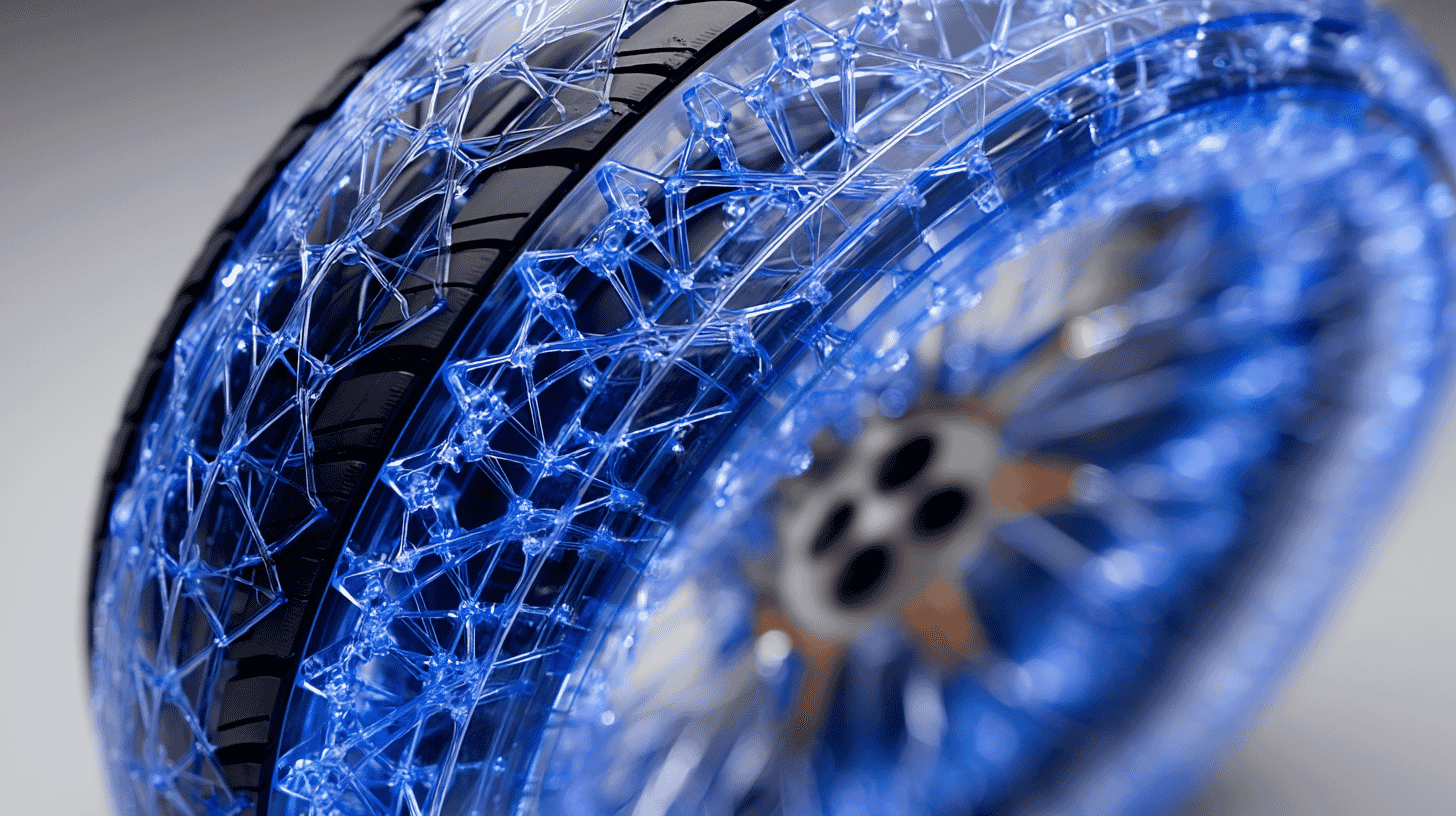
Bridgestone's AirFree deletes the air entirely. Instead of a pressurized cavity, the sides of the tire are filled with a lattice of spokes made from a specially developed thermoplastic resin. The spokes flex under load and rebound, taking over both jobs the air used to do: bearing weight and absorbing shock. A rubber tread wraps the outside, so the part touching the road behaves like a familiar tire. The model now in service supports roughly 300 kg per wheel, enough for a light, low-speed vehicle but not a highway sedan.
Two design choices give it a distinct personality. The spokes are dyed a deliberate blue, which Bridgestone calls "Empowering Blue," chosen because it stays visible at dusk better than red or yellow. And the whole thing is built to come apart cleanly: when the tread wears down you re-cover it rather than scrap the tire, and when the resin spokes reach the end of their life they can be ground up, melted, and reformed into new ones. A conventional tire, with its tangle of steel cords, fabric, and wire, is a nightmare to recycle by comparison.
Bridgestone has been chasing this since 2008. It began public-road testing near Tokyo in early 2024, and the effort has since earned a brand-new slot in the Japanese tire industry's official yearbook, "non-pneumatic tire," a category that didn't exist before.
Why robotaxis really hate punctures
There's a reason an airless tire and a driverless vehicle are such a natural pair, and it isn't romance about the future. It's plumbing.
A pneumatic tire assumes a human in the loop. Someone notices the car pulling to one side, hears the thump, checks the pressure light, swaps in the spare. Remove the driver and every one of those steps has no one to perform it. A self-driving shuttle that punctures on a rural loop can't call itself in for a tire change; it just stops, and so does the service. Across a fleet meant to run all day with minimal staff, that multiplies. Maintenance a human driver used to absorb quietly becomes an operational headache.
This is exactly the gap Japan is staring at. Rural depopulation and a shrinking labor pool are pulling bus drivers and transit crews out of small towns faster than they can be replaced. In Oku-Eigenji itself, more than 60% of residents are 65 or older, and finding anyone to keep local transport running had become a problem in its own right. Which is why "green slow mobility" (tiny electric vehicles capped below 20 km/h that can legally share public roads) has become a favored stopgap for keeping communities connected. A tire that never needs a pressure check and never leaves a shuttle stuck by the roadside removes one of the quiet ways these services fail. Bridgestone tested the idea with four municipalities, Toyama, Kurume in Fukuoka, and Tokyo's Suginami ward alongside Higashiomi, before deciding Higashiomi was ready to go live. In Toyama, an AirFree-equipped community vehicle has been running weekend loops for a flat 100-yen fare, about 60 cents.
Michelin took the hard road; Bridgestone took the useful one
Bridgestone is not alone in this, and the contrast with its biggest rival is the most revealing part of the story.
France's Michelin has been working on airless tires even longer, and has aimed much higher. Its Uptis ("Unique Puncture-proof Tire System"), co-developed with General Motors, is built for the thing Bridgestone is not attempting: full-speed passenger cars. Michelin has tested Uptis at up to 210 km/h with police pursuit in mind and run it on delivery fleets for DHL in Singapore and La Poste in France, logging more than three million kilometers of real-world running. It's an impressive body of work. It is also, more than twenty years after Michelin first showed an airless tire in 2005, still officially a prototype you cannot buy on a new car. The homologation problem is real: there is no international standard for a tire with no air in it, so much of the rulebook has to be written from scratch.
The two companies made opposite bets. Michelin chased the hardest version of the problem, a high-speed tire you couldn't tell apart from the one on your car now. Bridgestone aimed low, literally: sub-20-km/h vehicles, where the engineering is forgiving and the pain point of a stranded driverless shuttle is sharp. That is how it reached everyday use first, even if only on slow, light vehicles. Michelin does sell one airless product, the Tweel, on the market since 2012, but only for off-road gear like mowers and utility carts, not public roads.
The catch that both face, and that skeptics inside the industry keep raising, is cost. AirFree leans on a lot of high-strength resin, and Bridgestone concedes it won't undercut a normal rubber tire; one official has said the technology isn't even at the stage where a firm price can be calculated. Whether "never gets a flat" is worth a premium depends entirely on who's paying and what a breakdown costs them, which is why fleets and unstaffed shuttles, not private drivers, are where this makes sense first.
And yes, it's headed for the Moon
Since you may be wondering: the same spoke principle really is going off-planet. Bridgestone is adapting its airless technology into a tire for a lunar rover, the pressurized Lunar Cruiser that Toyota and Japan's space agency are building, and has been putting prototypes through their paces in the sand dunes of Tottori as a rough stand-in for lunar soil. The company likes to describe it as a two-way street: lessons from a vacuum where temperatures swing by nearly 300°C feed back into the tires it builds for Earth. That lunar-rover effort is a bigger story in its own right, and one we've told separately.
Japan is reaching for airless tires to keep its shrinking towns moving, and betting the technology proves itself on slow rural roads before it ever touches a highway. Where you live, is small-town transport still hanging on, and would you climb into a driverless shuttle riding on blue, air-free wheels?
References
- https://trafficnews.jp/post/685663
- https://www.bridgestone.co.jp/technology_innovation/air_free/
- https://www.bridgestone.co.jp/corporate/news/2024022901.html
- https://response.jp/article/2025/10/21/402383.html
- https://monoist.itmedia.co.jp/mn/articles/2510/21/news049.html
- https://www.watch.impress.co.jp/docs/news/1634221.html
- https://diamond.jp/articles/-/375419
- https://www.michelin.com/en/group/activities/tires/vision-concept




Global Discussion
0 comments