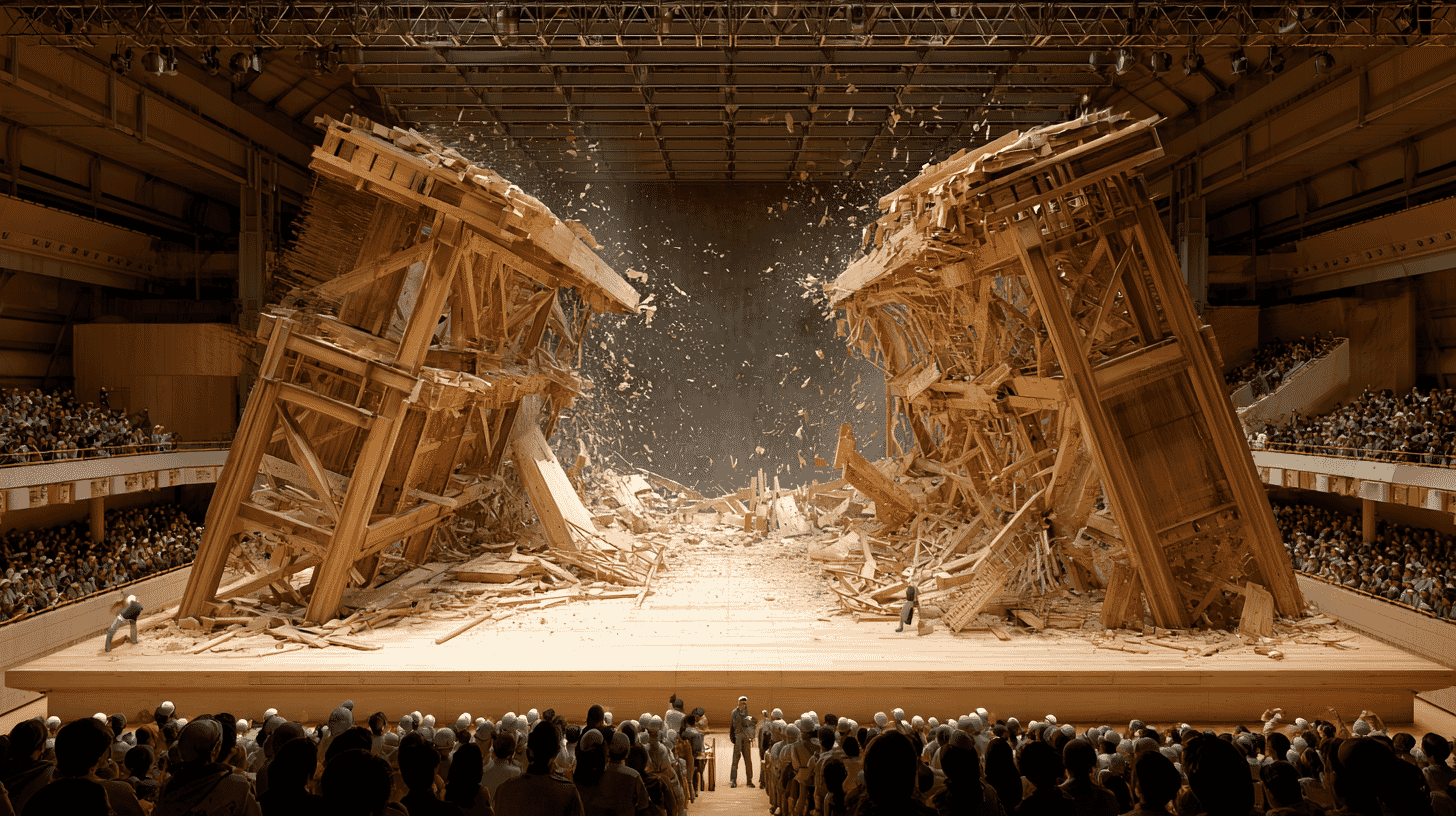
Two walls face off, and the first one to break loses. It's not the M-1 comedy contest or R-1, but a tournament to decide the strongest "wall": the Kabe-1 Grand Prix (Kabe-Wan GP). It sounds like a joke, but it's deadly serious. General contractors, university labs and home builders build what they hope is Japan's hardest-to-break wall, then pull them against each other until one gives way. Here is a structural-engineering combat sport, born from the Great Hanshin-Awaji Earthquake, where you learn while you laugh.
A Tug-of-War Between Full-Scale Walls
The Kabe-1 Grand Prix (officially "Kabe-Wan GP," a pun combining "kabe" meaning wall and "wan" meaning one/number one) is a tournament where full-scale wooden shear walls face off in head-to-head combat.
But first, what's a "shear wall"? In Japanese wooden houses, a shear wall (耐力壁 / tairyoku-heki) is the structural component that resists lateral forces from earthquakes and typhoons. It's essentially what keeps a house from collapsing sideways during a quake, arguably the single most critical component in Japanese residential construction.
In the competition, two teams build their walls on-site, bolt them to the ground, and connect the top beams with a hydraulic jack. The jack then pulls the two walls toward each other in a tug-of-war. The wall that breaks first (or deforms beyond a set limit) loses. It's sumo wrestling for building components: beautifully simple, brutally decisive.
Born From the Kobe Earthquake
Behind the playful name lies a profoundly serious origin.
The 1995 Great Hanshin-Awaji Earthquake killed 6,434 people including disaster-related deaths. According to health ministry figures, 77% of those who died between January and June that year died of suffocation or crushing, most of them under collapsed houses. Because wooden homes accounted for much of the visible damage, a belief took hold that wooden construction was inherently weak.
Professor Masahiro Inayama of the University of Tokyo (now Professor Emeritus) refused to accept that narrative. He believed that properly designed and engineered wooden walls could be incredibly strong, and set out to prove it. In 1998, he founded the "Wooden Shear Wall Japan Cup," a competition to push the limits of wooden wall engineering while making the results visible to the public. The Japan Cup ran for 20 years before being rebranded as the "Kabe-1 Grand Prix" in 2018. The 2025 edition marked the 8th Kabe-1 GP and the competition's 28th year overall, making it one of the longest-running structural engineering competitions anywhere.
From Construction Giants to Student Teams
The participant list reads like a who's who of Japanese construction, mixed with scrappy underdogs. Major general contractors (called "zenekon" in Japanese) like Kumagai Gumi and Maeda Construction compete alongside university research labs, vocational schools, house builders, and timber processing companies.
In the 2025 tournament, the 12 competing teams included "AQ Team Takumi" (a powerhouse alliance between AQ Group, University of Tokyo Professor Emeritus Inayama, and precut timber company Shinohara Shoten), Kumagai Gumi's volunteer engineering squad, a joint team from Maeda Construction and Kanazawa Institute of Technology, the "Academy Returns" alumni team from Gifu Academy of Forest Science, and several university lab teams.
What makes this special is that a student team from a regional vocational school competes on the same stage as billion-dollar construction companies. Every team gives its wall a name. The 2025 tournament champion was "Venus by the Window" (窓辺のヴィーナス); the overall champion, "Secret Shear Key-chan" (ひみつのシアキーちゃん). They sound like anime characters. They are pieces of cutting-edge structural engineering.
"Strongest" and "Best" Are Separate Titles
The Kabe-1 GP awards two major titles, each measuring something completely different.
The Tournament Championship goes to the last wall standing. Two walls fight head-to-head via hydraulic jack, and the one that breaks first is eliminated. A single wall must survive multiple rounds from the first match to the finals, so raw strength alone isn't enough: endurance under repeated stress matters just as much.
The Grand Prix (Overall Championship) is awarded based on total evaluation score divided by total cost. The score combines maximum resistance (from tournament matches), seismic performance rating (how "gracefully" a wall yields, essentially ductility), and a design score from expert judges. That total is divided by the combined cost of materials, processing, construction labor, and dismantling.
In other words, the Grand Prix goes to the wall with the best cost-performance ratio. A wall that's incredibly strong but insanely expensive will lose to a reasonably strong wall built on a modest budget. This mirrors real-world housing economics: the best wall isn't the strongest one, it's the one that delivers the most protection per yen spent.
Construction and deconstruction are also evaluated. Teams must build their wall on-site during the competition and disassemble it afterward. One team in a past tournament was penalized for taking too long to build, a reminder that elegant engineering also has to be practically buildable.
2025: A 5.4-Ton Final and a New Constraint
The 8th Kabe-1 GP was held on October 4-5, 2025, at the Institute of Technologists (Monodzukuri University) in Gyoda, Saitama Prefecture.
This year introduced a new rule: "The more metal hardware you use, the larger the opening (window) you must cut into your wall." This forces teams to balance strength against vulnerability: metal connectors add strength, but the window opening they trigger weakens the structure. An elegantly cruel dilemma.
The tournament ran over two days, qualifiers then a final knockout, with 12 teams that passed a preliminary screening. The top four from the previous year were seeded, and the remaining eight competed in the qualifiers for four places.
The tournament final pitted the defending champions "AQ Team Takumi" with their wall "Venus by the Window" against Kumagai Gumi's "Secret Shear Key-chan." The hydraulic jack drove the force up to 53kN (about 5.4 metric tons). At that point Kumagai Gumi's wall reached its limit, giving AQ Team Takumi a fourth straight tournament championship dating back to 2022. "Venus by the Window" was itself a revision of "Venus Strikes Back," the 2023 winner, with reinforced joints that freed up space for a full-size window opening.
However, the Grand Prix (overall championship) went to Kumagai Gumi. Their wall, built entirely from Japanese cypress (hinoki) laminated timber, scored well on material consistency and ease of sourcing, and also took the tournament runner-up spot and the seismic performance prize.
AQ Group holds the most wins across both the Japan Cup and Kabe-1 GP eras, and set the competition's all-time strength record at the 6th tournament in 2023.
A Place Where You Break Your Own Design
The essence of this tournament is extremely practical.
First, the experience of designing and then destroying your own creation is extraordinarily valuable for structural engineers. In normal practice, buildings are designed never to fail. Engineers rarely get to observe how their designs actually break at full scale. Kabe-1 GP is a public destructive test: teams watch in real time as their walls crack, deform and fail, learning exactly which components give way first and why.
Second, technologies developed for the competition have been directly applied to real buildings. AQ Group has used Kabe-1 GP innovations to construct a pure-timber 8-story headquarters building in Saitama and a 5-story office building in Kawasaki, structures previously thought impossible in wood. Innovations like "kumiko lattice shear walls" and "cross-notch column-beam frame structures" were born from this competition.
In the 2025 tournament, Maeda Construction entered with "Kasshaman" (a play on the Japanese word for pulley), a wall using aramid fiber ropes in a pulley mechanism, the kind of experimental approach that might reshape future structural design.
In a country where wood remains the dominant material for detached housing and where major earthquakes are a permanent risk, Kabe-1 GP is more than a spectacle. It drives earthquake-resistant housing technology forward, trains the next generation of engineers, and pushes what is learned back out across the industry.
The goofy names and the spectacle of walls shattering in front of a crowd are real. So is what sits underneath: the memory of 1995, and a determination that wooden houses should never again become coffins.
Does your country have any competitions that turn serious engineering challenges into entertaining spectacles? How does your country approach earthquake preparedness in residential construction?






Global Discussion
15 comments