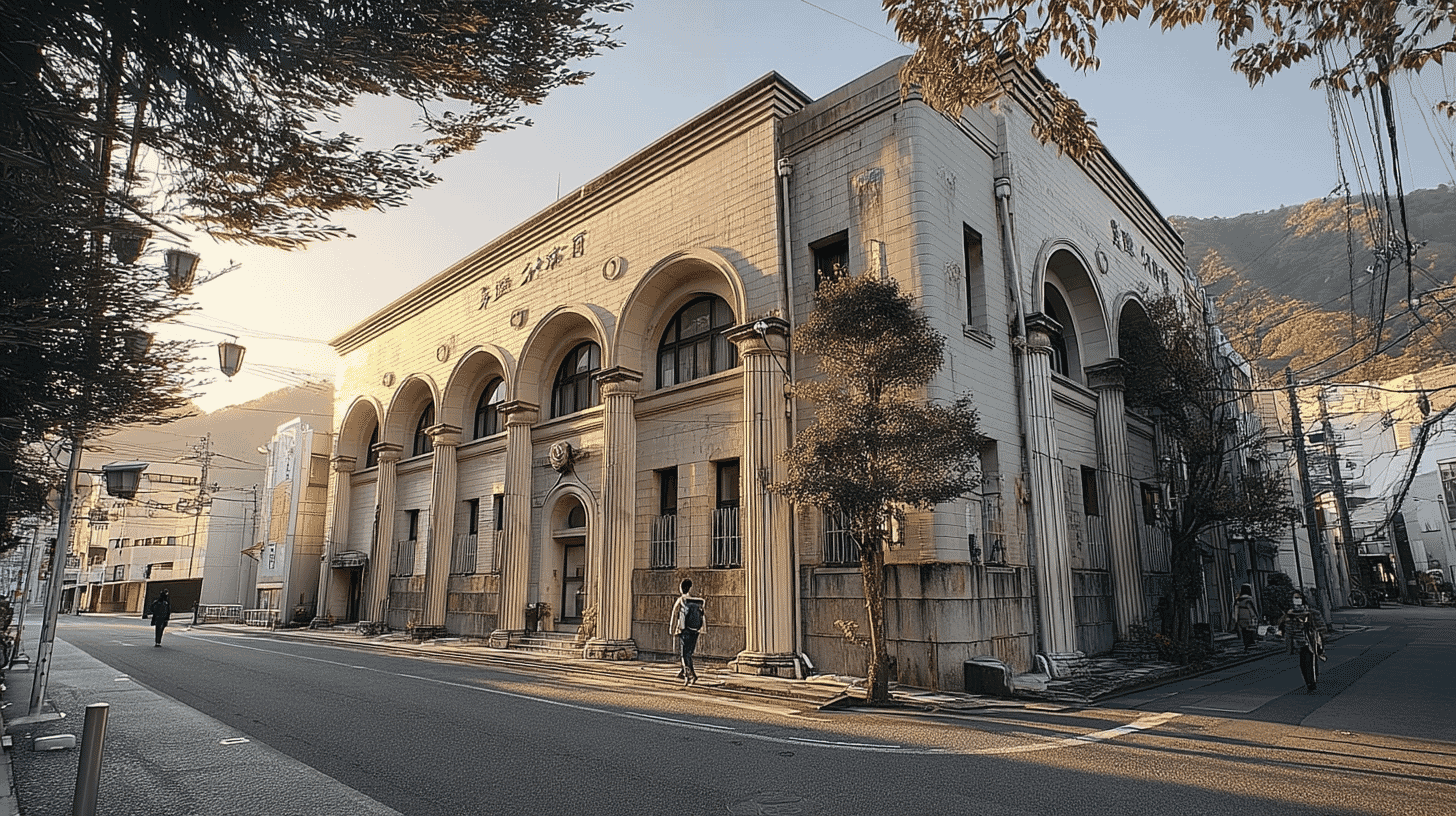
🏛️ The studio that animated Demon Slayer into the highest-grossing Japanese film ever has just bought a 98-year-old bank.
On May 11, 2026, ufotable, the Tokyo and Tokushima-based animation studio behind Demon Slayer: Kimetsu no Yaiba, announced it had acquired the former Mizuho Bank Tokushima Branch, a historic stone-faced building completed in 1928 that miraculously survived the firebombing of Tokushima in 1945. For Demon Slayer fans planning a future pilgrimage to Japan, the announcement may have just added a new must-visit stop to the map.
What ufotable Bought, and Why It Matters
The building is no ordinary piece of real estate. Originally constructed in 1928, the third year of the Showa era, as the headquarters of Awa Noko Bank, the structure is one of the few prewar buildings in central Tokushima that survived the city's near-total destruction by US incendiary bombs in July 1945. It later passed through several mergers before becoming a Mizuho Bank branch, then sat in search of a new tenant after Mizuho relocated to a building in front of Tokushima Station.
The building stands along Shinmachibashi-dori, a street that the City of Tokushima has officially designated as a "Key Landscape Formation Area" under its urban landscape plan. In plain terms: it's the kind of building Japan tries very hard not to lose.
ufotable's announcement framed the purchase in deliberately broad language. The studio said the goal is to "deepen our existing activities, pass Tokushima's historic architecture on to the next generation, and use it as a new base for entertainment." Translation: they're not telling us yet exactly what it will become.
ufotable's 26-Year Climb, and Why Tokushima
To understand why this acquisition is more than a local news story, it helps to know how ufotable got here. The studio was founded in October 2000 in northern Tokyo by Hikaru Kondo, a former production manager at Telecom Animation Film. The name comes from a UFO-shaped designer table that sat in their first office, a small detail that signals the kind of personality-driven studio they were trying to build.
For its first decade, ufotable was respected inside the industry, with Kara no Kyokai (The Garden of Sinners) in 2007, the Tales of games and the Fate franchise from 2011 onward, but it was not yet a household name. The breakthrough came in 2019 with the TV anime of Demon Slayer, followed by the theatrical film Mugen Train in October 2020, which became the highest-grossing Japanese film of all time at home.
Demon Slayer: Infinity Castle Chapter 1 then rewrote the record. Released on July 18, 2025, it closed its run on April 9, 2026 with 27.45 million admissions and ¥40.2 billion in Japan, and 98.52 million admissions and ¥117.9 billion worldwide across 157 overseas countries and regions plus Japan. That is the highest global gross of any Japanese film, and seventh among all films released in 2025. In North America it became the highest-grossing foreign-language release of all time, breaking a 25-year-old record.
Tokushima fits into this story because of Kondo himself. It is his hometown. In 2009, with the studio expanding, he opened a substudio there as a deliberate counter-Tokyo move. The branch was meant to train younger staff outside the burnout culture of the capital and to give ufotable's growth a stable, lower-cost foundation. The studio now employs around 256 people across both locations as of March 2024.
The same year ufotable opened its Tokushima studio, it also helped launch Machi★Asobi, a biannual citywide anime festival, with Kondo personally proposing the original idea to the Tokushima City Tourism Association. The event is now recognized internationally; it was selected as one of the official sites on the 88 Japanese Anime Pilgrimage Sites list in both the 2018 and 2019 editions, and at peak times has drawn around 100,000 visitors over a single weekend, comparable in local impact to Tokushima's famous Awa Odori dance festival.
The Timing Is Not Coincidental
The acquisition was announced just days before Machi★Asobi vol. 30 on May 16 and 17, 2026, and the building hosted its first public preview to coincide with the festival, with large-scale exhibits for Demon Slayer and Witch on the Holy Night (Mahoyo) and a Tales of series 30th-anniversary feature.
For now, ufotable has not committed to a long-term use. The building could become an expanded production studio, a permanent exhibition space, a cinema, a cafe, a hybrid of all four, or something the studio hasn't disclosed yet. Given ufotable's track record, which includes cafes in Tokushima, Tokyo and elsewhere plus the ufotable CINEMA theatres in Tokushima and Shinjuku, speculation in the Japanese fan community leans toward some kind of "ufotable flagship building" combining studio space with fan-facing facilities.
Why This Matters Beyond Tokushima
Step back, and the move illustrates two trends worth following:
1. A new business model for anime studios. Most anime production companies, even ones working on hit shows, struggle to capture much of the upside from those hits. They take production fees, not IP royalties. The Japanese industry is littered with studios that animated beloved series and then quietly went bankrupt. ufotable is one of the few that has secured a meaningful share of its IP and is now reinvesting those returns into long-term assets, historic real estate included. For aspiring Japanese studios, ufotable is becoming a kind of survival playbook: build outside Tokyo, control your IP, run your own theaters and cafes, and reinvest in your community.
2. Anime as rural revitalization. Japan's countryside is depopulating fast. Cities like Tokushima, with about 250,000 people, are exactly the kind of regional capital that struggles to keep young people from leaving for Osaka or Tokyo. An anime studio that is globally famous, growing, and headquartered in town is a rare gift. It creates jobs for young animators, draws fans from around the world, and gives the city a story to tell. Academic studies from Waseda University and Japan's Development Bank have documented measurable economic effects from "anime pilgrimage" tourism on host municipalities, from increased taxpayer income to higher nighttime luminosity (a proxy for economic activity) in towns that became "holy lands."
What This Means for International Fans
If you've ever thought about visiting Japan because of Demon Slayer, Tokushima just became a much more interesting place. Currently, the most obvious pilgrimage stops for the franchise are: the ufotable Cafe locations in Tokyo and Tokushima, the ufotable CINEMA in Shinjuku, and various locations connected to the manga's settings. The new Tokushima building doesn't yet have a public-facing identity. But if past ufotable patterns hold, and the Machi★Asobi CAFE BIZAN on top of Mt. Bizan with its panoramic night view of the city is the obvious precedent, fans should expect something photogenic, atmospheric, and tied directly to ufotable's IP.
The smart move for fans planning a 2027 or 2028 Japan trip: build in two or three days for Tokushima. The city is reachable by bus from Osaka (about 2.5 hours) or by plane from Tokyo. You can pair it with the Awa Odori in August, or with Machi★Asobi in May and November.
A Larger Question
There's a broader question lurking under all this: what is an anime studio? In ufotable's case, it's increasingly not just a production house. It's a cinema operator, a cafe chain, a festival organizer, a regional employer, and now, a custodian of prewar architecture. That's an unusual configuration anywhere in the world. The closest analogue might be the way Pixar transformed Emeryville, California, or the way Studio Ghibli built its museum in Mitaka, Tokyo, but ufotable's version is more decentralized, more rooted in a single regional city, and more openly tied to the goals of local revitalization.
For now, what we know is this: a 98-year-old building that survived a war, watched a banking industry consolidate around it, and stood empty for years has been handed to a company that turns drawings into worldwide phenomena. What ufotable does with it next will be worth watching.
🏘️ In your country, what happens to historic bank buildings, school houses, or other prewar architecture that lose their original purpose? Do creative companies step in to reuse them, or do they tend to get demolished? Tell us in the comments. We'd love to hear how this looks from where you are.
References
- https://news.yahoo.co.jp/articles/bb2730c2803a3a40ca3f9f80d01774d6291b125f
- https://magmix.jp/post/353577
- https://www.ufotable.com/en/
- https://www.machiasobi.com/
- https://www.hollywoodreporter.com/movies/movie-features/demon-slayer-infinity-castle-hikaru-kondo-interview-1236477550/
- https://en.wikipedia.org/wiki/Ufotable








Global Discussion
14 comments