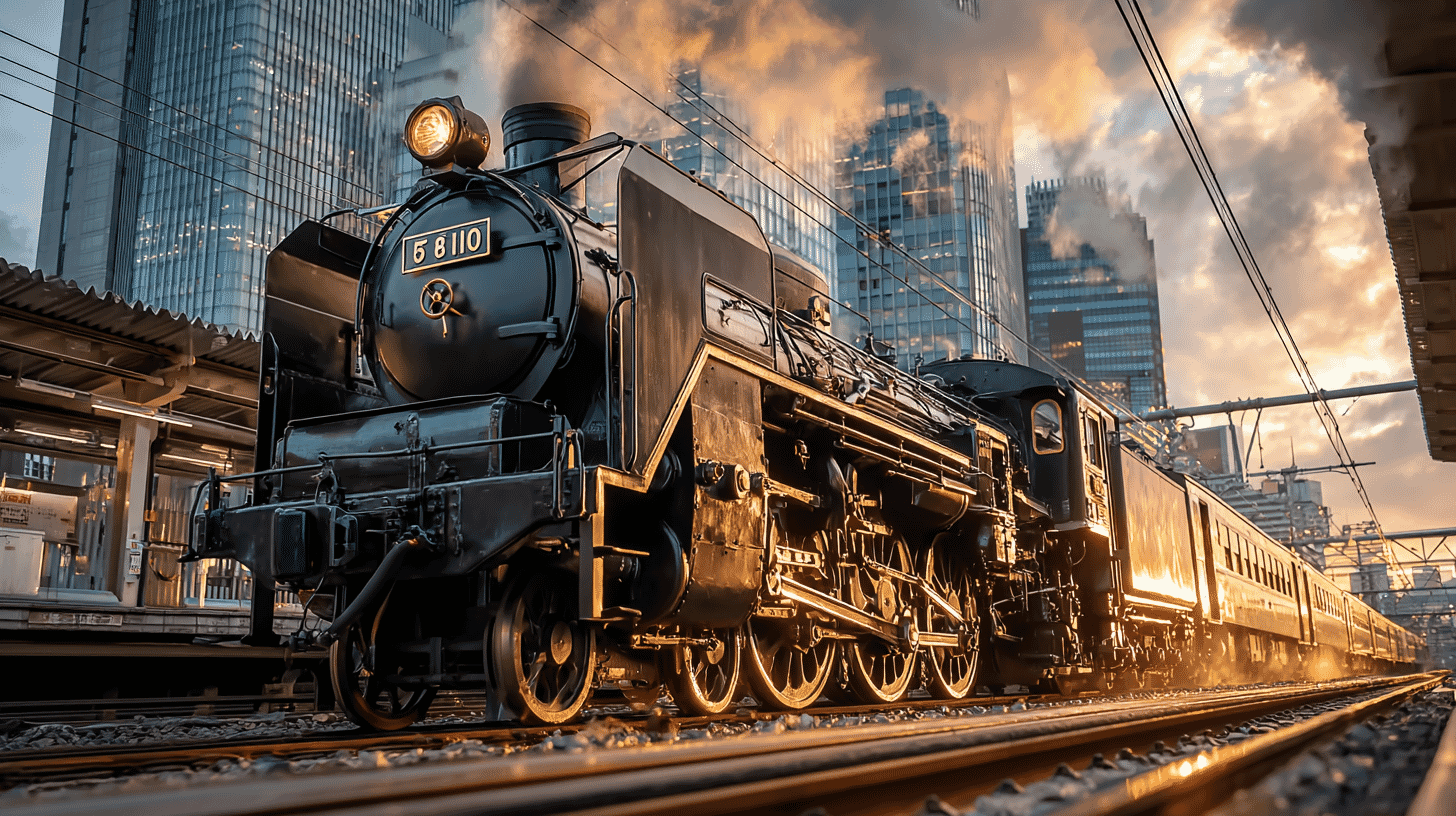
In the heart of downtown Nagoya, a 120-year-old steam locomotive has roared back to life. Its wheels turn, its whistle screams, smoke billows from its stack, and admission is free. Built in Germany during the Russo-Japanese War era, it is said to be the only German-made B6-class engine left anywhere. How did engineers bring it back after decades of dormancy? The answer involves a missing part, a German factory, and a set of drawings destroyed in a war.
"Railway Square" Opens at Nagoya City Science Museum
On March 28, 2026, a brand-new outdoor exhibition area called "Tetsudō Hiroba" (Railway Square) opened at Nagoya City Science Museum in the Sakae district, the very center of Japan's fourth-largest city.
The star of the show is a B6-class steam locomotive manufactured in Germany in 1904. At a ceremony the day before, Nagoya Mayor Ichirō Hirosawa and other officials attended an unveiling followed by the locomotive's first live demonstration, drawing cheers from rail fans and curious locals alike.
Nagoya City Science Museum is already famous for housing one of the world's largest planetariums and an outdoor display of Japan's H-IIB rocket. With Railway Square, it now offers visitors the rare experience of seeing, and feeling, a piece of living railway history alongside cutting-edge space science.
The entire Railway Square area is free to enter, making it an easy stop during a day of shopping or sightseeing in central Nagoya.
A 120-Year Journey: From the Russo-Japanese War to Downtown Nagoya
The B6's story reads like a history of modern Japan compressed into a single machine.
This engine is No. 2412, built in 1904 at the Hannover works in Germany. It was reportedly imported to haul military supplies during the Russo-Japanese War (1904–1905) and was first delivered to the Imperial Japanese Army.
The museum's exhibit guide traces what came next. From April 1905 the locomotive belonged to the Railway Bureau, the ancestor of today's JR. It ran the Chūō Line in the Taishō era and the Taketoyo and Takayama lines through the Shōwa years. Withdrawn at the Takayama depot in January 1948, it was sold to Ishihara Sangyo's Yokkaichi plant and worked the factory's private line hauling freight and commuting workers until July 1968. It served the main lines first and put in another two decades inside a chemical plant afterward.
Once retired, it was donated to Nagoya City Science Museum and stood in the outdoor exhibition area on the museum's southeast side until September 2016, when circumstances took it away from the museum for what turned out to be a long absence. It is said to be the only German-made B6 left anywhere.
The design pedigree is the intriguing part. According to the museum, the engineer who designed it, R.F. Trevithick, also supervised construction of Japan's first domestically built steam locomotive, and the draftsman, Yoshimatsu Ōta, drew the plans for that same pioneering engine. The design work happened at the government railway's Kobe works. So this German-built machine was designed in Japan, drawn by a Japanese engineer, and of the locomotives that pair produced together, the museum says the B6 is the only one preserved.
The Hardest Part: A Component That No Longer Had Drawings
What makes Railway Square's exhibition truly special is that this 120-year-old locomotive actually moves.
Burning coal in the middle of a modern city was never an option, so the power source was switched to compressed air. The engine sits on roller bearings, so it travels nowhere, but the wheels spin and the rods pump on the same mechanism they used a century ago.
Each demonstration lasts about 40 seconds. The wheels rotate powerfully, the body vibrates, smoke rises from the chimney, and the whistle lets out a sharp blast. It's surprisingly dramatic for something that isn't technically going anywhere.
According to the restoration team, the single hardest part was making the "eccentric rod" (henshinbō), the component that controls piston movement in a steam engine. When the locomotive was donated to the museum decades ago, this part had been removed.
The museum went to the German manufacturer that built the engine and asked for the drawings. There were none: they had been destroyed during the Second World War. So the rods had to be made from nothing. Four of them were needed, and each was a slightly different length, which is where most of the difficulty lay.
Beyond the eccentric rods, the team restored the braking system and the oil distribution mechanisms. The point, the staff member said, is for visitors to understand how a steam locomotive actually worked.
A see-through LED display sits near the locomotive, overlaying animated diagrams onto the machine itself so visitors can see how the internal mechanisms work.
Demonstrations run approximately seven times per day on weekends and holidays, and three times on weekdays.
More Than Just the B6: What Else to See
Railway Square features several other historically significant vehicles.
The Oha 35 No. 2001 is a passenger coach built in Nagoya during the early Shōwa period (1930s). Transferred from JR East's Ōmiya General Rolling Stock Center and carefully restored, it allows visitors to step inside and experience the craftsmanship of prewar Japanese railcar manufacturing.
Perhaps even more unusual is the Gubusha (Imperial Escort Car) No. 344, a special vehicle used to carry attendants accompanying members of the Imperial Family. These cars were rarely seen by the public, making this a genuinely rare viewing opportunity.
The museum's existing Nagoya City Tram No. 1401 (Type 1400) also remains on display within the Railway Square area.
Wall-mounted exhibition panels trace the history of rail technology from the Industrial Revolution to the present day, explaining how railways transformed everyday life. The space itself is designed to evoke the atmosphere of a traditional Japanese train station, complete with wooden benches, platform clocks, and station-name signboards.
A Rail Fan's Dream Day: The Nagoya Railway Route
Nagoya may not be the first city that comes to mind for railway tourism, but the opening of Railway Square completes what may be the most comprehensive single-day rail heritage experience in Japan.
Stop 1: Railway Square at Nagoya City Science Museum, Start your morning with the B6 demonstration. The museum's world-class planetarium and rocket exhibits make it easy to spend the first half of the day here.
Stop 2: SCMAGLEV and Railway Park, Take the Aonami Line from Nagoya Station to Kinjōfutō Station (about 24 minutes). JR Central's railway museum displays 39 real vehicles, from the record-breaking C62 steam locomotive to the experimental superconducting maglev. The Shinkansen driving simulator and Japan's largest railway diorama are highlights. Admission is around $8 (¥1,000) for adults.
Stop 3: Meiji-mura (Museum Meiji Village), For the truly dedicated, head to Inuyama (about 40 minutes from central Nagoya). This open-air museum preserves over 60 Meiji-era (1868–1912) buildings, but for rail fans, the real draw is two steam locomotives, No. 12 and No. 9, that actually pull passenger coaches along a short line within the grounds. Both the locomotives and the coaches date from the Meiji period, making this a globally unique experience of riding vehicles that are all over 100 years old.
From an 1904 German-built steam engine to a superconducting maglev designed for 310 mph, Nagoya may be the only city in the world where you can trace the entire arc of railway history in a single day.
Japan's Railway Preservation Culture: A Global Comparison
Steam locomotive preservation is a global passion, but different countries approach it in distinctly different ways.
In Britain, volunteer-run heritage railways are the backbone of preservation culture. Organizations like the Bluebell Railway and the North Yorkshire Moors Railway operate regular steam-hauled services on real track, funded largely by donations and volunteer labor. Britain has over 100 heritage railways, more than any other country, reflecting a deeply grassroots tradition of preservation.
In the United States, preservation tends toward the spectacular. Union Pacific's 2019 restoration of "Big Boy" No. 4014, one of the largest steam locomotives ever built, was a corporate-funded project that sent the engine on tours across the country. American preservation often involves railroad companies themselves investing significant resources to restore flagship locomotives as moving corporate heritage.
Japan's approach is notably multi-layered. JR companies operate steam trains on mainline tracks (like the SL Yamaguchi-gō and SL Taiju), private railways like the Ōigawa Railway run steam services year-round, theme parks and open-air museums like Meiji-mura offer steam experiences in curated settings, and now Nagoya's Science Museum demonstrates a city-government-led urban approach using compressed air. Between them, Japan keeps a dozen or so locomotives in a condition where fire can still be lit, in a country that retired steam from regular mainline service in the 1970s.
The compressed-air approach seen at Railway Square is particularly innovative. Unable to burn coal or raise live steam downtown, the team made a century-old machine move on modern pneumatics instead, keeping the mechanical experience intact while working inside the constraints of a city center.
No Drawings, and It Still Moves
The best part of this restoration is that the drawings no longer exist. The museum asked the factory that built the engine, and the answer had been lost in a war. The four eccentric rods were made anyway, each length adjusted by hand, and the wheels turned.
Preservation is not only about keeping objects still. Sometimes it means rebuilding knowledge that has already disappeared. Those 40 seconds in Nagoya are what that looks like.
How are historic steam locomotives and railway vehicles preserved in your country? Are there heritage railways where you can actually ride behind a steam engine? We'd love to hear your stories.
References
- https://trafficnews.jp/post/649944
- https://www.ncsm.city.nagoya.jp/visit/visitors_guide/information/2025/b6_1.html
- https://railf.jp/news/2026/01/20/004000.html
- https://www.ncsm.city.nagoya.jp/visit/attraction/special_exhibition/sl.html
- https://museum.jr-central.co.jp/
- https://www.meijimura.com/experience/sl%E4%B9%97%E8%BB%8A%E4%BD%93%E9%A8%93/







Global Discussion
15 comments