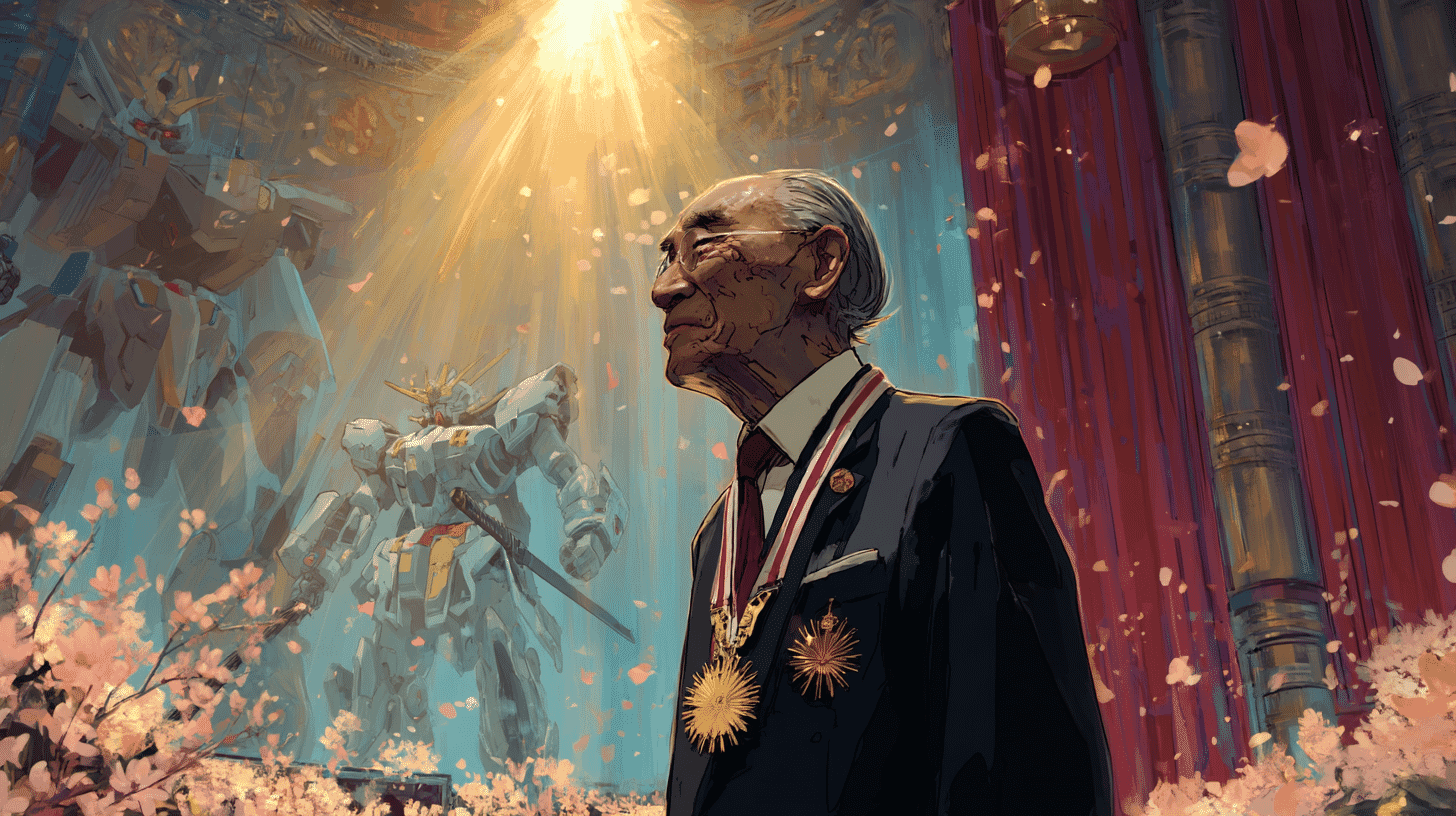
"I'm happy they noticed someone who's basically a behind-the-scenes worker."
The man who, in 1979, fundamentally rewrote what mecha anime could be has finally received an official decoration from the Japanese government. The Order of the Rising Sun, awarded to Mobile Suit Gundam creator Yoshiyuki Tomino, is more than personal recognition: it's the moment Japan formally acknowledged that anime has graduated from "kids' entertainment" to a cultural medium that adults take seriously. If you're a Gundam fan anywhere in the world, this is news worth understanding.
What just happened
On April 29, 2026 (Showa Day, a Japanese national holiday), the Japanese government announced its 2026 Spring Conferment of Decorations. Among the 3,875 recipients, 84-year-old Yoshiyuki Tomino, known internationally as the original creator and chief director of Mobile Suit Gundam, was awarded the Order of the Rising Sun, Gold Rays with Neck Ribbon (旭日中綬章, Kyokujitsu Chūjushō). Manga artist Machiko Satonaka, known for Aries no Otometachi, was also honored with the same decoration.
Tomino's reaction comment was vintage Tomino: "Animators get the spotlight, while directors aren't really recognized as a presence. So it makes me really happy that they noticed me, someone who's basically behind the scenes, and chose to honor me." He added a message to younger creators: "I want to tell young people that you can work in anime even if you can't draw."
What is the Order of the Rising Sun? A primer for international readers
Japan's Jokun (叙勲) system is a state honors program dating back to 1875 (Meiji 8). Decorations are conferred in the name of the Emperor on individuals who have made significant contributions to the nation or society. Announcements come twice a year, Spring (April 29) and Autumn (November 3), and recipients are generally aged 70 or older.
The Order of the Rising Sun specifically recognizes outstanding achievements in non-governmental sectors: industry, culture, arts, sports, NGOs, and so on. It's organized in six classes, from highest to lowest:
- Grand Cordon of the Order of the Rising Sun
- Gold and Silver Star
- Gold Rays with Neck Ribbon ← Tomino's class
- Gold Rays with Rosette
- Gold and Silver Rays
- Silver Rays
Tomino's class corresponds to what was historically called Kun-santō (Third Class). The medal is worn around the neck on a white ribbon with red borders. Recipients have the right to be received in audience by the Emperor, with the actual conferment delivered by the Minister of Education, Culture, Sports, Science and Technology in this case.
Tomino had already received Japan's near-highest cultural honor
This isn't Tomino's first state recognition. In 2021, he was designated a Person of Cultural Merit (文化功労者, Bunka Kōrōsha), a separate honor for individuals who have made distinguished contributions to cultural advancement. It's considered second only to the Order of Culture itself, comes with a lifetime annuity, and Tomino was only the second anime director ever named to this rank, following Hayao Miyazaki in 2012.
So the 2026 Order of the Rising Sun isn't an upgrade, it's a parallel acknowledgment from a different axis of the honors system. Tomino is now decorated through both the cultural-merit and imperial-decoration tracks, which is rare for anyone, let alone someone from anime.
Why does Tomino get honored? What Gundam actually changed
For longtime mecha fans, this is preaching to the choir, but it's worth restating Tomino's place in anime history.
He invented the "Real Robot" subgenre: full stop
Until the late 1970s, Japanese giant-robot anime largely meant Super Robots, Mazinger Z style shows where the protagonist's special powers piloted an oversized robot to defeat evil organizations in episodic, child-targeted morality plays.
When Mobile Suit Gundam premiered in 1979, it inverted that premise. Mobile Suits were mass-produced weapons, deployed within a politically and militarily complex war, and young soldiers were chewed up by attrition. Drawing on his own childhood memories of incendiary bombs falling near his hometown during WWII, Tomino brought the brutality of war and the humanity of soldiers into the foreground.
Western anime scholarship is unambiguous about the impact: "With its new, realistic approach to giant robots, Gundam changed the face of mecha anime and split the genre into two. Single-handedly inventing the 'Real Robot' subgenre, Gundam forced all of its predecessors to be redefined as part of the 'Super Robot' subgenre."
One franchise rewrote how anime makes money
The original Mobile Suit Gundam TV broadcast was actually canceled at episode 43 due to weak initial ratings. But reruns and three compilation films (1981–82) ignited fandom, and Bandai's Gunpla (Gundam plastic models) exploded into a social phenomenon. Gundam essentially rewrote the business model for monetizing anime IP, becoming an early template for what we now call media-mix strategy.
After 1979, Tomino directed Mobile Suit Zeta Gundam, Char's Counterattack, Mobile Suit Gundam F91, Victory Gundam, ∀ (Turn A) Gundam, and Gundam Reconguista in G, plus non-Gundam classics like Space Runaway Ideon, Aura Battler Dunbine, and Overman King Gainer.
Reading Tomino's "behind-the-scenes" comment
When Tomino calls himself "behind-the-scenes," he isn't just being modest. He's making a structural point about the industry. Animator-directors like Hayao Miyazaki are visible because they personally draw. Non-drawing directors, those who work on storyboards, screenplay, and direction, have long been treated, even internationally, as little more than the name at the bottom of the credits.
His message to young creators, "you can work in anime even if you can't draw", is encouragement specifically for those pursuing non-drawing roles: scriptwriters, episode directors, producers, sound directors. Read in that context, the comment is industrial advocacy, not just personal humility.
His follow-up, "anime, which used to be considered not a job for adults, has come to be accepted by society and to function as entertainment", is the kind of summary only a 47-year industry veteran could offer with that weight.
The state of Gundam in 2026: globally
As Tomino receives this honor, the Gundam IP is operating at the highest international visibility in its history.
SD Gundam G Generation ETERNAL: the all-Gundam mobile collision
For Gundam game fans, the headline title right now is SD Gundam G Generation ETERNAL, released globally on iOS and Android on April 16, 2025. It's a free-to-play turn-based strategy game featuring 500+ mobile suits drawn from 70+ Gundam titles, letting players form squads across series boundaries.
This is also significant as the first mobile Gundam strategy game to launch in the West since the series' console debut in 1998, marking a real shift in Bandai Namco's global Gundam strategy. The game just passed its first anniversary, with scenarios from Tomino-directed entries, original Mobile Suit Gundam, Zeta Gundam, G-Reco, being added in rolling updates.
A Netflix live-action Gundam film is in production
Filming for the Netflix × Legendary Pictures live-action Gundam feature took place in Queensland, Australia from April 2026, with Sydney Sweeney leading and Japanese actress Shioli Kutsuna joining the cast; production wrapped in mid-2026. While Tomino's personal involvement isn't publicly stated, Sunrise / Bandai Namco Filmworks holds executive-producer positions, and after 47 years, a serious Hollywood adaptation is finally happening.
Life-size Gundam statues are global landmarks
From Odaiba's first life-size statue (2009), to Yokohama's moving RX-78 (closed 2024), Fukuoka's life-size ν Gundam at LaLaport, and Shanghai's life-size Freedom Gundam, the giant humanoid Tomino imagined in 1979 now physically stands in cities worldwide as tourist landmarks. That's a remarkable arc for a fictional weapon system.
What's next, and what this means for the industry
In his statement, Tomino said: "I expect the next new talent, the kind who can present a new worldview, to emerge." An 84-year-old active creator publicly looking past himself toward "the next talent" is a strong signal to the industry.
For the record, Tomino remains characteristically blunt about contemporary Gundam consumption. In the May 2026 issue of Animage, he expressed disappointment that fans who consume the series as military-otaku content "didn't get the message", a reminder that the franchise's anti-war origins are central to its meaning. State decoration hasn't softened him.
This Order of the Rising Sun isn't only personal recognition. It's a marker that the role of anime director and screenwriter is now eligible for state-level honor in Japan. As Japanese animation crosses a trillion-yen global market and shares marquees with Hollywood blockbusters, formally honoring the people who built that foundation is overdue, but the symbolism of the state shining a light on what Tomino calls "behind-the-scenes" work is significant.
How is Gundam received in your country?
It's been 47 years since Mobile Suit Gundam premiered in Japan. In North America, Gundam Wing on Cartoon Network's Toonami block is what hooked Millennials, with Gen Z picking up via streaming. In China, the Shanghai Freedom Gundam is a destination. In Europe, French bande dessinée festivals and Italian anime conventions have championed Gundam. In Brazil and Mexico, it's central to anime communities.
Gunpla, anime, video games, films, what was your entry point to Gundam? How well-known is the name "Yoshiyuki Tomino" where you live? And do you think anime directors in your own country could ever receive a state honor like this? Tell us in the comments.






Global Discussion
12 comments