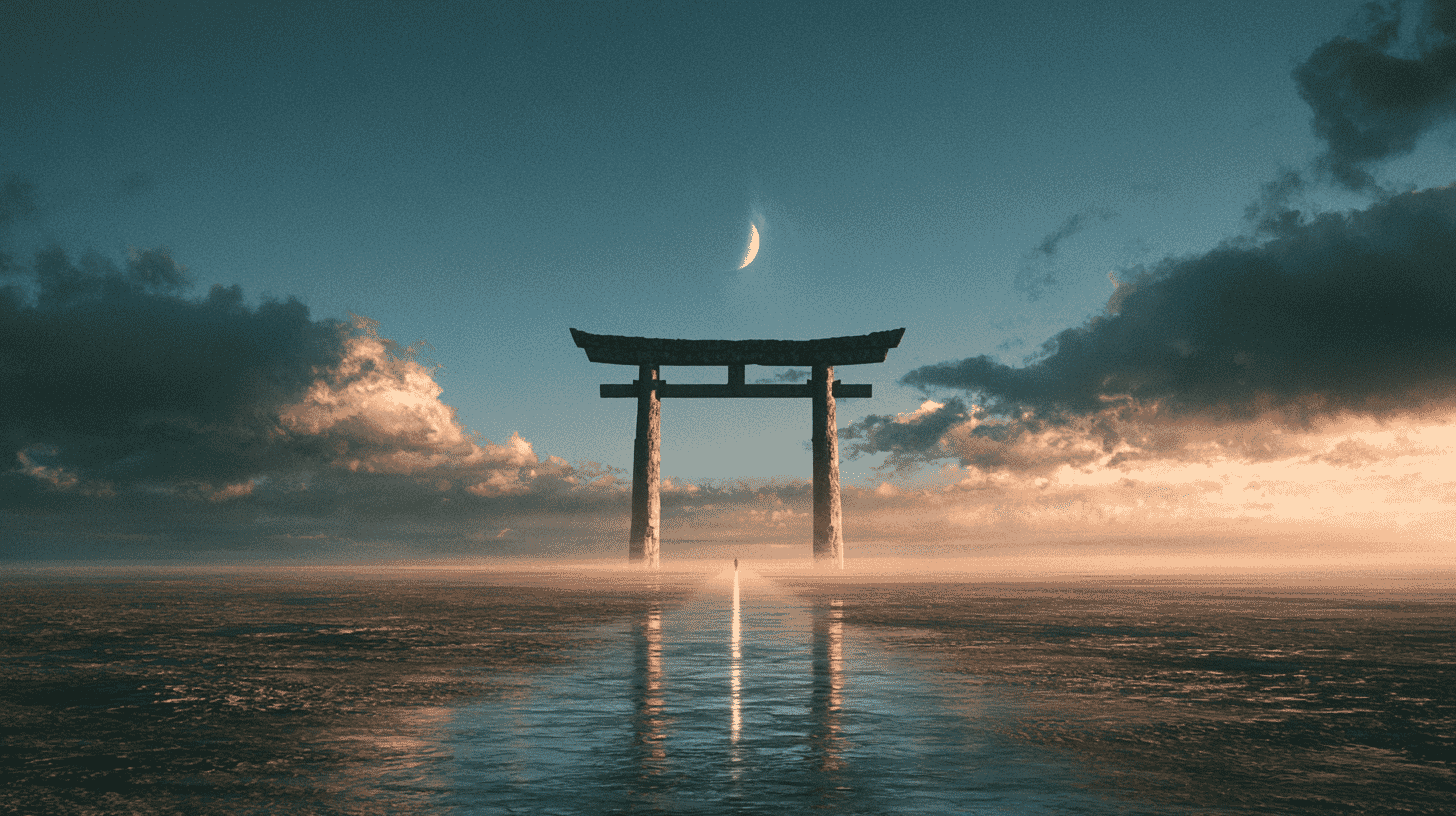
⛩️ A German karate world champion posted a photo of herself mid-high-kick under a torii gate, and Japanese social media split clean in two. Half called it sacrilege. Half asked what, exactly, was so bad about it. A magazine put that second question to the shrine authorities. The answer: there's no rule to break.
Nobody could say which rule she broke
Sophie Wachter won gold in women's team kata for Germany at the 2014 World Karate Championships. Visiting Japan, she put a photo on Instagram. The spot is reported to be a shrine in Fukuoka Prefecture. Standing right under a row of stone torii, she has one leg swung high into the space inside the pillars. Her foot never seems to touch the stone. The caption said, roughly, that she couldn't see a torii without kicking at it.
The pile-on was immediate. Would she do that to a crucifix in a church? Wachter took the photo down and apologized, saying she had meant no insult to Japanese culture and hadn't thought it through in the moment.
Then came the pushback. She didn't actually kick the gate. Plenty of Japanese athletes train right next to shrines. Would a punch pose have been fine? Can anyone actually put the line into words?
There's precedent. In October 2024, two sisters from Chile posted video of themselves hanging off the torii at Nakashima Shrine in Muroran, Hokkaido, doing pull-ups. They deleted it and apologized, and the shrine told reporters it had found the whole thing disrespectful. But dangling from a gate and posing next to one aren't the same act, and the argument lived in that gap.
So Shueisha Online called the Fukuoka Prefectural Shrine Agency, which coordinates shrines across the prefecture and posts basic etiquette on its own site. The official said the agency knew about the case, then explained that shrine Shinto simply isn't built on commandments or regulations, which makes it hard to rule anything absolutely out. What counts is how other worshippers feel and how you feel yourself; his closing line was to act in a way you wouldn't consider rude.
That isn't a dodge. That's the answer.
There are 52 million more believers than people here
Every year the Agency for Cultural Affairs asks religious organizations how many adherents they have. In the count for December 31, 2024, Shinto groups reported 86.36 million and Buddhist groups 80.46 million, for a national total of 175 million.
By the Statistics Bureau's estimate for August 1, 2026, Japan's population was about 123 million.
That's roughly 52 million extra. The trick is simple: one household gets counted as parishioners of the neighborhood shrine and also as members of the family temple.
Ask individuals about themselves, though, and the answer flips. The Institute of Statistical Mathematics has run the same question since 1958: do you hold any faith or belief? In the most recent published round, in 2018, 26 percent said yes. Asked instead whether a "religious mind" matters, 57 percent said it does.
Most people say they have no religion, say religious feeling matters, and on paper belong to two faiths. All three are true at once.
A shrine isn't a belief. It's your neighborhood.
Shrine Shinto has no founder. No scripture doing the job a Bible does. And, as the Fukuoka official put it, no commandments. What it has is places. Japan holds 80,570 shrines and 76,390 Buddhist temples. Add them up and you're near 157,000 sites. Inari shrines alone account for about 32,000.
The Association of Shinto Shrines describes your ujigami as the kami of the district you live in, the deity closest to you. Not the one you picked. The one your address assigned you.
That's what a torii is for. By the association's own account, the gate stands on the boundary between inside and outside, and everything past it is shin'iki, the god's ground. Some shrines have no building at all, because the sacred object is a mountain or a rock, and the torii is what marks where ordinary life stops.
Which is why the kick photo hit the way it did. A torii isn't a backdrop. It's a property line. And what the association writes about passing through it isn't a rule but a comparison: bow first, the way you would stepping into the home of someone older than you.
Even the famous rules are looser than the internet claims. The association mentions that people often avoid the center of the path, since that lane belongs to the kami, and then adds that there's no strict regulation about how to walk it. On offerings, it states outright that no set amount has ever been fixed.
Shrines are Shinto, temples are Buddhist. So where's the Emperor?
Start with the basics. A torii out front means a shrine, and a shrine means Shinto. A temple gate with a statue you can see behind it means Buddhism. So far, so good.
The awkward part is that not many Japanese people can take it much further. You learn it with your body: New Year at the shrine, funerals at the temple. Ask what the actual difference is and most people land on "the one with the torii."
At the center of Shinto is Amaterasu, enshrined at Ise. The Association of Shinto Shrines treats Ise as its honso, the shrine the rest of the country looks up to. And in the mythology, the imperial family descends from Amaterasu. That's why most shrines carrying the name jingu are tied to the imperial house or enshrine past emperors.
But there's no pope sitting at the top. The national body, the Association of Shinto Shrines, is a postwar creation: in 1946 shrines left state control and became ordinary religious corporations. The link between the Emperor and Shinto is a matter of myth and history, not a chain of command running out of the palace today.
Buddhism arrived in 538, by the Agency for Cultural Affairs' reckoning. Kami worship was already here. The fourteen centuries since are a story about dividing up the work.
The visible differences are easy. Shrines open with a torii and a pair of komainu, the lion-dogs. Temples open with a gate and often a statue you can look straight at. A shrine's inner hall is usually shut, opened only for the big rites, while a temple's main hall shows you exactly what you came for.
At a shrine: two bows, two claps, one bow. Temples vary by sect: Pure Land schools center on the nenbutsu, Nichiren schools on the daimoku, Zen on sitting. What a visitor notices across all of them is that nobody claps.
The split across a lifetime is sharper. Shrines handle beginnings: a baby's first visit, Shichi-Go-San, weddings, the rite before you build a house, the first prayer of the year. Temples handle endings: funerals, memorial services, the family grave.
But the line leaks everywhere. Shinto funerals exist, and the association publishes the order of service. It also says Shinto and Buddhist graves look basically alike, because building graves wasn't an Indian Buddhist idea at all and came from Japanese custom. Obon and the equinox visits, it notes, sit on both sides of the fence.
The clearest boundary is how death is handled. For the mourning period after a family member dies, conventionally fifty days, the association says you hold off on shrine visits and pause the household altar. Death isn't evil in Shinto. It's kegare, something you wash off before stepping back inside the gate. Temples keep the dead; shrines handle the return to ordinary life.
They used to be the same place
This division of labor isn't an old arrangement. Under honji suijaku, the framework that shaped Japanese religion from roughly the twelfth century, kami were understood as buddhas who had shown up in Japan to help people. Shrines had temples in their grounds and temples had shrines. In the Edo period every household was legally required to register at a Buddhist temple, a system built to flush out hidden Christians, and that's exactly how temples ended up owning funerals.
Then in 1868 the Meiji government ordered the two pulled apart, and the wave of anti-Buddhist destruction that followed wrecked a great deal.
So the tidy shrine-versus-temple chart visitors memorize is about 160 years old, a line drawn from above onto a thousand years of mixture. No wonder there's no rulebook to hand you.
Nobody can explain it, and everybody protects it
The word running through the angriest replies was bachi-atari. Read literally: the punishment lands on you. There's no hell doctrine behind it and no priest enforcing it. It's closer to a flinch than a belief.
That's the honest answer to everyone demanding somebody define the line. If nearly six in ten think religious feeling matters while barely a quarter claims a faith, then most of the people defending that torii were defending something they can't fully explain either. They weren't quoting scripture. They were reacting the way you would if a stranger turned your grandmother's front step into a photo studio.
The usable rule is the one the Fukuoka official gave: don't do the thing you'd feel weird doing. Bow at the gate. Rinse your hands. Take photos, since most shrines are relaxed about it, and read the signs, because some inner areas aren't. Then go.
Japan has a lot of these boundaries and almost nothing written down about them. Where does that line sit where you live, between a place you photograph and a place you don't, and how did you learn where it was?
References
- https://shueisha.online/articles/-/258435
- https://www.bunka.go.jp/tokei_hakusho_shuppan/hakusho_nenjihokokusho/shukyo_nenkan/pdf/r07nenkan.pdf
- https://www.stat.go.jp/data/jinsui/pdf/202608.pdf
- https://www.ism.ac.jp/survey/index_ks14.html
- https://www.jinjahoncho.or.jp/omairi/torii/
- https://www.jinjahoncho.or.jp/omairi/sanpai/
- https://www.jinjahoncho.or.jp/omairi/bukki/
- https://www.jinjahoncho.or.jp/shinto/
- https://www.jinjahoncho.or.jp/honsou_jingu/
- https://www.jinjahoncho.or.jp/faq/
- https://projects.mcah.columbia.edu/jaanus/node/3928
- https://www.cambridge.org/core/books/new-cambridge-history-of-japan/religion-in-the-tokugawa-period/11598B1FDD9D9927BB5DB18289B92C50
- https://en.wikipedia.org/wiki/2014_World_Karate_Championships






Global Discussion
4 comments