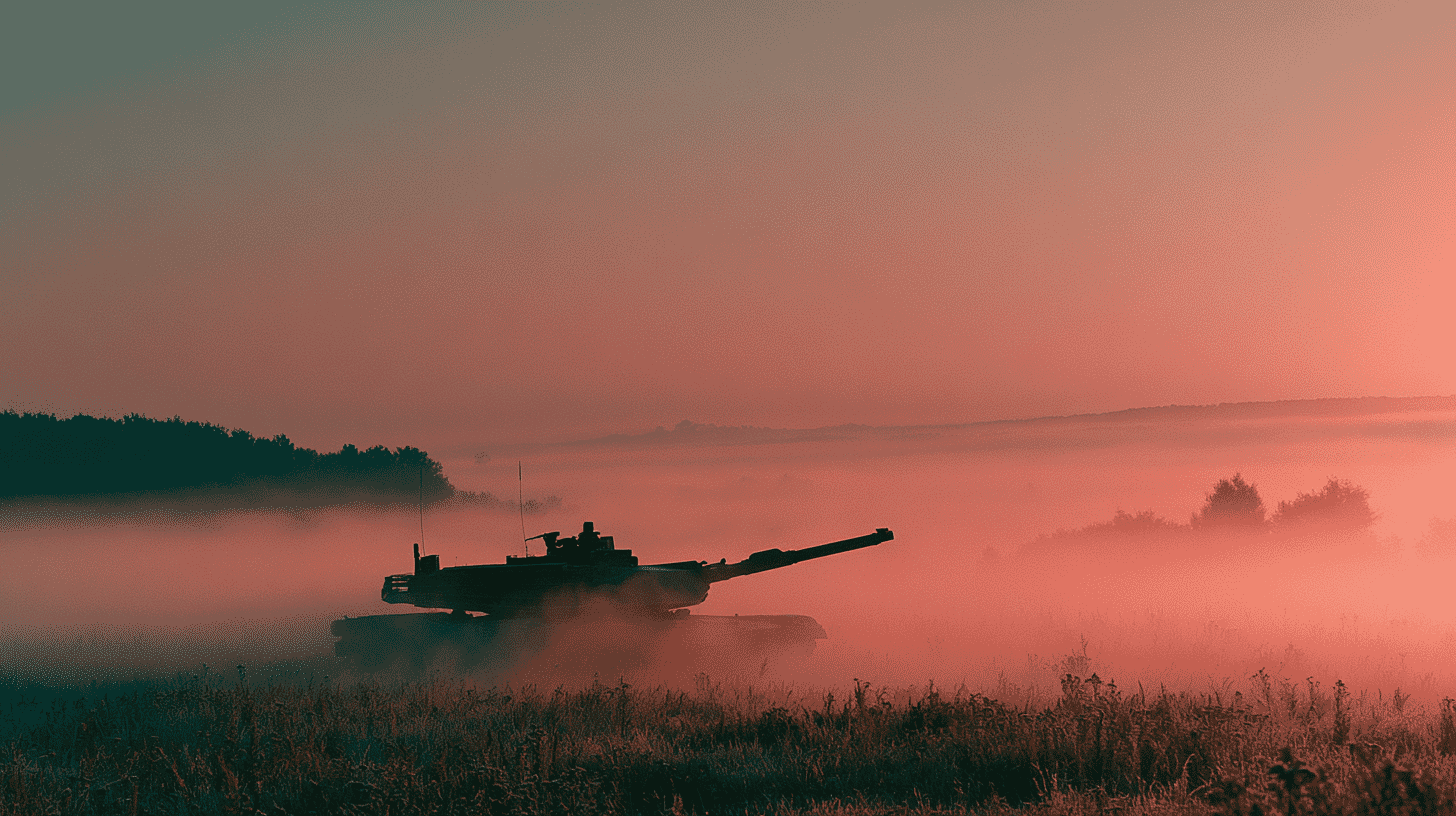
🛡️ You may never have heard the name Rheinmetall. But if you've ever seen a Leopard 2 tank rolling across the news from Ukraine, or, for that matter, Japan's own Type 90 tank on the plains of Hokkaido, you've already seen the company's handiwork. The long gun in the turret is theirs. In June 2026, Germany's largest arms maker said it wants to build its first defense plant in Japan. So who exactly are they, what do they make, and why is a 137-year-old European firm suddenly looking east?
The gun in everyone's tank
Rheinmetall was founded in 1889 in Düsseldorf as a maker of metal goods and machinery, and it has been building weapons for most of the time since. Today it runs two main businesses, defense and automotive parts, but the war in Ukraine has tilted it decisively toward the former. It is listed on the Frankfurt exchange, and its name is now shorthand in Europe for the entire defense boom.
What it is best known for is firepower. Rheinmetall's 120mm smoothbore tank gun became the Western standard, fitted to the German Leopard 2, the American M1 Abrams, and (a detail most readers outside Japan miss) the Japanese Type 90 tank that has anchored the Ground Self-Defense Force's armored units since the 1990s. In other words, Japan has been quietly relying on Rheinmetall engineering for over three decades.
The catalog goes well beyond tank guns. The company makes the next-generation Panther tank, the Lynx and Puma infantry fighting vehicles, the Boxer wheeled armored carrier, artillery shells by the hundreds of thousands, missiles, air-defense systems, and components for combat aircraft. Its divisions span vehicles, weapons and ammunition, electronics, and sensors. If a NATO army drives it, fires it, or hides behind it, there is a decent chance Rheinmetall had a hand in it.
The company the war remade
For most of its modern history, Rheinmetall was a solid but unspectacular firm in a Germany that preferred not to think too hard about weapons. Russia's full-scale invasion of Ukraine in 2022 changed that almost overnight.
The clearest measure is artillery shells. Before the invasion, Rheinmetall turned out about 70,000 155mm rounds a year. In April 2026, Papperger said the figure had reached 1.1 million, more than the roughly 600,000 shells the entire US defense industry produced in 2024; the comparison is his own and has not been independently verified. To get there, the company opened new plants, spent €1.2 billion (about $1.3 billion) to buy the Spanish ammunition maker Expal, and even stood up a repair operation inside Ukraine itself.
The financial story is just as steep. Group revenue reached €9.935 billion (about $11.6 billion) in 2025, up 29% year on year, and the order backlog closed the year at a record €63.8 billion (about $73 billion), 36% above the €46.9 billion of a year earlier. That is years of work already booked. The company guides to €14 billion to €14.5 billion of sales in 2026 and a backlog of €135 billion, with a target of €50 billion in sales by 2030. The share price became the talk of European markets, climbing some 900% in three years and earning the nickname "wunderstock," though it cooled in 2026 as investors began asking how fast all those orders can actually be turned into finished hardware. One more detail captures how high the stakes have become: the plot Russia was reported in 2024 to have laid against chief executive Armin Papperger was confirmed as real by a NATO official before the European Parliament in January 2025.
The backlog is the key to understanding what comes next. Europe's factories, even running flat out, cannot keep up with what Europe's governments are now ordering. Rheinmetall has to build capacity somewhere, and increasingly, that somewhere is outside Europe.
Why it's knocking on Japan's door
In mid-June 2026, Papperger told the Nikkei, and then the wire service Jiji, that the company is considering its first defense production base in Japan, most likely through a joint venture with a Japanese partner. The aim, he made clear, is not only to supply Japan's military but to export from Japan. Rheinmetall already has a foothold in the country: a wholly owned subsidiary in Odawara, Kanagawa, that makes automotive parts such as electric water pumps. What it does not yet have is a single defense facility there.
To understand the plan, it helps to know how Rheinmetall expands abroad. It rarely just ships finished products. Its model is the local joint venture: build the factory in the partner country, share the technology, and plug local suppliers into a global network. In Italy, its venture with Leonardo agreed to carry out 60% of the work on new tanks inside Italy. In Australia, under the "Land 400" program, it set up production for Lynx and Boxer vehicles in Queensland, a plant that now also exports components abroad, making it a node in a global chain rather than just a local supplier.
That is almost certainly the blueprint for Japan: not a sales office, but a manufacturing hub feeding both the local market and allies abroad. Japan is attractive for unglamorous but decisive reasons: reliable electricity, a deep base of advanced materials and precision suppliers, a skilled workforce, and a location far from Europe's immediate threats. In a nervous world, it looks like a safe place to make things that are hard to make.
There is also a legal reason the timing works now. On April 21, 2026, the Takaichi government rewrote the operational guidelines of Japan's "Three Principles on Defense Equipment Transfer," scrapping the so-called "five categories" (rescue, transport, warning, surveillance, and minesweeping) that had long confined exports to non-lethal gear. Lethal weapons can now, in principle, be transferred to the 17 countries that have signed equipment-transfer agreements with Japan, a list that includes Germany, the United States, and Britain. For the first time, a company could legally produce ammunition or vehicle parts in Japan and ship them to an allied country. Without that change, Rheinmetall's "export from Japan" pitch would have been a non-starter.
What Japan gets, and what it's signing up for
For Japanese industry, the appeal is straightforward. Domestic defense suppliers have spent decades locked inside a small home market, and many left the business. A partner like Rheinmetall offers orders, technology, and a route into a global supply chain at exactly the moment Japan is spending more on defense than ever, a record budget of ¥9.0353 trillion (roughly $56 billion) for fiscal 2026, including about ¥907.5 billion (some $5.6 billion) earmarked for ammunition alone.
A German arms giant setting up shop is one more sign that Japan is being woven into the supply network of Western defense, no longer just buying or building for itself, but potentially arming others. The irony is sharp: less than a year ago, Australia chose Japan's Mogami-class frigate over a European bid. Now Germany's biggest arms maker wants Japan as a base of its own.
None of this is settled, and not everyone is comfortable. The export-rule change drew opposition at home, including from the Japan Federation of Bar Associations, which warned against expanding the trade in lethal weapons. Critics also note that such a fundamental shift was decided by the cabinet without a vote in the Diet. Abroad, South Korea urged Japan to hold to its pacifist constitution. For a country whose postwar identity was built on staying out of the arms trade, inviting a foreign weapons maker to build on its soil is not a small step; it is a redefinition of what Japan is willing to be.
Japan spent eighty years as the country that did not export weapons. It is now deciding, factory by factory and partner by partner, whether to become something else. In your country, would a foreign arms maker building a plant be welcomed as jobs and security, or fought as a line that shouldn't be crossed?
References
- https://www.nikkei.com/article/DGXZQOCD180HZ0Y6A610C2000000/
- https://www.jiji.com/jc/article?k=2026062201001&g=int
- https://ja.wikipedia.org/wiki/%E3%83%A9%E3%82%A4%E3%83%B3%E3%83%A1%E3%82%BF%E3%83%AB
- https://ja.wikipedia.org/wiki/%E9%98%B2%E8%A1%9B%E8%A3%85%E5%82%99%E7%A7%BB%E8%BB%A2%E4%B8%89%E5%8E%9F%E5%89%87
- https://www.cnbc.com/2025/11/18/rheinmetall-german-defense-giant-sees-sales-surging-fivefold-by-2030.html





Global Discussion
0 comments