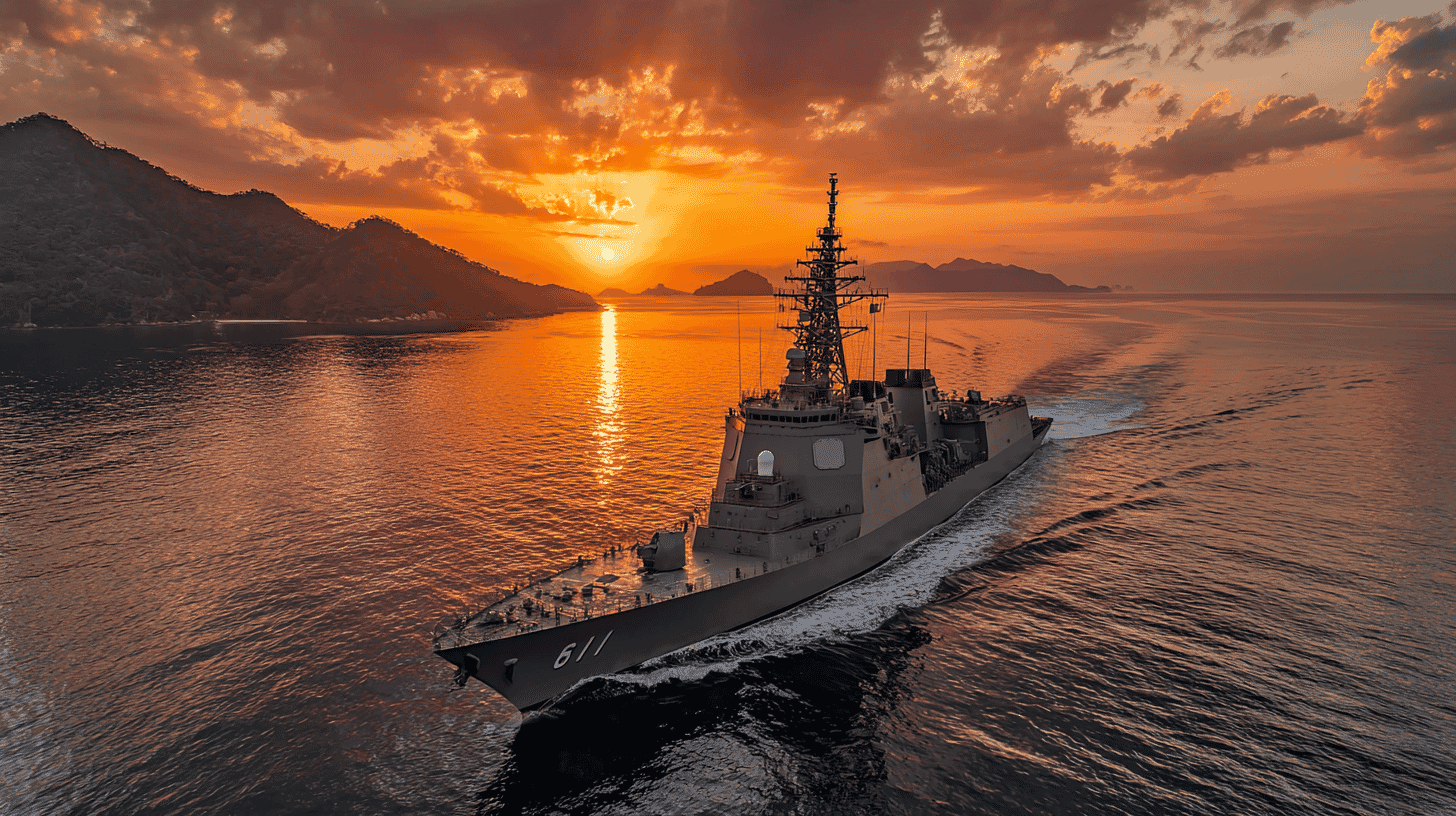
Two weeks after Japan lifted its decades-old ban on lethal weapons exports, the first concrete deal was already taking shape. On May 5, 2026, Defense Minister Shinjiro Koizumi flew to Manila and signed a framework to transfer used Abukuma-class destroyer escorts to the Philippine Navy. These are real warships carrying anti-ship missiles, and they are also close to 35 years old and headed for retirement. A pragmatic giveaway, or the most consequential precedent in Japan's postwar arms policy?
This is part 4 in our running coverage of Japan's defense export pivot. See also: Mogami-class frigate "Yoshii" and Japan's shipbuilding capability (the industrial base); Japan-Australia FFM deal and Three Principles reform proposal (the policy roadmap); and The April 21 cabinet decision that scrapped the Five Categories (the rule change itself). This article covers the first real-world application of those new rules.
What Was Signed in Manila
In Manila on Tuesday, May 5, 2026, Japanese Defense Minister Shinjiro Koizumi met with his Philippine counterpart, Defense Secretary Gilberto Teodoro Jr., and signed a joint statement on the further promotion of defense equipment and technology cooperation. The two sides agreed to establish a bilateral working group bringing together policy, operational, and equipment officials from both defense ministries to fast-track the transfer of Japanese defense gear to the Philippines.
The headline item: the Maritime Self-Defense Force's used Abukuma-class destroyer escorts. Plus possibly TC-90 trainer aircraft, and reportedly the Type-03 Medium-Range Surface-to-Air Missile system as well.
Speaking to reporters after the meeting, Koizumi laid out what would be discussed: the number of ships to be transferred, the timing, comprehensive equipment cooperation including training, education, and maintenance support. Teodoro supplied the most striking detail: he told reporters that the destroyers would be a donation rather than a purchase, without specifying how many would be involved.
This came one day after Koizumi signed a separate defense cooperation agreement with Indonesian Defense Minister Sjafrie Sjamsoeddin in Jakarta. The visit also overlapped with Balikatan 2026, the annual US-Philippine joint military exercise, in which 1,400 Japanese personnel are participating for the first time at this scale, having brought in equipment under the Reciprocal Access Agreement that entered into force in September 2025.
Why This Is a Big Deal: The Two-Week Context
The calendar explains why this matters.
On April 21, 2026, the cabinet of Prime Minister Sanae Takaichi formally revised Japan's "Three Principles on Transfer of Defense Equipment and Technology" and the implementation guidelines. The change scrapped the so-called "Five Categories" framework that had restricted finished-product exports to rescue, transport, surveillance, monitoring, and minesweeping equipment only. Lethal weapons, meaning destroyers, missiles, and fighter jets, became exportable in principle to the 17 countries with which Japan has a Defense Equipment and Technology Transfer Agreement.
Just 14 days later, Japan signed a framework for what could become the first export of a complete lethal naval combatant since the end of World War II.
The speed is not a coincidence. The Abukuma transfer had been quietly negotiated for nearly a year. Japanese and Philippine defense ministers reached a basic understanding at the Shangri-La Dialogue in Singapore in June 2025, and a Philippine inspection team conducted a Joint Visual Inspection of the ships in summer 2025. But the deal could not be closed under the old rules. The April 21 revision unlocked it. Manila was the first place Tokyo went to put the new rules to work.
The Abukuma Class: What's Actually Being Transferred
The Abukuma class is a set of six destroyer escorts (Japanese designation: DE) built between 1989 and 1993 by Sumitomo Heavy Industries and Mitsui Engineering & Shipbuilding. The ships are named after Japanese rivers: Abukuma, Jintsu, Oyodo, Sendai, Chikuma, and Tone.
Specifications worth knowing for non-specialists:
- Length: 109 meters (358 feet), beam 13.4 meters
- Displacement: about 2,000 tons standard, up to 2,550 tons full load
- Top speed: 27 knots (50 km/h, 31 mph)
- Crew: roughly 120 sailors per ship
- Construction cost (when new): about ¥25 billion for the lead ship, roughly $153 million at the July 2026 rate of ¥163 to the dollar
The armament is what makes this a meaningful transfer rather than a symbolic gesture. Each Abukuma carries a 76mm OTO Melara main gun, a Phalanx 20mm close-in weapon system, eight RGM-84 Harpoon anti-ship missiles, an ASROC anti-submarine rocket launcher, and Mk32 torpedo tubes. The ship has a flight deck for helicopter landings but no hangar.
For the Philippine Navy, this is a categorical capability upgrade. Manila currently has no destroyers in service. Its largest combatants are two Jose Rizal-class frigates (about 2,600 tons, of South Korean design), recently joined by the smaller Miguel Malvar-class. Adding several Abukuma hulls would more than double the navy's blue-water surface combatant fleet, and would give it anti-submarine warfare capability it currently lacks almost entirely.
The catch: these ships were commissioned between December 1989 and February 1993, putting them in their late thirties. Japan's 2022 Defense Buildup Program had already scheduled the entire class for decommissioning by the end of fiscal 2027, with the new Mogami-class frigates taking over.
Why Philippines, Why Now: The China Frame
Both Koizumi and Teodoro put China at the center of their joint statement. They expressed serious concern over what they called Beijing's "intensifying coercive activities" in both the East China Sea (where Japan and China dispute the Senkaku/Diaoyu Islands) and the South China Sea (where the Philippines and China are locked in repeated maritime confrontations around Scarborough Shoal and the Spratly Islands).
The strategic logic is straightforward. Japan has no Senkaku issue without the broader pattern of Chinese maritime assertiveness; the Philippines has no South China Sea issue without it either. If Manila operates Japanese-designed warships using Japanese training, Japanese maintenance pipelines, and Japanese munition standards, the two navies become genuinely interoperable. They can share data, refuel each other, and coordinate patrols in ways that two friendly but separate navies cannot. That interoperability is itself a deterrent.
The institutional plumbing was built for this. The 2024 Reciprocal Access Agreement between Japan and the Philippines, which entered into force in September 2025, already lets each country deploy troops and equipment on the other's territory under a defined legal status. The Acquisition and Cross-Servicing Agreement allows logistical support exchanges. The Philippines has been the only country to receive Japanese Official Security Assistance (OSA) for four consecutive years. Japan has previously transferred radar systems, coast guard vessels, and five TC-90 trainer aircraft (donated 2017-2018, and used by the Philippine Navy for maritime patrol).
The Abukuma transfer is the next rung on a ladder that has been climbing for a decade.
The "Donation" Question
Teodoro's remark that the ships would be a donation rather than a purchase is interesting because it sidesteps a fight that would otherwise be politically awkward in Tokyo.
Selling weapons abroad makes Japan a "merchant of death" in the eyes of its still-influential pacifist constituency. Donating retired equipment to a frontline partner that cannot otherwise afford to deter China reads, by contrast, as solidarity and burden-sharing. The framing matters. Japan can effectively say: we were going to scrap these ships anyway, the Philippines needed them, the bill is mostly for refurbishment and modifications, and the strategic effect is to deny China a free ride in the South China Sea.
There is also a regulatory wrinkle. Even after the April 21 revision, exporting ships with lethal armament is most easily structured as a "joint development": the Philippines specifies modifications (new communications, possibly different torpedo tube standards, ISR upgrades), and the modified ship is treated as a co-developed product rather than a finished export. The Yomiuri Shimbun reported in 2025 that the Abukuma transfer would likely use exactly this framing. In the event, the framework settled in July went a different way: a no-cost transfer under Official Security Assistance, with the Philippines absorbing refurbishment, sustainment, and integration costs.
There is one further complication: the Abukuma's main striking power, the Harpoon missile, is American, as is ASROC. That puts US re-export approval squarely in the critical path. None of this is unsolvable, but it is the sort of detail that explains why the working group exists.
How Many Ships, and to Whom Else
Numbers reported publicly have shifted. The earliest Yomiuri reporting from July 2025 suggested all six hulls would go to the Philippines. By October 2025, Philippine Navy chief Vice Admiral Jose Ma. Ambrosio Ezpeleta told a Senate hearing that Manila might take only three, enough to keep one deployed, one in maintenance, and one for training. Reports since then have suggested Vietnam and Indonesia could be candidates for some of the remaining hulls.
Indonesia is the most plausible secondary recipient. Koizumi signed a defense cooperation agreement in Jakarta on May 4, the day before the Manila meeting, and Indonesia has previously expressed interest in surplus Japanese submarines and destroyers. Vietnam is a more delicate case given Hanoi's careful balance between Beijing, Washington, and Tokyo, but not impossible.
The number has since been settled. Meeting again in Singapore on May 31, 2026, Koizumi and Teodoro broadly agreed to transfer the ships promptly after decommissioning, and disclosed that one TC-90 trainer due to retire in fiscal 2027 would go to Manila as well. Then on July 7, Teodoro told reporters in Manila: "Five. Five Abukuma." The governments had settled everything of substance, he said, leaving only administrative arrangements. The transfer runs through Japan's Official Security Assistance program, at no cost to the Philippines.
Delivery is expected within two to three years, placing it around 2028 to 2029. The timing depends on how well the ships' existing systems match Philippine requirements. Manila will also have to build out home port facilities, and it takes on sustainment and operating costs from handover onward.
The bottom line: Japan converted a planned scrappage into a regional security distribution program. The working group framework signed in Manila is the template the others will probably copy. Where the sixth hull ends up has not been announced.
What Could Go Wrong
The broad shape is settled, but delivery is still years out, and several things could reshape it.
First, cost. Refurbishing a warship in its late thirties to the standard a foreign navy needs is not cheap, and the split between Tokyo's OSA budget and Manila's own funds is still being worked out.
Second, US approval for re-exported components remains a gating step. The Pentagon has been broadly supportive of Japan-Philippines defense ties, but approvals are slow and individual systems can become sticking points.
Third, China has already pushed back. Beijing's Defense Ministry warned in 2025 that Japan's "weapons exports create instability factors in the Asia-Pacific region," and after the April 21 cabinet decision Beijing again warned against what it called Tokyo's "moves towards militarism." If Beijing decides to escalate diplomatically, for example by tightening rare-earth or maritime-related export controls against Japan or the Philippines, that creates economic pressure neither government can ignore.
Fourth, domestic Japanese politics is not unanimous. The Constitutional Democratic Party and Komeito (the former coalition partner) have raised concerns about the speed of the policy shift, the absence of prior Diet approval, and the elasticity of the "special circumstances" clause that allows exports even to countries near armed conflict. Critics worry that the Abukuma case, framed as a humanitarian-flavored donation to a frontline partner, will lower the political bar for harder cases later.
Fifth, the "donation" framing has its own diplomatic risks. If something goes wrong, Japan owns part of the consequences: an Abukuma involved in an incident at Scarborough Shoal, a maintenance failure that costs lives, a future Philippine government that pivots toward Beijing. Permanent strategic exposure tends to come with arms transfers, even free ones.
What This Tells Us About Post-April 21 Japan
The speed was possible because the infrastructure was pre-positioned: the working group format, the OSA budget pipeline, the RAA that lets Japanese personnel operate on Philippine soil. The cabinet decision was a green light, not a starting line.
And the mode Tokyo chose is partnership-as-deterrence rather than direct confrontation. Instead of expanding the Self-Defense Forces' overseas footprint, Japan is making it easier for partner navies to do more of the work themselves with Japanese-compatible equipment. Structurally this resembles how the United States built up partner militaries during the Cold War, scaled down to fit Japan's constitutional and budgetary limits. The Philippines case is the prototype. If it works, Indonesia and possibly Vietnam follow next.
This is not the Japan that wrote a "no war" constitution in 1947, and it is not the Japan that confined itself to the Five Categories until April. It is something newer, and not yet named.
How does your country handle decisions to transfer used military equipment to a partner state in maritime tension with a major power? Is donation the same as export, or fundamentally different? Tell us how the conversation is going where you live.
References
- https://news.yahoo.co.jp/articles/fb8e809d05d8a4204848e79c3c9301640a41bd45
- https://www.scmp.com/news/asia/east-asia/article/3352529/japan-philippines-fast-track-transfer-navy-destroyers
- https://www.gmanetwork.com/news/topstories/nation/986542/ph-japan-security-ties-equipment-technology/story/
- https://www.manilatimes.net/2026/05/05/news/world/japan-and-philippines-agree-to-weapons-pact-talks-as-chinas-coercive-activities-cause-alarm/2336349
- https://www.nippon.com/en/news/yjj2026050500425/
- https://www.navalnews.com/naval-news/2025/07/japan-in-talks-to-transfer-warships-surveillance-aircraft-to-the-philippines/
- https://defensemirror.com/news/40598/Philippines_Seeks_Five_Japanese_TC_90_Maritime_Patrol_Aircraft




Global Discussion
14 comments