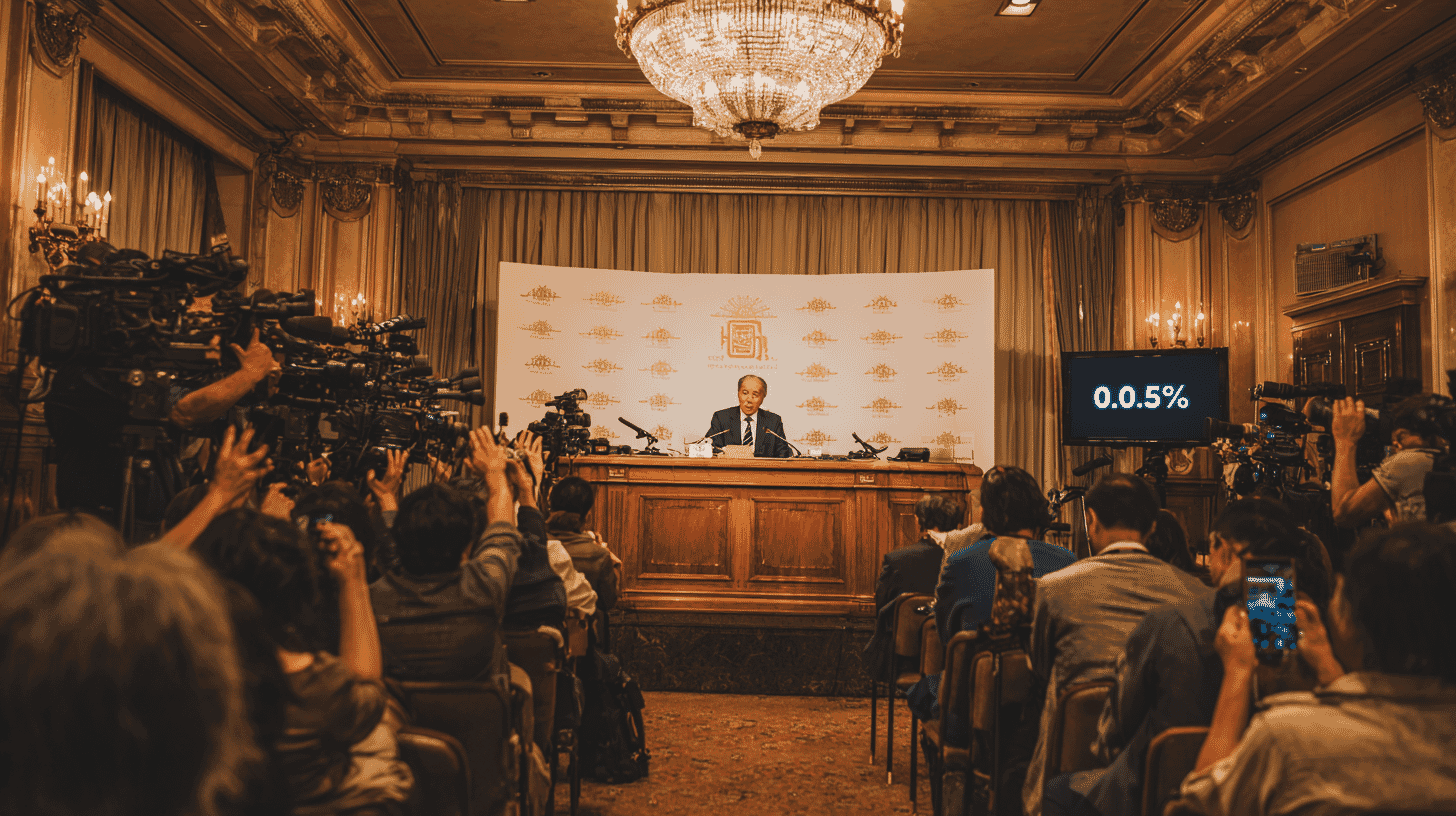
The Bank of Japan left rates alone. What came out of Governor Ueda's mouth, though, was not "the hiking is over" but "we want to watch the situation a little longer." War in the Middle East, oil spiking, the yen at 159, and a third straight year of 5%-plus spring wage settlements. Where does Japanese monetary policy go from here?
The Decision: Holding at 0.75% While the World Burns
On March 19, 2026, the Bank of Japan voted 8-to-1 to keep its short-term policy rate at 0.75%, the level set during a historic rate hike in December 2025, the highest in roughly 30 years. This marks the third consecutive meeting without a rate change.
The reason is straightforward: the U.S.-Israel military operation against Iran that began on February 28 has thrown the global economic outlook into chaos. The Strait of Hormuz, through which roughly 20% of the world's oil passes, has been effectively blockaded. Oil futures have surged as much as 70% since the conflict began, with Brent crude hovering around $100 per barrel.
For Japan, this is not just another geopolitical risk. The country depends on the Middle East for over 90% of its crude oil imports. Prime Minister Takaichi announced emergency fuel subsidies on March 11, aiming to cap gasoline prices at around 170 yen ($1.06) per liter as they threatened to surpass 200 yen ($1.25).
Governor Ueda's Press Conference: Five Key Takeaways
At his post-meeting press conference, BOJ Governor Kazuo Ueda delivered some of his most nuanced, and closely watched, remarks yet. Here are the five statements that matter most.
1. This May Not Be a "Temporary" Shock
Central banking orthodoxy says you can "look through" a supply shock if it's temporary. Ueda acknowledged this principle but immediately undercut it: "It's not clear whether the shock would be temporary, making it hard to say in advance how much it could take to determine the impact on underlying inflation." Translation: the BOJ cannot simply ignore the oil price surge and wait for it to pass.
2. Cost Pass-Through Could Be Stronger Than After Ukraine
This was the headline-grabber. Ueda warned that "recent developments come at a time when companies are already actively pushing up prices and wages, which suggests they could pass on costs more aggressively than after the war in Ukraine." In other words, the same wage-price spiral that the BOJ has been nurturing as a sign of healthy reflation could now amplify an external energy shock into persistent domestic inflation.
3. The Weak Yen Could Hit Inflation Harder Than Before
Ueda also turned to currency markets, stating: "We need to be mindful that currency fluctuations could have a stronger impact on underlying inflation than in the past." With USD/JPY flirting with the 160 level, near where authorities intervened in July 2024, this remark signals that the BOJ sees yen weakness not just as an import cost problem, but as a potential structural driver of inflation.
4. Inflation Is Getting Harder to Read: So the BOJ Will Show More Data
Perhaps the most quietly significant announcement was Ueda's admission that gauging underlying inflation is becoming "increasingly difficult" due to the combination of government subsidy programs and volatile oil prices. In response, the BOJ will publish more granular data on core consumer inflation. Additionally, it will recalculate Japan's estimated neutral interest rate (the rate that neither stimulates nor restrains growth) and release its findings. This is a clear move toward greater transparency, and market participants read it as the BOJ preparing the ground for a more data-driven approach to future rate hikes.
5. Rate-Hike Bias Maintained, But No April Signal
Ueda reiterated that real interest rates remain "at significantly low levels" and that the BOJ would continue raising rates if its economic forecasts materialize. However, he offered no signal on when the next hike might come, stating that "the likelihood and timing of future rate hikes" would depend on economic and price developments at each meeting. He also emphasized the need to scrutinize this year's spring wage negotiations to determine whether the wage-price cycle remains intact.
The Elephant in the Room: Government-BOJ Tensions
Ueda did not directly address the BOJ's relationship with the government at this press conference. But the unspoken tension is impossible to ignore.
Prime Minister Takaichi's administration champions aggressive fiscal spending and has historically favored easy monetary policy. When the BOJ raised rates in December 2025, the first hike under the Takaichi government, Ueda carefully noted that "we have been communicating with the government at various levels" and pledged to "make further efforts" on that front.
The friction became more visible at the January 2026 meeting. When asked about surging long-term bond yields (which had crossed 2% for the first time in decades), Ueda repeatedly read from what appeared to be prepared talking points, stating that the BOJ would "coordinate with the government, with each side fulfilling its respective role." Takahide Kiuchi, a former BOJ board member now at Nomura Research Institute, interpreted this as evidence of "friction between the government and the BOJ", with the government reportedly pressing the BOJ to increase bond purchases to cap yields, while the BOJ countered that only fiscal consolidation could durably stabilize the bond market. Ueda himself stated in January: "The Bank of Japan has told the government that securing market confidence in medium- to long-term fiscal soundness is important."
The International Monetary Fund added its voice in February, explicitly calling on Japan to maintain the BOJ's "continued independence and credibility" while warning that the Takaichi government's proposed consumption tax cut would "erode fiscal space and add to fiscal risks."
For international investors, this dynamic is a critical watchpoint: whether the BOJ can maintain policy independence while normalizing rates under a government that has signaled preference for loose conditions.
The Lone Dissenter: Takata Pushes for 1.0%
Board member Hajime Takata cast the only dissenting vote, arguing for an immediate rate hike to 1.0%. Takata's position is that the BOJ's 2% inflation target has essentially been achieved and that the risk of imported inflation spilling over into domestic prices is high. His proposal to guide the uncollateralized overnight call rate to around 1.0% was voted down, a clear hawkish signal within the nine-member policy board.
Spring Wage Negotiations: A Third Year of 5%+ Raises
Just one day before the BOJ meeting, Japan's annual spring wage negotiations (known as "shuntō") reached their peak on the March 18 deadline day. The results were strong: Toyota Motor granted full union demands for a sixth consecutive year. Hitachi, NEC, Mitsubishi Heavy Industries, and Mitsubishi Electric all met union wage demands in full.
Mitsubishi Electric's base pay increase of 18,000 yen ($113) per month, combined with merit raises, totaled an average 7% wage hike, the highest since the company adopted its current bargaining format in 2008.
The Japanese Trade Union Confederation (Rengo) had set a target of 5%+ wage increases for the third consecutive year. Early results suggest that target will be met or exceeded, with Rengo's first official tally due on March 23.
This matters because the BOJ has consistently cited the "virtuous cycle of wages and prices" as a prerequisite for continued rate hikes. Strong wage growth gives the central bank confidence that inflation is being driven by domestic demand, not just imported costs, and supports the case for future tightening.
Market Reaction: Yen Slides, Stocks Plunge
Financial markets had a rough day. The yen weakened to around 159.75 against the dollar, its softest level in approximately 20 months, approaching the 159.45 level where Japanese authorities intervened in July 2024. The Nikkei 225 tumbled over 2,000 points at one point, with energy-importing sectors hit hardest.
The combination of a BOJ on hold and rising oil prices is a toxic mix for the yen. Japan's carry-trade dynamics, where investors borrow in low-yielding yen to invest in higher-yielding assets, continue to pressure the currency. If USD/JPY pushes past 160, the risk of government intervention in the foreign exchange market rises significantly.
The Fed Held Too: Central Banks in Wait-and-See Mode
The BOJ wasn't alone in standing pat. The U.S. Federal Reserve held its benchmark rate at 3.5–3.75% the previous day, with Chair Jerome Powell saying it was "too soon to know" the impact of the Middle East war. The Fed's updated projections showed expectations of at most one rate cut in 2026, down from two previously expected.
With the Fed, BOJ, ECB, and Bank of England all holding steady, the world's major central banks have effectively entered a collective wait-and-see mode, watching how the geopolitical crisis unfolds before making their next moves.
What Comes Next: Will April Bring a Hike?
According to a Bloomberg survey, 37% of economists expect the BOJ to raise rates in April, while 22% see June and 29% see July. Key variables include oil price movements, the yen's trajectory, and the breadth of wage increases beyond large corporations to small and medium-sized businesses.
Japan's situation is unique: it's simultaneously experiencing the strongest wage growth in three decades, an energy crisis that threatens to erode real purchasing power, and a historic transition away from decades of near-zero interest rates.
How is your country's central bank handling the same oil price surge and inflation pressures? We'd love to hear your perspective, share your thoughts in the comments!
Update: This article reflects the position immediately after the March 19, 2026 meeting. The April hike the article flagged as the next focus did not materialize. The BOJ held at 0.75% again on April 28, though the vote shifted to 6-3, the first time three members had dissented under Governor Ueda, and the accompanying Outlook Report sharply raised the fiscal 2026 price forecast.
The hike came on June 16, when the policy rate went from 0.75% to 1.0%, the first move since December 2025 and the highest level since 1995. Ueda missed the meeting while hospitalized for treatment of an infection, leaving Deputy Governor Shinichi Uchida to hold the press conference. The vote was taken among the remaining eight members and carried 7-1; Toichiro Asada, appointed in April by the Takaichi government, argued for a hold on the grounds that downside risks to output and employment outweighed upside risks to prices. The BOJ also decided to stop tapering its JGB purchases from April 2027, settling at a pace of about ¥2 trillion a month.
References
- https://www.boj.or.jp/mopo/mpmdeci/mpr_2026/k260319a.pdf
- https://www.bloomberg.com/news/articles/2026-03-19/boj-holds-rates-steady-as-iran-conflict-clouds-inflation-outlook
- https://www.marketscreener.com/news/boj-governor-ueda-s-comments-at-news-conference-ce7e5ed9d08ffe25
- https://www.fxstreet.com/news/bank-of-japan-expected-to-hold-rates-as-high-oil-prices-temper-near-term-hikes-202603182300
- https://www.cnbc.com/2026/03/18/fed-interest-rate-decision-march-2026.html








Global Discussion
12 comments