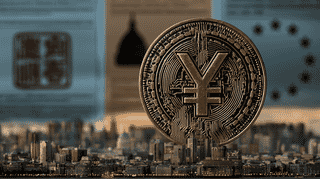
Japan's Finance Ministry is studying on-chain settlement of government bonds. Bonds and cash already swap together on BOJ-NET; what could change is the one-day T+1 gap and night hours.
Minoru Kiuchi, Japan's economy minister and long seen as a reflationist, says Abenomics-style reflation is over. The BOJ was already at 1.25%. Yet Japan still hasn't declared deflation over.
Japan bought yen without warning on July 30, moving the currency five yen in an hour. The BOJ then held at 1% and warned inflation could overshoot, as Washington and Seoul moved too.
Japan's three megabanks, Mizuho, MUFG and SMBC, are jointly issuing a single-brand trust-type stablecoin. We unpack why it skips the 1-million-yen cap, why banks are building a tool that could drain their own deposits, and how it lines up with Japan's revised Payment Services Act, the US GENIUS Act, EU MiCA and the digital yen.
On June 16 the Bank of Japan raised its policy rate to 1.0%, the highest in 31 years, with Governor Ueda hospitalized and absent. We unpack the 7-1 vote, the lone hiker among major central banks, the still-weak yen, and Japan's swelling debt-service bill.
The Bank of Japan began selling its ETFs, yet its holdings ballooned past 110 trillion yen, over 8% of the Tokyo market. Why the Fed and ECB never bought stocks, how Switzerland differs, and whether central banks should own equities at all.
China overtook Japan in net external assets at the end of 2025, dropping it to third place, yet Japan's holdings hit a record high. Here is what the numbers really mean for the yen.
PM Takaichi met BOJ Governor Ueda on May 22 and asked the central bank to carry out 'appropriate policy.' We explain Japan's central bank independence next to the US Fed and the ECB, and how a weak yen near 159 and the carry trade tie this to global markets.
On May 16, 2026, BOJ Deputy Governor Ryozo Himino delivered a keynote on the 'singleness of money' at the Japan Society of Monetary Economics. Beyond the binary of US-style stablecoin policy and a digital euro, the BOJ is quietly exploring a third path built on tokenized deposits and tokenized central bank reserves on blockchain.
Japan's three megabanks (MUFG, SMFG, and Mizuho) posted a combined net profit of 5.26 trillion yen ($33B) for the fiscal year ended March 2026, breaking the 5-trillion-yen barrier for the first time. We unpack how BOJ rate hikes drove the surge, how the numbers compare to JPMorgan and HSBC, and what Japan's monetary normalization means for global markets.
On the afternoon of May 14, Japan's 10-year government bond yield hit 2.625%, the highest since 1997. OIS markets now price a 74% probability of a rate hike at the June 15-16 BOJ meeting. BOJ board member Kazuyuki Masu, previously considered cautious, said in a Kagoshima speech that 'early rate hikes are desirable.' With US PPI surprise, USD/JPY near 158, and 'long rates at 3% in sight,' we map where Japan's FX, bond, and rate-hike expectations stand right now.
Reuters reported that Japan conducted multiple yen-buying interventions during the May Golden Week, exploiting thin holiday liquidity. Market estimates put the total at roughly 10 trillion yen including the April 30 operation; the Ministry of Finance later confirmed 11.7349 trillion yen, a record for a yen-buying episode. Vice Finance Minister Mimura said IMF rules do not constrain intervention frequency. Within a month the effect had faded and the yen was back at 161 to the dollar.
The BOJ released its March 18-19 meeting minutes on May 7. The deliberation sections are anonymous, but votes and dissenting opinions are published with names attached. The 8-1 split? Hajime Takata alone dissented. We trace the 9 members behind the March meeting, the shift to a 6-3 split in April, and the rebalancing coming when Nakagawa's term ends in late June.
On May 7, 2026, the Nikkei 225 closed 3,320 yen higher at 62,833, the largest single-day point gain in its history, surpassing the 3,217 yen record of August 6, 2024. Hopes of a U.S.-Iran ceasefire and an AI semiconductor rally drove it. Yet the 5.58% gain does not crack the all-time top 20, a sign that a higher index level has changed what a record means. Inside the 10.8 trillion yen session, the link to Korea's KOSPI passing 7,000, and how the index reached 70,000 by June.
Private estimates put Japan's April 30 yen-buying intervention at 5 to 5.4 trillion yen, derived from the gap between the BOJ's current-account forecast and money brokers' projections. What that bazooka means in practice: a 190bp US-Japan rate gap, a yen carry trade starting to unwind into emerging markets, and the political constraint of the US Treasury's monitoring list.
Haruhiko Kuroda, the governor who ran Japan's decade of extraordinary easing, now calls the weak yen excessive and wants 130 per dollar, plus rate hikes to 1.5%. Japanese social media responded with a collective 'look who's talking.' The rate-gap mechanics, the carry trade, and why the yen kept sliding even after the BOJ went to 1.00% in June 2026.
The day after Japan's April 30 intervention, Vice Finance Minister Atsushi Mimura hinted at more with a single line: Golden Week is just getting started. The campaign eventually totalled a record 11.7 trillion yen. But against a fifth straight year of trade deficits, an oil bill inflated by the Iran conflict, yen weakness against every major currency, and a 40-trillion-yen carry trade, intervention only buys time. Even the June hike to 1.0 percent did not turn it.
On April 30, Japan intervened to buy yen for the first time in 21 months. Hours after Finance Minister Satsuki Katayama warned of 'decisive action' and Vice Minister Atsushi Mimura issued a 'final evacuation warning,' the dollar fell about 5 yen from the high 160s to 155.50, its steepest one-day drop since December 2022. The campaign continued through Golden Week and totalled a record 11.73 trillion yen. The yen kept falling anyway.
One day after the Bank of Japan held rates on April 28, the yen hit a 21-month low of 160.67 and 10-year JGB yields reached 2.535 percent, the highest since 1999. A falling currency and rising yields are not supposed to move together. We unpack what that combination says about being behind the curve, the intervention question, the carry trade, and a hawkish Fed, then follow the story through the June hike to 1.0 percent and a yen that kept sliding anyway.
The Bank of Japan held its policy rate at 0.75% on April 28, 2026 by a 6-3 vote, with three dissenters proposing a hike to 1.0%, a first under Governor Ueda. We unpack Ueda's press conference, allegations of pressure from the Takaichi administration, the sharp upward revision in inflation forecasts, the immediate market reaction, and the divergence between domestic and international assessments.