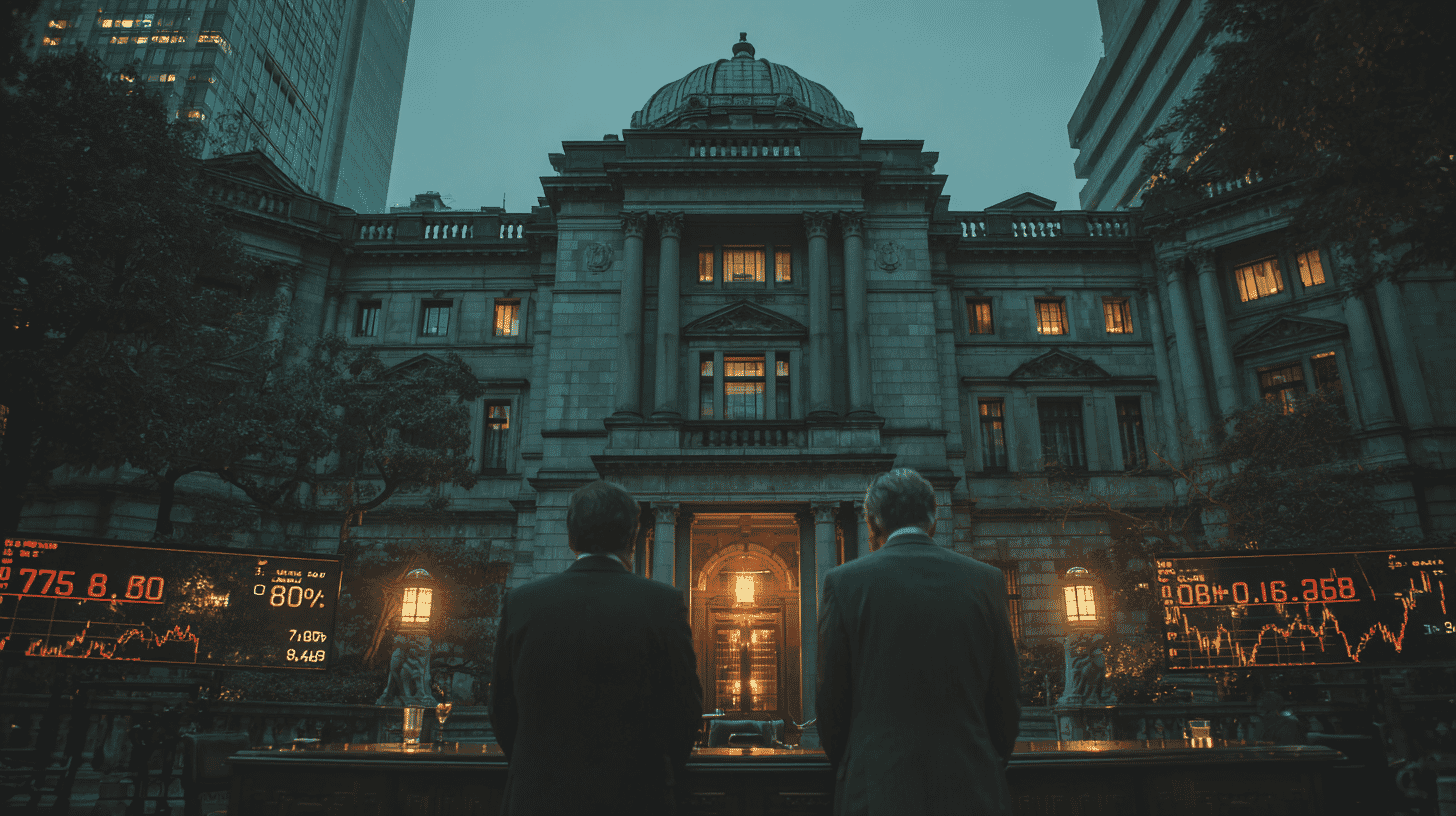
On April 28, 2026, the BOJ kept its policy rate at 0.75%, but the 6-3 vote split was the first three-way dissent under Governor Ueda's tenure. Even Junko Nakagawa, long seen as a moderate, voted for a hike. What did Ueda say in his press conference? And what's behind market chatter about "political pressure" from the Takaichi government?
What the BOJ Decided on April 28
The Bank of Japan kept its uncollateralized overnight call rate target at "around 0.75%" at its monetary policy meeting on April 28, 2026. This marks the third consecutive meeting where rates have been held since the central bank lifted its policy rate to a roughly 30-year high of 0.75% in December 2025. A pre-meeting Bloomberg survey of economists showed 80% expected a hold, so the headline decision was no surprise.
What did jolt markets was the vote split: 6 in favor, 3 against. The dissenters, Hajime Takata, Naoki Tamura, and Junko Nakagawa, each proposed raising the policy rate to 1.0% instead of holding.
Three dissenters is a first under Governor Kazuo Ueda, who took office in April 2023. At the March meeting, only Takata had dissented. This time, newly-installed Tamura joined him, and so did Nakagawa, a board member widely viewed as a moderate aligned with the executive line. Nakagawa's term ends on June 29, 2026, and her replacement Ayano Sato is reportedly more dovish. Some overseas strategists noted that the June 16 meeting will effectively be Nakagawa's last opportunity to vote for a hike.
Inflation Forecasts Sharply Up, Growth Forecasts Down
The accompanying Outlook Report drew significant attention. The BOJ raised its forecast for fiscal year 2026 core CPI (consumer prices excluding fresh food) to 2.8%, up 0.9 percentage points from the 1.9% projected in January. The revision reflects the impact of higher oil prices stemming from Middle East tensions. The fiscal 2027 forecast was lifted by 0.3 points to 2.3%, and the newly-released fiscal 2028 figure was set at 2.0%.
Growth forecasts moved in the opposite direction. Real GDP for fiscal 2026 was cut from 1.0% to 0.5%, and fiscal 2027 from 0.8% to 0.7%. Higher oil prices worsen Japan's terms of trade and weigh on activity.
Why hold rates against a backdrop of higher inflation and weaker growth, what economists sometimes call a "stagflationary" outlook revision? At the press conference, Governor Ueda explained that the BOJ needs "a bit more time to assess how Middle East developments will affect Japan's economy."
Ueda's Press Conference: "No Urgent Need to Hike"
The press conference began at 3:30 PM and Ueda's tone was carefully measured throughout.
He stated there was "no urgent need to raise rates immediately," while also emphasizing that the BOJ would "make appropriate policy decisions to avoid falling behind the curve." The basic stance, that the rate-hike path remains intact, was preserved. A particularly notable line: "Even if the Strait of Hormuz blockade continues, a rate hike is possible." This signaled that worsening Middle East conditions and rate-hike decisions are not necessarily linked one-for-one.
On the timing of the next hike, however, Ueda kept his cards close. "We'll judge based on economic, price, and financial developments," he said, declining to specify a horizon "in months." On underlying inflation, he noted it currently runs slightly below the 2% target but is expected to reach around 2% by the second half of fiscal 2026.
The forward guidance language in the statement was also revised. The BOJ now says it "will continue to raise the policy interest rate and adjust the degree of monetary accommodation in accordance with developments in economic activity, prices, and financial conditions." Compared with the March statement, this is more explicitly hawkish.
Allegations of Political Pressure: The "Vote Postponement Right"
Behind Ueda's caution lies a delicate relationship with the administration of Prime Minister Sanae Takaichi.
Mari Iwashita, senior economist at Nomura Securities, suggested that government coordination may be influencing rate decisions. According to Iwashita, "If the BOJ cannot secure the Takaichi administration's understanding, the government could submit a vote-postponement request even if the BOJ tries to consider a hike."
The vote-postponement request is a right enshrined in Article 19, Section 2 of the Bank of Japan Act. The Finance Minister or the Minister of State for Economic and Fiscal Policy (or designated officials) attending the monetary policy meeting can request that a vote on a policy item be postponed to the next meeting. The request does not automatically delay the vote, the Policy Board votes on the postponement itself. Historically, this right was used for the first time in August 2000 when the government requested postponement of the BOJ's zero interest rate policy exit; it was rejected by majority. Notably, Ueda was a Policy Board member at that time and aligned with the government's view by opposing the rate-hike side.
Since taking office in November 2025, the Takaichi administration has championed "responsible expansionary fiscal policy," pursuing consumption tax cuts and supplementary budgets. Takaichi appointed reflationist economists as private members of the Council on Economic and Fiscal Policy. At her inauguration, she stated: "The government must take responsibility for both fiscal and monetary policy", a remark widely read as signaling government involvement in BOJ policy decisions.
Finance Minister Satsuki Katayama also struck a hawkish FX tone. On April 3, when the dollar approached 160 yen, she stated the government would "take comprehensive measures from every angle," signaling readiness to intervene in currency markets. Takahide Kiuchi, executive economist at Nomura Research Institute, observed that the BOJ "will emphasize that its basic stance on rate hikes remains unchanged, both to push back on yen weakness and as a counter to the Takaichi administration's perceived opposition to hikes."
Ueda himself avoided directly addressing the government relationship at this press conference, but in past appearances he has repeatedly noted that "the BOJ maintains communication with the government at various levels." The three-way dissent is, in some market analysts' reading, a sign that some board members are pushing to accelerate rate decisions free of government coordination.
Immediate Market Reaction: Yen Spike, Then Reversal
The decision and press conference whipsawed markets.
USD/JPY traded near 159.50 just before the announcement, then strengthened (yen up) to 158.99 once the three-dissenter split became known. After Ueda's more measured tone in the press conference, the yen pared most of those gains and drifted back toward weakness.
The Nikkei 225, which had closed above the 60,000 mark for the first time the previous day, ended April 28 down 619 points at 59,917.46, falling below 60,000 intraday. Semiconductor and financial shares led the decline.
In the bond market, JGB futures fell, with the 10-year yield trading in the 2.4% range, slightly higher than the previous day. The implied probability of a June rate hike, derived from the overnight index swap (OIS) market, settled around 60% after the decision.
Domestic vs. International Assessments: How Hawkish Was the "Hold"?
Domestic and overseas analysts split somewhat in their reading.
In Japan, "hawkish hold" was the dominant framing. Eiji Maeda, former BOJ Executive Director and now president of Chibagin Research Institute, called it "a hawkish hold." Nikkei reported that the BOJ "scrambled to discourage yen weakness during Golden Week and crafted its messaging to broaden market expectations of a June hike," suggesting the central bank carefully designed its communication around the holiday period when FX volatility tends to spike.
International coverage leaned more decisively hawkish. Reuters reporters' poll of market participants included the take from Saktiandi Supaat, Maybank's Singapore-based regional head of FX research: "The three dissenters send a signal that the BOJ could have hiked this time if not for the war. June could be the next live date for a rate hike." A Société Générale strategist noted that "the 6-3 vote split (versus 8-1 in March) plus the rewritten forward guidance flagging that the bank 'will continue to raise the policy interest rate' reads as a hawkish hold setting up a June move, especially with FY2026 core CPI lifted to 2.8% from 1.9%." On Nakagawa's surprise dissent, the same analyst noted it "suggests the hawkish shift could run deeper than the headline split implies."
The yen's gains partly faded after Ueda's press conference, as his tone turned more measured. FXStreet analysts had pre-warned that "if officials do not show clear willingness to raise rates, the risk increases significantly that the yen could weaken sharply."
Compared with the Fed and ECB
The BOJ decision came just before two other major central bank meetings. The U.S. Federal Open Market Committee (FOMC) meets April 28-29, and the European Central Bank (ECB) Governing Council meets April 29-30.
Middle East developments are pulling these central banks in different directions. The Federal Reserve has grown more cautious about further rate cuts as inflation re-emergence concerns build, and the ECB is now debating whether to pause its cutting cycle or even pivot toward hikes. The BOJ remains the only major central bank with a clear tightening bias.
Tomoaki Shishido, senior rates strategist at Nomura Securities, commented that "concerns about being behind the curve may be pushing up Japan's medium- and long-term yields." The Nikkei recently set new all-time highs while the 10-year JGB yield remains anchored in the 2.4% range, a divergence Shishido described as "not a simple return to pre-conflict conditions."
Looking Ahead to June: Nakagawa's "Last Vote"
The next monetary policy meeting is scheduled for June 15-16. Markets are split between "next hike in June" and "next hike in July."
Harumi Taguchi, principal economist at S&P Global Market Intelligence, sees July as the main scenario. She views Ueda's strategy as preserving rate-hike commitment in principle while keeping a free hand on timing.
International strategists, however, frame June as critical specifically because of Nakagawa. "June is effectively her last window to vote for a hike," they note, given her June 29 term expiry.
Middle East developments, oil prices, the yen, and the Takaichi administration's fiscal stance, multiple uncertain factors are shaping how the Ueda BOJ chooses its next move.
In Japan, the question of "central bank independence from government" is being debated again. Faster rate hikes would help curb inflation and stem yen weakness, but they would also raise mortgage payments and squeeze small business financing. Slower hikes risk worsening import-driven inflation that hurts everyday consumers. How independent is your country's central bank from its government? How do you weigh rate hikes against economic growth?
References
- https://www.bloomberg.com/jp/news/articles/2026-04-28/T4VHQXGP9VCW00
- https://www.nikkei.com/article/DGXZQOUB281PT0Y6A420C2000000/
- https://www.nikkei.com/article/DGXZQOUB2743G0X20C26A4000000/
- https://www.investing.com/news/economy-news/investors-react-to-bojs-decision-to-hold-rates-4640231
- https://www.fxstreet.com/news/bank-of-japan-expected-to-hold-rates-amid-iran-war-driven-inflation-fears-202604272300
- https://www.nomura.co.jp/wealthstyle/article/0682/
- https://www.nri.com/jp/media/column/kiuchi/20260421_2.html









Global Discussion
14 comments