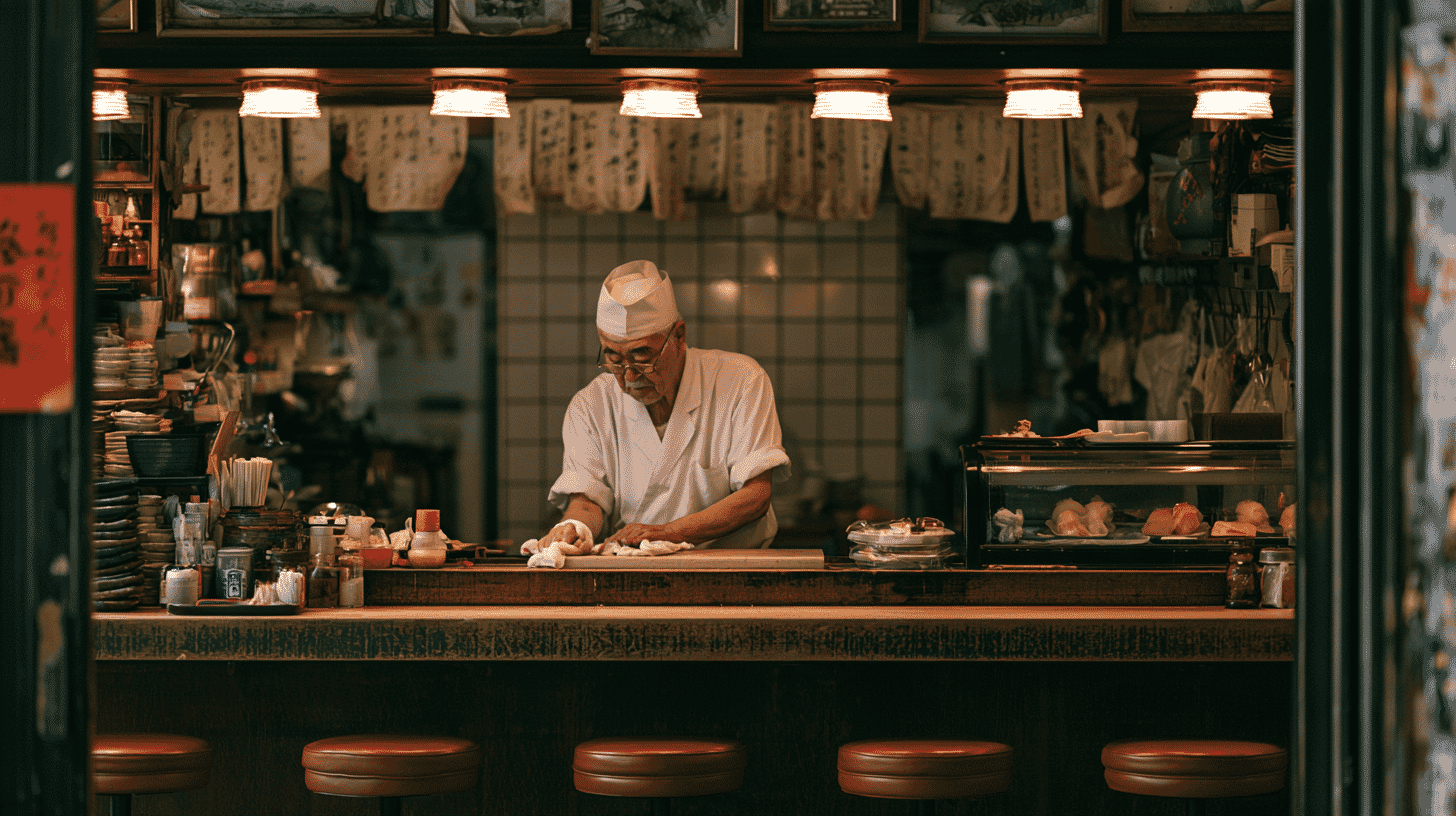
🍣 Sushi-shop bankruptcies in Japan jumped 45.5% in the first half of 2026. That reads like a story about restaurants losing money. It isn't. In the same stretch, the share of sushi businesses operating at a loss fell to 18.8%, the lowest in the twenty years Teikoku Databank has tracked. The neighborhood sushi shop isn't going broke. It's being switched off, deliberately, by an owner with nobody to hand the knife to.
Bankruptcies up 45.5%, and fewer sushi shops in the red than in 20 years
Teikoku Databank counted 16 sushi-shop bankruptcies between January and June 2026, against 11 in the same months of 2025. That is the 45.5% increase. Shops capitalized at under 1 million yen made up 43.8% of the total, the smallest of the small.
Then comes the number that refuses to fit the narrative. In fiscal 2025, only 18.8% of sushi businesses posted a loss. That is the lowest share TDB has recorded in two decades. On a separate axis, 64.4% grew profits and 33.9% saw them shrink, with the shrinking share up for a fourth straight year.
Put those together and the picture inverts. The sushi shop closing in 2026 is usually not a failing business. It is a working business whose owner has decided to stop, and TDB's own analysis says why: in a shop this small, the owner is often effectively the only chef. When that person stops, there is no second knife behind the counter.
What's really shrinking isn't the bankruptcy count
Sixteen is a very small number, and small numbers swing wildly. On TDB's own series the peak was 27 cases in 2013, so 16 sits well below it. Tokyo Shoko Research, which tracks the same industry on a slightly different basis, counted 24 sushi bankruptcies in January to October 2024 (up 33.3%), then 17 in the same months of 2025 (down 29.1%). Its explanation for the 2025 dip was blunt: inbound tourists were spending enough to absorb the cost increases.
One year's percentage tells you nothing. The long line does.
Japan's Economic Census, on the internal affairs ministry's tally of all private establishments, counted 25,536 sushi establishments in 2012 and 22,556 in 2016, a drop of 11.7% in four years. Split by ownership, the gap opens up. Individually owned shops fell from 15,887 to 13,461, down 15.3%. Incorporated ones went from 9,649 to 9,095, down 5.7%. Employment moved the same way and harder: down 16.0% at individual shops, up 11.4% at companies. The 2016 count was taken on June 1 of that year and the next census fell on June 1, 2021, in the middle of the pandemic, so this is the last clean pre-COVID pair the census offers. The contraction it shows had already begun.
None of that happened in a shrinking market. Japan's sushi restaurant market was worth about 1.5 trillion yen ($9.6 billion; all dollar figures here use the September 4, 2026 rate of 156 yen to the dollar) in 2017. It grew roughly 20% over the eight years from 2012 and then flattened out. The money didn't leave. It changed hands, moving from the shop with a name on a noren curtain to the company with a logo.
Only the top and the bottom are growing
The chains are the visible half of that transfer. FOOD & LIFE COMPANIES, which runs Sushiro, posted consolidated revenue of 429.5 billion yen ($2.75 billion) for the year ended September 2025. Its domestic Sushiro business alone brought in 265.9 billion yen ($1.7 billion), with same-store sales at 110.1% of the prior year. Store counts went from 646 to 659 in Japan and from 174 to 227 overseas, 1,198 across the group. Kura Sushi turned over 245.1 billion yen ($1.57 billion) in the year to October 2025 and finished the year with 687 outlets, 548 of them in Japan and 139 abroad. Kappa Sushi spent five weeks last summer selling plates at 90 yen on weekdays.
The other half is the counter. In a September 2025 piece for President Online, pricing consultant Yoshihiro Takahashi put Sushi Ginza Onodera in Tokyo at 27,500 yen ($176) a head before service, Sushi Arai at 55,000 yen ($353) and Sukiyabashi Jiro from 88,000 yen ($564). Onodera's 27,500 yen also appears on its restaurant listing. Takahashi noted that 20,000 to 30,000 yen used to be considered expensive at this level and that 40,000 to 50,000 yen has become ordinary. Inbound demand keeps the seats full: 3.44 million foreign visitors arrived in July 2026 alone, a record for the month.
The middle isn't being left empty either; it is being occupied. FOOD & LIFE COMPANIES also runs Sugidama, a sushi izakaya format with an average check of around 3,000 yen ($19), which is roughly where the independent shop used to sit. Restaurant analyst Daisuke Miwa, quoted by Shueisha Online, explains that the big chains use scale to hold down what they pay for fish and technology to hold down what they pay in wages. An independent shop has neither lever.
The top counters have a second lever the middle lacks: scarcity. A bad tuna season becomes a reason to raise the price, and the reservation list barely notices.
Fish prices don't fall, and there's only one chef
Japan's consumer price index for fresh fish and seafood hit 143.7 in January 2026 and was still at 138.0 in May, against a 2020 baseline of 100, on the series that ran until the index was rebased to 2025 in August. Nearly 40% above the 2020 level, and easing only slightly.
Rice, the other half of a sushi shop's cost base, went the other way. The supermarket average for 5 kilograms peaked at 4,416 yen ($28) in January 2026 and was down to 3,191 yen ($20) in the week to August 16. The grain got cheaper. The fish did not.
A chain absorbs that: Sushiro's average check in July 2026 was 3.9% higher than a year earlier and its customer count still rose 3.7%, because the increase lands on a plate priced in the low hundreds of yen and nobody recalculates their evening over it. A neighborhood shop raising a 4,000 yen dinner to 5,000 yen is asking a regular to make a real decision, and it usually only gets to ask once.
Behind the cost squeeze sits the succession math. TDB put the share of Japanese companies with no identified successor at 50.1% in 2025, a record low after seven straight years of improvement. But at small companies the figure was 57.3%, and a one-counter sushi shop is about as small as a company gets. Improvement at the national level does not reach a business whose entire operating knowledge is stored in one pair of hands. The shape of that improvement is telling: in 2025 promotion from within accounted for 36.1% of successions and passed family succession, at 32.3%, for the first time. A company can hand itself to somebody on the payroll. A shop with one chef has nobody to hand it to.
What disappears isn't a price band, it's variety
The last survey to price the three tiers side by side was in 2016. Average check at a general sushi restaurant: 3,941 yen ($25). At a conveyor-belt chain: 1,496 yen ($10). At a takeout counter: 2,880 yen ($18). Prices have risen everywhere since and the top has run away entirely. Even so, there used to be a normal, unremarkable middle where most people ate sushi most of the time.
That middle wasn't only a price. It was where sushi stayed local. Nara wraps sushi in persimmon leaves. Toyama presses salted trout over rice in a round wooden mold lined with bamboo leaf, and the agriculture ministry's own catalogue of regional dishes notes that the thickness of the fish, the sharpness of the vinegar and how hard the rice is pressed differ from shop to shop, with more than 20 specialist makers in the city of Toyama alone. Twenty versions of one dish in one city is not a rounding error. It is the substance.
None of that lives on a conveyor belt, where the menu is identical from Hokkaido to Kyushu. Almost none of it reaches a high-end counter either, where the template is Edomae Tokyo and the best fish is flown in. The independent shop is where something nobody exports gets served, because that is what the supplier landed that morning. Take out the layer and you don't lose a price point. You lose the part of Japanese sushi that was different in every town.
Eating sushi in Japan: how to use all three tiers
Conveyor belt. Sushiro, Kura Sushi, Hama Sushi, Kappa Sushi. The 2016 survey put the average check here at 1,496 yen ($10); allow for a decade of price rises and budget somewhere under 2,500 yen ($16). Even premium items stay cheap: Sushiro sold seared wild blackthroat seaperch, two pieces, at 110 yen this summer, and Kappa ran 90 yen weekday plates for five weeks. No reservation, no ceremony, and worth doing once.
The neighborhood shop. The 2016 average was 3,941 yen ($25), so after ten years of food inflation a realistic budget is roughly 4,000 to 10,000 yen ($26 to $64). This is the tier at risk and the one worth seeking out. Sit at the counter, say omakase if there is no printed course, and ask what is local today. Outside the big cities the answer is often something you will not see anywhere else.
The high-end counter. From 27,500 to 88,000 yen and up ($176 to $564). Book weeks or months ahead, expect a fixed course, and understand that you are paying for a scarce seat as much as for the fish.
The middle tier gives a visitor the most per yen and is also the likeliest to be gone next trip. If a town has an old shop with a hand-written sign, go in.
France went from 500,000 cafés to fewer than 40,000
This is not only a Japanese story. The Connexion reports that France had close to half a million cafés and bistros early in the 20th century and has fewer than 40,000 today; other counts put the survivors nearer 30,000. In 2024 the Association des Bistrots et Cafés de France, led by Paris restaurateur Alain Fontaine, launched a campaign to put the café on UNESCO's intangible cultural heritage list, arguing that these are community spaces rather than businesses. President Macron backed the bid again on January 5, 2026.
Whether heritage status can keep a room open is a fair question, and the same one applies to a sushi counter on a shopping street in a Japanese regional city. Sushi spent the last few decades becoming a global category while the local version of it quietly thinned out at home.
Is the same thing happening where you live? Are the family-run places in your town being replaced by chains, and did anyone try to stop it?
References
- https://www.tdb.co.jp/report/industry/20260704-sushi26y1-6/
- https://www.tsr-net.co.jp/data/detail/1201981_1527.html
- https://ss-net.com/succession/files/rieki2110s.pdf
- https://www.fukuoka-seiei.or.jp/pdf/hint13.pdf
- https://www.food-and-life.co.jp/wp-content/uploads/2025/11/FY25_JP_Presentation.pdf
- https://www.kurasushi.co.jp/company/ir/upload_file/tdnrelease/2695_20251210517069_P01_.pdf
- https://president.jp/articles/-/102289
- https://www.tdb.co.jp/report/economic/20251121-successor25y/
- https://jp.gdfreak.com/public/detail/jp010050006070101023/1
- https://news.web.nhk/newsweb/na/na-k10015022931000
- https://news.web.nhk/newsweb/na/nd-20260821de45521
- https://www.jnto.go.jp/news/press/20260819_montly.html
- https://www.maff.go.jp/j/keikaku/syokubunka/k_ryouri/search_menu/menu/37_20_toyama.html
- https://www.maff.go.jp/j/keikaku/syokubunka/k_ryouri/search_menu/menu/kakinoha_zushi_nara.html
- https://www.oanda.jp/lab-education/historical-rate/usdjpy/20260904/
- https://r.gnavi.co.jp/a0ya4gkv0000/menu1/
- https://franceinenglish.com/p/french-bistros-face-extinction-as-numbers-plummet-to-30-000
- https://www.connexionfrance.com/news/unesco-listing-sought-for-french-bistros-and-cafes/765211
- https://shueisha.online/articles/-/258525
- https://shueisha.online/articles/-/258499





Global Discussion
4 comments