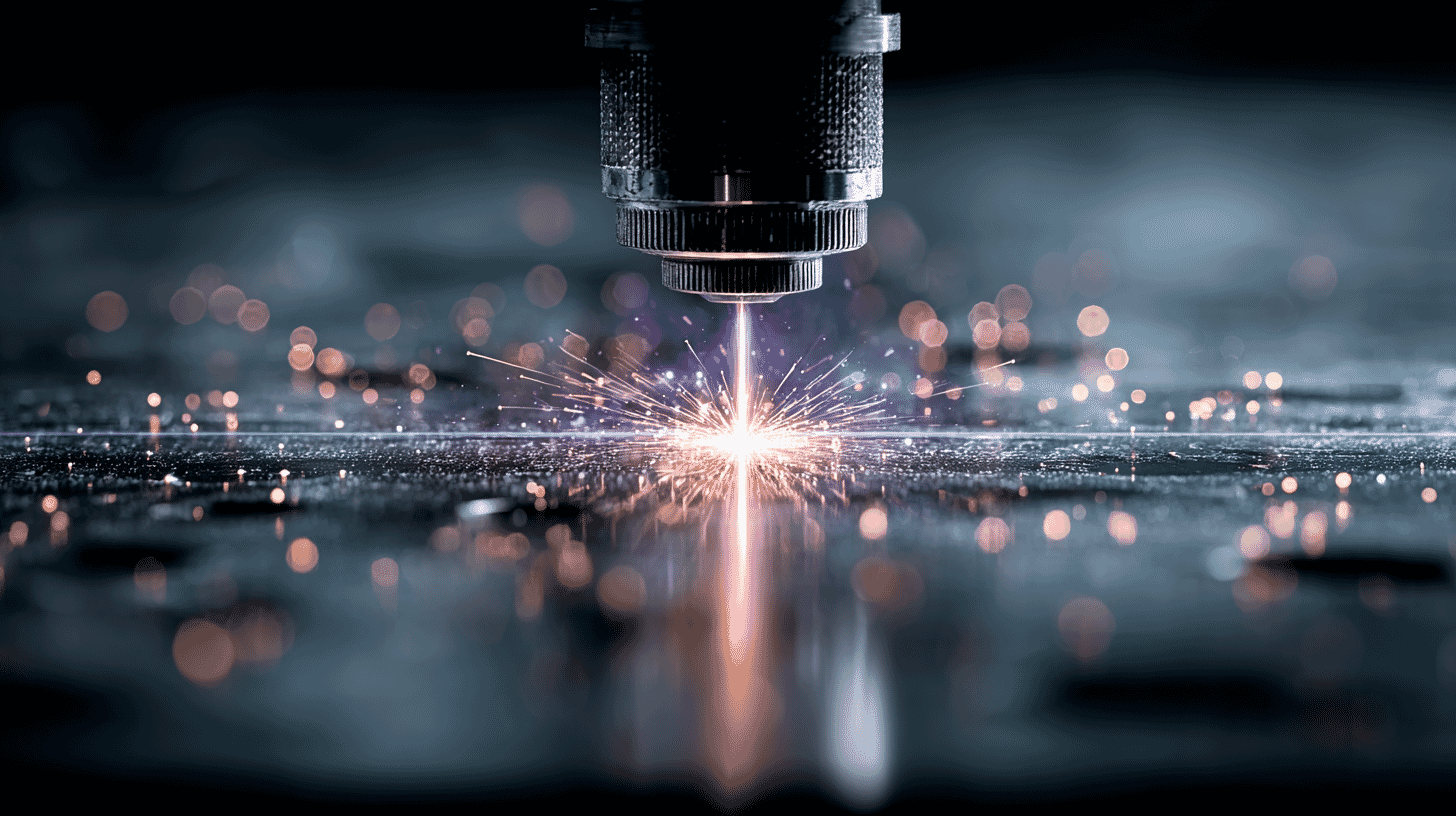
🔬 Quantum computing stories usually open with a qubit count. But before you can use an atom as a qubit, you need light at exactly the right wavelength. For neutral-atom machines built on ytterbium, that wavelength is 302 nanometers in the ultraviolet. Very few companies anywhere can ship that light as a product. One of them sits in Hokuto, a small city in Japan's Yamanashi Prefecture.
A factory in Yamanashi makes the light
Oxide Corporation (Tokyo Stock Exchange Growth, 6521) is an optical crystal maker spun out of Japan's National Institute for Materials Science (NIMS) in October 2000. Its headquarters and plant are in Hokuto; it keeps an office in Yokohama. Growing oxide single crystals, hence the name, is where the business started.
The company is not a household name, but its position is unusual. In the wavelength-conversion single crystals used in the 266nm deep-UV lasers that inspect semiconductor wafers for surface defects, Oxide holds roughly 95% of the world market. In the deep-UV lasers themselves, more than 30%. Both figures are the company's own estimates. Its parts run inside inspection tools at Intel, TSMC, and Samsung. Japan's trade ministry named it to the "Global Niche Top 100" in 2014, and Forbes JAPAN gave it the grand prize at its Small Giants Award in 2021. More than 70% of revenue comes from outside Japan.
On March 9, 2026, Oxide started selling a 302nm ultraviolet laser source for quantum computers. It is called Frequad-K: linearly polarized continuous wave, over 500mW, narrow linewidth, built to run stably for a long time. The first unit has already shipped.
Why it has to be 302nm
Quantum computers come in flavors. Superconducting machines from IBM and Google carried the field for years, but neutral atoms and trapped ions have surged into contention recently.
The neutral-atom approach captures uncharged atoms one by one in optical tweezers, traps made of focused laser light, and uses each atom as a qubit. The appeal is easy to state. Atoms are identical by physics, so there is no manufacturing variation the way there is with fabricated chips. Control is optical, so there is no wiring. You can rearrange the atoms mid-computation. And there is no dilution refrigerator hauling the system down near absolute zero, which keeps the footprint comparatively small.
To actually compute, though, you have to make atoms interact and entangle. That job belongs to the Rydberg state. Push an atom's outer electron into a very high energy level, far from the nucleus, and the atom swells to thousands of times its normal size and starts interacting strongly with its neighbor. You use that window to run a two-qubit gate.
The wavelength that performs the push is set by which atom you chose. For ytterbium, it is 302nm. It cannot drift, the linewidth cannot be sloppy, and it has to hold power for hours on end. Sources that do all three at once have not been easy to buy.
Semiconductor inspection turned out to be the same problem
Oxide's answer looks less like invention than transfer.
Wafer inspection means finding nanometer-scale defects, which means a very stable, high-power deep-UV laser that runs for years without stopping. Power stability, narrow linewidth, long-term reliability. The requirements list for quantum lasers uses nearly the same words. Two decades of being held to that standard turned out to port cleanly.
The second advantage is vertical integration. Not many companies own the whole chain from growing the crystal to shipping the finished laser. Oxide can tune crystal quality and laser design as one problem, solving from the material side what competitors have to solve by assembly.
The first unit went to a domestic customer
According to Nikkei, Frequad-K's first unit went to a customer in Japan. This was not a case of walking straight into the big overseas accounts.
The leaders in neutral atoms are QuEra Computing and Atom Computing in the U.S. and Pasqal in France. QuEra raised more than $230 million in 2025 in a round led by Google Quantum AI and SoftBank Vision Fund 2, and in January 2026 reported in Nature that it had run 96 logical qubits on 448 physical atoms. It has a Gemini-class machine installed at Japan's AIST and was selected for NEDO's Post-5G program. Atom Computing is working with Microsoft and Denmark's QuNorth on Magne, an error-corrected system. Pasqal hit 1,000 qubits in 2024 and has laid out a path to 10,000.
They do not all use the same atom. A 302nm source is the heart of any ytterbium system, but the rubidium and strontium camps need different wavelengths. Which is why Oxide describes 302nm as a starting point and talks about broadening its wavelength lineup. The strategy is not to build a quantum computer. It is to own the thing everyone needs regardless of who wins.
What happened in the four months after launch
That strategy shows up plainly in what followed.
On March 16, Oxide signed a strategic partnership with Finland's Vexlum to develop and manufacture lasers for quantum computers. Vexlum spun out of Tampere University in 2017 and builds VECSELs, vertical-external-cavity surface-emitting lasers, which pair high power with good beam quality. The point of the pairing is to take quantum lasers that currently look like an optical bench assembled by hand and shrink them into industrial products.
Then on July 10, Oxide announced shipments of lasers for quantum communications. The first went to LQUOM, a startup spun out of Yokohama National University in 2020, and is a 436nm narrow-linewidth CW laser that generates the wavelength used by the quantum memory inside a quantum repeater. Quantum communication is extremely secure but distance-limited, and repeaters are the core technology for getting past that limit. Oxide is an investor in LQUOM, which raised over 1 billion yen in 2026. Oxide's share price climbed on the announcement.
Quantum computing, quantum communications, quantum sensing. Oxide says it intends to supply wavelength-conversion components and light sources across all three. The 302nm laser is simply the first one to reach a price list.
Playing the position nobody photographs
Japan has made quantum technology a national priority. But competing head-on with U.S. players on finished quantum computers is a hard argument to make on capital alone.
What Oxide is going after sits one layer earlier: key materials and key components. It is structurally the same move Japanese firms made in semiconductors, where the country ended up owning equipment and materials rather than chips. QuEra's selection for NEDO's Post-5G program, aimed at building a manufacturing supply chain for quantum components in Japan, is part of the same picture.
IEEE Spectrum expects 2026 to be the year error-corrected "Level 2" quantum computers start reaching customers. Whichever factory made the ultraviolet light glowing inside those machines will not appear in the press photos. Industrially, it is close to where the value is.
Japan is angling for the parts, not the products. Where is quantum money going in your country, into finished machines or into what goes inside them?
References
- https://prtimes.jp/main/html/rd/p/000000013.000173865.html
- https://prtimes.jp/main/html/rd/p/000000019.000173865.html
- https://optronics-media.com/news/20260310/107941/
- https://www.nikkei.com/article/DGXZQOCC0929Z0Z00C26A3000000/
- https://eetimes.itmedia.co.jp/ee/articles/2603/16/news110.html
- https://www.quera.com/
- https://spectrum.ieee.org/neutral-atom-quantum-computing







Global Discussion
12 comments