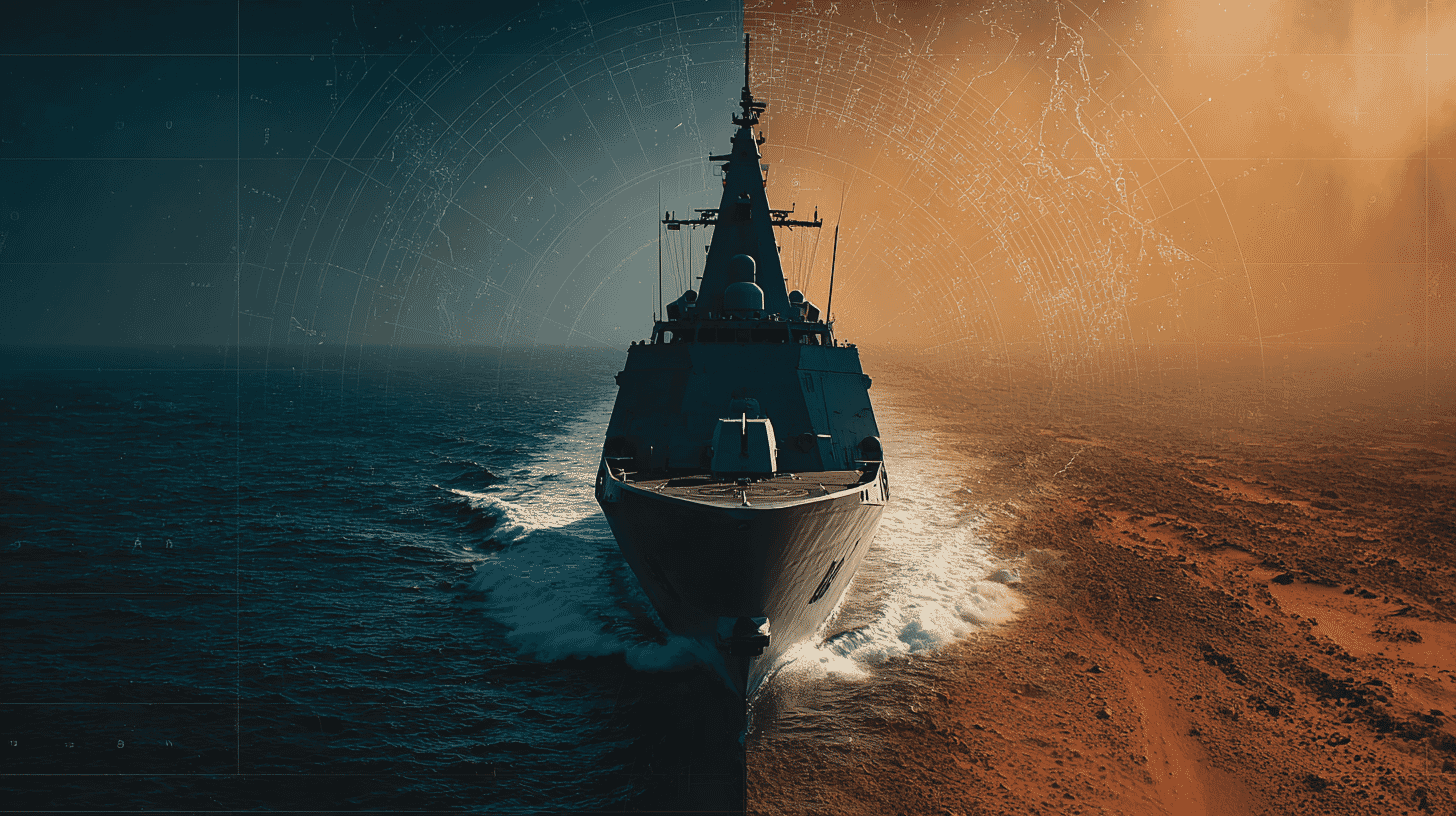
On April 18, 2026, in Melbourne, history quietly shifted. Japan's Defense Minister Shinjiro Koizumi and Australia's Deputy PM and Defence Minister Richard Marles confirmed the joint development contract for 11 upgraded Mogami-class frigates, worth up to AUD 20 billion. Marles said it bluntly: "There is no country we are more strategically aligned with, or that we trust more, than Japan." But this is not just a procurement deal. The postwar Japanese principle of "not being an arms-exporting nation" is being fundamentally rewritten under PM Sanae Takaichi's government.
Our previous article "Mogami-class Frigate 'Yoshii' Launched: Japan's Shipbuilding Prowess" covered Japan's capacity to build 12 ships in 5 years and why Australia trusted Japan on delivery. This follow-up dives into two questions: why Japan and Australia became such a tightly-knit "quasi-alliance", and how the Takaichi government is trying to rewrite Japan's Three Principles on Defense Equipment Transfer, the treaty and the strategy behind the headline.
What Actually Happened in Melbourne
At the meeting, the two ministers confirmed that the contract had been signed to jointly develop a new frigate class for the Royal Australian Navy, based on the upgraded Mogami-class (the "New FFM") operated by Japan's Maritime Self-Defense Force. They also signed a document to smoothly execute the program. The Australian government announced it would invest up to AUD 20 billion (approximately USD 12.6 billion, or JPY 2.2 trillion) in the program over the next decade.
The specifics: of the 11 ships, the first three will be built in Japan, and the first vessel will be delivered to the Royal Australian Navy in December 2029. Ships four onwards will be constructed in Western Australia. On the deck of the Japanese Mogami-class frigate "Kumano", which was in Australia for the Kakadu multilateral maritime exercise, Marles said the first frigate would arrive in Australia in 2029, and that by the early 2030s the Mogami class would form the "backbone of continuous naval shipbuilding in Western Australia."
The deal is described as a "de facto warship export" because Japan's current Three Principles on Defense Equipment Transfer generally prohibit the direct export of finished products with lethal capability, but the joint development and production framework makes this possible. It's not a loophole; it's the maximum use of a legitimate channel that the rules themselves created.
Why Japan and Australia Trust Each Other So Deeply
Marles's "no country more strategically aligned" line might sound like diplomatic boilerplate, but the institutional architecture makes it accurate.
The foundation is the 1976 Basic Treaty of Friendship and Cooperation, 2026 marks its 50th anniversary. What began as a resource-trade partnership evolved through the 2007 Japan-Australia Joint Declaration on Security Cooperation (JDSC) and the 2014 "Special Strategic Partnership" declaration into a comprehensive military-economic alignment.
The 2007 JDSC mattered because it was Japan's first full-scale security declaration with any country other than the United States. In April 2007, a Japanese senator asked Foreign Minister Taro Aso whether Japan-Australia relations could be called a "quasi-alliance", and that term has stuck in official Japanese discourse ever since.
A sequence of agreements followed:
| Year | Agreement | Significance |
|---|---|---|
| 2007 | JDSC | Foundation of the "quasi-alliance" |
| 2010 | Acquisition and Cross-Servicing Agreement (ACSA) | Mutual supply of fuel, food, transport |
| 2012 | General Security of Military Information Agreement (GSOMIA) | Classified information sharing |
| 2014 | Defense Equipment and Technology Transfer Agreement | Framework for mutual transfer |
| 2023 | Reciprocal Access Agreement (RAA) in force | Legal status for joint training |
The only two countries with which Japan has concluded all five of these agreements are the United States and Australia. That is the institutional substance behind the word "quasi-alliance."
The values alignment is equally substantial. Both are democracies committed to the rule of law, maritime nations, supporters of the Free and Open Indo-Pacific (FOIP) vision, and share concerns about China's maritime assertiveness. Economically, Australia is one of Japan's most important suppliers of coal, LNG, iron ore, beef, and rare earths, a lifeline for Japan's energy security.
Japan's participation in the "Second Pillar" of AUKUS (the Australia-UK-US pact), the advanced technology cooperation including maritime autonomous systems, was publicly announced in September 2024. The newly-emerging "SQUAD" grouping (US-Japan-Australia-Philippines) further amplifies this. Japan and Australia function, quite literally, as the northern and southern anchors of the Indo-Pacific security architecture.
Understanding Japan's Defense Export Rules as They Stand
This is the part that often mystifies foreign readers, but you can't understand today's deal without it.
After World War II, Japan adopted the "Three Principles on Arms Exports" in 1967 under PM Sato Eisaku, banning exports to communist bloc countries, UN-sanctioned states, and parties to conflicts. Further Cabinet statements in 1976 under PM Miki tightened this into a near-total ban on arms exports.
The turning point was 2014. The second Abe administration replaced this with the "Three Principles on Defense Equipment Transfer", a framework that allows transfers under specific conditions.
The current three principles are:
- Clarify prohibited transfers: transfers violating treaties, UN Security Council resolutions, or going to parties in armed conflict are banned.
- Limit and strictly screen permissible transfers: only those contributing to peace and international cooperation, or to Japan's own security.
- Ensure proper management of end-use and third-country transfer: require prior consent from the recipient.
Under the implementation guidelines, finished-product exports from Japan have been restricted to five categories known as the "Five Categories": rescue, transport, surveillance, monitoring, and minesweeping.
Frigates and fighter jets are not in that list. So direct export of finished products was essentially impossible. However, the December 2023 revision allowed some exceptions, licensed production items for the US, and a specific Cabinet decision to permit direct third-country transfer of the GCAP fighter jet (being developed with the UK and Italy). The Japan-Australia FFM deal exploits a separate route: the joint development and production framework that bypasses the Five Categories entirely.
What Takaichi Wants: Scrap the Five Categories
Here's the core of the story. PM Sanae Takaichi's government wants to eliminate the Five Categories altogether.
In October 2025, after Komeito left the coalition, the Liberal Democratic Party (LDP) and Nippon Ishin no Kai formed a new coalition government whose pact explicitly included "scrapping the Five Categories." On March 6, 2026, LDP Security Research Commission Chair Yasukazu Hamada and Ishin counterpart Seiji Maehara delivered a joint recommendation to PM Takaichi.
Key points of the recommendation:
- Abolish the Five Categories and make export of finished products and components "permissible in principle."
- Classify equipment by whether it has lethal or destructive capacity: "weapons" (frigates, submarines, missiles) vs. "non-weapons" (ballistic vests, helmets).
- Weapons may only be exported to countries with a Defense Equipment and Technology Transfer Agreement.
- Export approvals for weapons must be screened by the National Security Council (NSC) chaired by the PM.
- The government will work out methods to ensure sufficient Diet and public explanation.
- No transfers to countries "currently engaged in combat" as a general rule, with humanitarian exceptions.
After the handover, Hamada told reporters: "We must build the foundation of the defense industry." Maehara added: "Our defense industrial base has weakened, undermining our ability to defend our own country." PM Takaichi responded: "We must explain this carefully to the public." The government plans to revise the implementation guidelines as early as Spring 2026. Defense Minister Koizumi has said he will move with "a sense of speed."
In plain terms: the current narrow whitelist of five categories gets replaced with a framework where everything is permissible in principle, but weapons require screening and are limited to treaty partners. The coalition's own recommendation calls this a "major transformation" of postwar Japanese defense equipment policy.
What Changes: The Pros and Cons
What happens if the Five Categories are actually scrapped?
Pros (the proponents' case)
Revitalizing the defense industrial base. Japanese defense firms have had only one customer (the Ministry of Defense) and suffer from low-volume, high-mix production. In the past 20 years, over 100 companies have exited the defense business, Komatsu got out of armored vehicles, Yokogawa Electric dropped avionics displays, Sumitomo Heavy ended machine gun production. Opening export markets would bring economies of scale, lower unit costs, and a more resilient supply chain.
Allied interoperability and deterrence. Countries operating the same equipment develop stronger interoperability and combined operational capability. The Japan-Australia FFM is a perfect example: the JMSDF and RAN operating the same ship class will share training, maintenance, munitions, and parts.
Economic security. Dependence on one supplier for equipment creates supply-halt risk in crisis. Spreading Japanese defense equipment across allies creates mutual stakes and a more resilient network.
Accelerating technology development. Multi-nation joint development lets partners share R&D costs and requirements, producing more capable systems. The GCAP fighter with the UK and Italy is the prime example.
Cons (the cautious view)
Eroding the peaceful-nation brand. Japan's postwar identity as "the country that doesn't export weapons" has been part of its soft power. Normalizing lethal weapon exports could erode this intangible asset.
Diversion and third-country transfer risk. No prior-consent regime can fully prevent recipients from using equipment for unintended purposes after a government change or from re-transferring it.
Entanglement risk. If Japanese-made equipment is used in another country's combat operations, Japan may face international scrutiny, especially if the equipment is used in ways that raise humanitarian law concerns.
Domestic political division. Reconciling this with Article 9 of the Constitution and postwar pacifism remains contested among religious groups, civil society, and opposition parties. Komeito, once a coalition partner, was cautious about scrapping the Five Categories even before leaving the coalition; the issue had been deferred as "ongoing discussion" in previous coalition negotiations.
Industry adaptation risk. Japanese defense companies accustomed only to domestic procurement may struggle with foreign customers. Mitsubishi Heavy Industries has a 35-year on-time delivery record with Japan's MoD, but the RAN is a new kind of demanding customer.
Transparency and democratic oversight. NSC screening is a Cabinet process with limited Diet involvement. How much information about what is sold to whom becomes public will define democratic accountability.
What the Japan-Australia Deal Shows
The Japan-Australia contract offers "real-world answers" to all of these concerns. The counterparty is a mature democracy, already bound by the Technology Transfer Agreement, a member of AUKUS, with aligned values and strategy. The transfer route sits inside the existing joint development framework. Production shifts to Australia, building local industry. The risk of diversion to conflict zones is, practically speaking, near zero.
In other words, Japan and Australia have essentially pre-written a model case for what a post-Five-Categories weapons export should look like. Indonesia, New Zealand, and the Philippines have expressed interest in the New FFM; with guideline revision, those could follow.
The deal has also surfaced a domestic strain: only one New FFM is planned for procurement in fiscal 2026 for the JMSDF, as Mitsubishi Heavy's Nagasaki shipyard slots get priority for Australian orders. Boosting industrial capacity through exports could paradoxically create domestic supply bottlenecks. Capacity investment and workforce expansion must run in parallel with policy reform.
Eighty years after the war, Japan is quietly shedding its role as "the country that doesn't export weapons" and becoming "the country that builds and sells weapons with its allies." The Japan-Australia New FFM contract is the symbol; scrapping the Five Categories will be the milestone. Whether this is the right answer for Japan's security, or an irreversible choice, remains to be seen.
What's It Like In Your Country?
America's FMS program, France's Dassault, Germany's Rheinmetall, South Korea's K9 howitzer: arms exports are a core industry and a diplomatic tool for many advanced economies. For Japan, though, they clash uncomfortably with postwar pacifist identity.
How does your country regulate arms exports? Embargo lists, transparency of licensing, parliamentary oversight, civil society debate: tell us how the conversation looks from where you are.
References
- https://news.yahoo.co.jp/articles/f09ea58e68c0275cffc6dc6dd121cf3b209f888e
- https://news.yahoo.co.jp/expert/articles/ef73925d374ece5f18a2e28170a6131fca370919
- https://www.japantimes.co.jp/news/2026/04/18/japan/mogami-japan-australia-announcement/
- https://www.jimin.jp/news/policy/212627.html
- https://www.nikkei.com/article/DGXZQOUA060X30W6A300C2000000/
- https://news.yahoo.co.jp/articles/5c6a8b582179f8be6e650037c8729dfb3b3ba9d6
- https://www.dlri.co.jp/report/ld/551490.html
- https://www.mofa.go.jp/mofaj/fp/nsp/page1w_000097.html
- https://www.spf.org/iina/articles/thomas_03.html
- https://apinitiative.org/2021/02/23/16787/
- https://idsa.in/publisher/issuebrief/japan-and-australia-50-years-of-the-basic-treaty-of-friendship-and-cooperation
- https://www.orfonline.org/expert-speak/the-strategic-impact-of-the-japan-australia-frigate-deal
- https://kantenna.com/topic/mogami-class-frigate-yoshii-japan-shipbuilding-capability







Global Discussion
14 comments