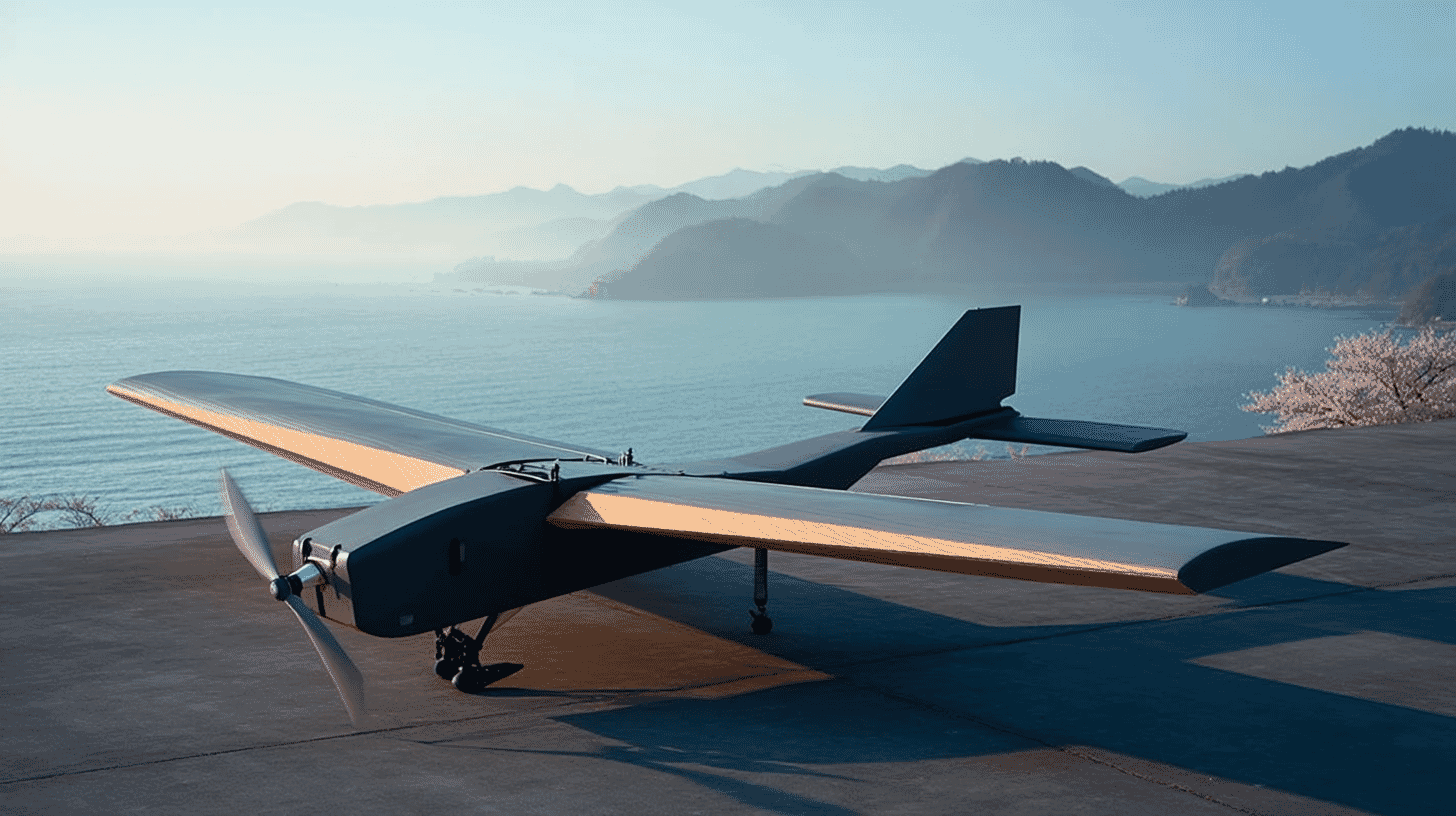
A 1.9-meter wooden airframe. Domestic parts from nose to tail. A retail cost of just 70,000 yen, around 440 dollars. A Japanese startup whose founders spent three years within 12 miles of the Ukrainian front line has just released a drone designed to be used, crashed, replaced, and forgotten. This isn't about the aircraft. It's about Japan's defense mindset finally catching up to the era of attritable mass.
On April 14, 2026, JISDA (Japan Integrated Security Design Agency) announced the "ACM-01 Shiraha," a fully domestic fixed-wing drone with a wooden fuselage, a 1.9-meter wingspan, and a base cost of about 70,000 yen (approximately 440 USD). The entire supply chain, materials, manufacturing, assembly, inspection, quality control, lives inside Japan.
A drone built to be broken
What separates the Shiraha from every other made-in-Japan UAV isn't its specs. It's its design philosophy.
JISDA describes the Shiraha plainly: it is a training platform built to be used, damaged, and swapped out. It deliberately steps away from the usual arms race over flight endurance, communication range, and payload capacity. Instead, the design optimizes for something Japan has chronically neglected, the ability to fly enough hours, crash often enough, and replace airframes fast enough for operators to actually learn.
Domestic fixed-wing drones in Japan typically cost millions of yen per unit. The doctrine that follows is obvious: fly carefully, log every incident, preserve the aircraft. JISDA rejects that entire paradigm. "In training environments where airframes will be consumed in bulk," the company states, "the real value isn't high performance. It's a price point that makes repeated use realistic."
Lessons from 12 miles out
The thinking behind the Shiraha came from somewhere very specific: three years of field research in Ukraine, conducted before JISDA even incorporated.
The founding team didn't stop at Kyiv or the rear areas. They traveled to zones within roughly 20 kilometers of the front line, less than 12 miles from active combat, to observe how equipment actually gets used, how it fails, how it gets modified, and what operators really need.
What they saw was this: hardware specs don't win fights on their own. Frequency choices, video transmission, navigation, antenna placement, airframe configuration, payload handling, all of it gets revised on a weekly cadence. Aircraft break, get repaired, get replaced, get improved. The system for sustaining that cycle is itself part of combat power. Defense-focused outlets reporting from Ukraine note that frontline fixed-wing interceptor drones now cost roughly 5,000 USD per unit, the "cheap and plentiful" doctrine has already stopped being theoretical.
JISDA's insight is that Japan's elite components and manufacturing don't currently connect into an operational system. Excellent pieces, no integrated whole. The Shiraha is designed as the anchor of a domestic supply chain that can feed training demand continuously, not a showcase product.
"Skill House", training as a package
The Shiraha isn't sold as a standalone airframe. It's the core of a bundle JISDA calls "Skill House."
Skill House wraps training, airframe storage, repair and replenishment, and hands-on practice scenarios into a single integrated offering. For a drone operations unit, it functions as "a practice field, a tool shed, and a repair hangar rolled into one." Attrition-aware training environments, airframe stock management, repair response, practical curricula, all delivered as one package rather than as scattered procurements.
Put differently: JISDA is not a drone manufacturer. It's a sustainment-capability vendor. The airframe is a consumable; the real product is the continuous-improvement loop underneath.
How it differs from the "AirKamuy" cardboard drone
Japanese readers might remember AirKamuy 150, the cardboard military drone from a Nagoya University spinoff that made international headlines in January 2026. 300,000 yen (about 1,900 USD), 120 km/h, two-hour endurance, foldable for transport.
Shiraha and AirKamuy both fall under "affordable domestic drone," but they're solving genuinely different problems:
| Dimension | AirKamuy 150 | Shiraha |
|---|---|---|
| Material | Cardboard | Wood |
| Unit cost | ~300,000 yen (~$1,900) | ~70,000 yen (~$440) |
| Primary role | Short-range operations | Training (plus short-range) |
| Philosophy | Make the operational drone cheap | Make the pilot-training drone cheap |
| Packaging | Airframe only | Bundled with Skill House |
AirKamuy attacks the cost of the mission drone itself. Shiraha attacks the cost of training the humans who fly mission drones. Both are needed. JISDA is deliberately targeting the second gap, the one that conventional procurement tends to leave invisible.
CEO Kunii's "stop selling things, start selling outcomes"
JISDA CEO Shota Kunii made a striking public statement alongside the release. The key points:
"Obsessing over the airframe itself isn't meaningful. Building something that flies isn't particularly hard, and if you ignore cost, you can push specs as high as you want. But a drone that's actually viable in modern combat is never just an aircraft that flies. It only exists through the integration of multiple layers, network connectivity, real-time processing, autonomy, jamming resistance, tactical integration, sustainment."
Kunii continued: the 70,000-yen figure isn't a marketing hook. It's a provocation. The goal is to shift Japan's mindset away from "use expensive machines carefully, in limited scenarios" toward "treat drones as a service and solution that gets used repeatedly in the field."
This echoes a broader challenge facing Japanese manufacturing: the long-running tension between "keep polishing the specs of a standalone product" and "design the experience, the meaning, the system." Shiraha isn't just a drone story. It's a product-philosophy story.
Where Shiraha fits, and what it doesn't solve
Coverage by DroneXL has framed the Shiraha as a solution for the training and attrition problem generated by the large imported UAVs now entering Japanese service, platforms like Baykar's TB2 or IAI's Heron Mk II. You can't build a proficient drone force if every flight hour costs thousands of dollars and every crash triggers an incident review. Shiraha is the low-cost "learning layer" underneath those expensive systems.
But the challenges are real. 70,000 yen is a minimum-spec training cost; extending range, hardening communications, or adding payload capability all push the price higher. And the "consume in bulk, iterate fast" philosophy runs directly against Japan's procurement culture, which has historically prioritized treating equipment with extreme care and extending service life. Scaling production, building out training facilities, and educating operational units, the non-hardware work, is where this project will actually be tested.
The real story isn't wood, it's imported thinking
Shiraha is not a breakthrough aircraft. Russian-designed, Ukrainian-copied Molniya drones use a similar wooden architecture. Australian firm Sypaq's Corvo PPDS cardboard drone has been flying in Ukraine for years. The engineering here isn't what's new.
What's new in Japan is the thinking, the transplant of a doctrine from a country fighting a drone war into a country that has spent decades optimizing for expensive, precious, long-service equipment. Moving from "preserve the asset" to "replace the asset; grow the human" is a genuine cultural shift, and Shiraha is the first tangible artifact of it.
Japan is only now beginning to seriously debate volume and training in defense. In your country, how has military training doctrine and defense procurement thinking changed since the Ukraine war?
References
- https://drone-journal.impress.co.jp/docs/news/1188436.html
- https://prtimes.jp/main/html/rd/p/000000010.000179032.html
- https://jisda.jp/
- https://www.jwing.net/news/107566
- https://dronexl.co/2026/04/19/japans-450-drone-ukraine/
- https://maia.my/news/japanese-startup-develops-shiraha-drone-under-450-unit
- https://defence-blog.com/what-ukraines-drones-really-cost/





Global Discussion
14 comments