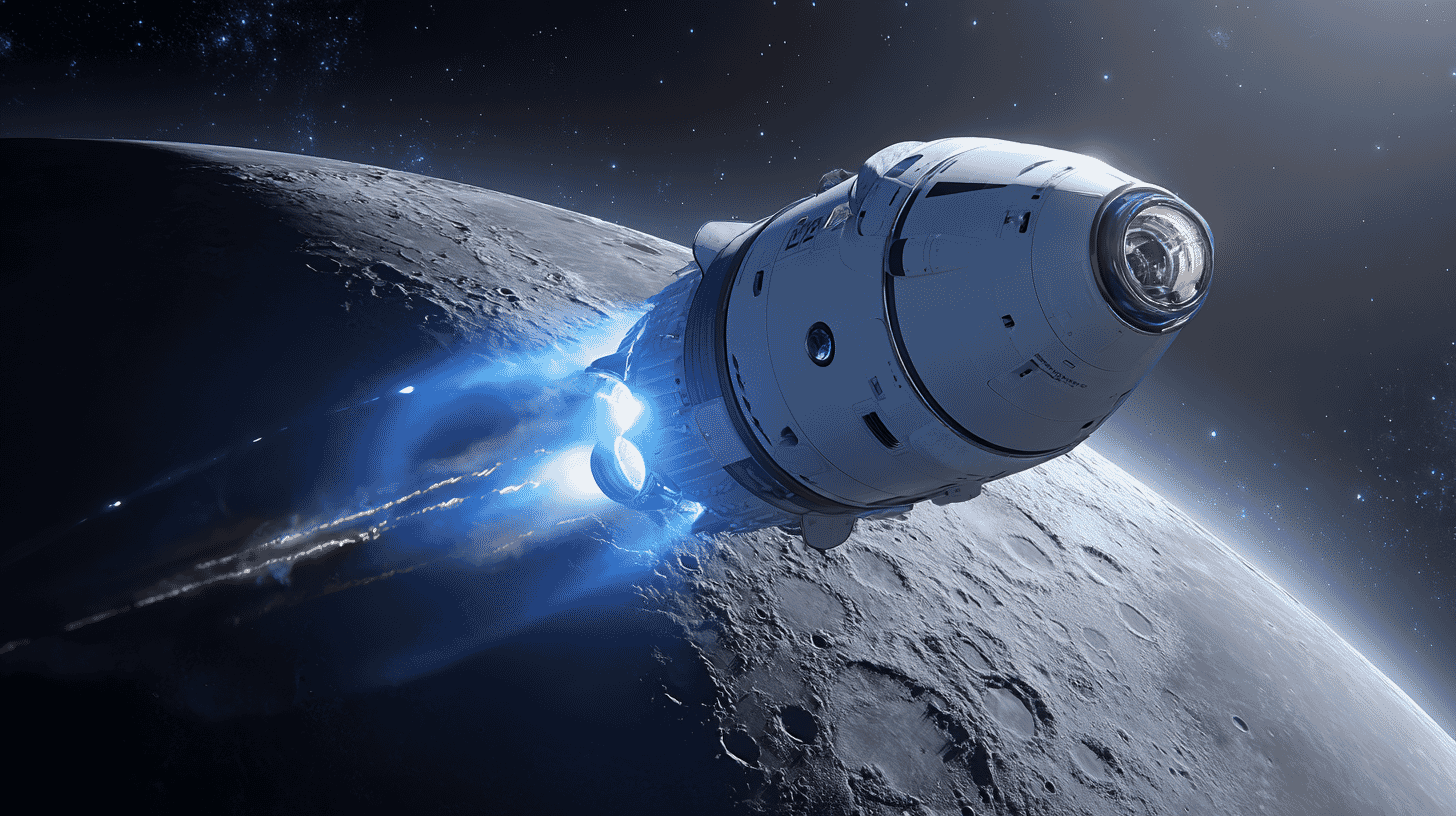
🚀 Rockets get your cargo to space — but who delivers it to the final destination? Space is developing its own "last mile delivery" problem, much like e-commerce on Earth. A University of Tokyo-born startup called Pale Blue is stepping up with water-powered engines to build the "branch line transportation" network that space desperately needs.
The Space Logistics Gap: Why Rockets Alone Aren't Enough
Getting satellites and payloads into space requires rockets — that much is obvious. But rockets can only deliver cargo to a limited set of orbits, typically low Earth orbit (LEO). The actual destinations where satellites need to operate might be in higher orbits, near the Moon, or even beyond.
This creates a fundamental logistics challenge: bridging the gap between where the rocket drops you off and where you actually need to be. Think of it like ground transportation — a highway truck (the rocket) delivers goods to a regional hub, but you still need a local delivery vehicle to reach individual addresses. That local delivery vehicle, in space terms, is called an Orbital Transfer Vehicle (OTV).
Meet Pale Blue: The Water-Powered Engine Startup from the University of Tokyo
Pale Blue was founded in April 2020 by researchers from the Koizumi Laboratory at the University of Tokyo's Graduate School of Frontier Sciences. CEO Jun Asakawa, a former assistant professor at the university, leads the company with a mission to "continue expanding humanity's potential."
The company's defining innovation is using water as propellant. Traditional satellites rely on toxic chemical propellants like hydrazine, which are hazardous to handle and expensive to store. Water, by contrast, is safe, abundant, easy to handle, and can be stored at low pressure. Perhaps most excitingly, water exists on the Moon, asteroids, and other celestial bodies — opening the door to in-space refueling in the future.
Pale Blue has developed two types of water-powered thrusters: a resistojet (which heats water into steam for thrust) and an ion thruster (which ionizes water into plasma for high-efficiency propulsion). The company has also created an integrated system called "KIR" that combines both thruster types into a single compact unit, which has been successfully demonstrated in space through JAXA's Innovative Satellite Technology Demonstration Program.
On the business side, Pale Blue has raised approximately ¥2.5 billion (roughly $17 million) through its Series B round. In 2025, Mitsubishi Electric also made a strategic investment in the company, recognizing the growing importance of sustainable propulsion technology.
JAXA's Space Strategy Fund Backs Pale Blue's OTV Ambitions
On January 30, 2026, Pale Blue announced a pivotal development: the company was selected for JAXA's Space Strategy Fund under the technology development theme "Technology for Free Movement in Space (A) Development of Orbital Transfer Vehicles."
The Space Strategy Fund is a massive Japanese government initiative created in 2024, with a budget of up to ¥1 trillion (approximately $6.7 billion) over ten years, designed to strengthen Japan's competitiveness in space technology. With this backing, Pale Blue will partner with the University of Tokyo to develop an ultra-compact orbital transfer vehicle.
The company's strategic concept centers on "branch line transportation" — serving the growing demand for precise, flexible delivery to diverse orbits that large-scale launch vehicles alone cannot address. In particular, Pale Blue sees a critical gap in access to cislunar space (the Earth-Moon region) and beyond, which their compact OTV is designed to fill.
Why OTVs Are Having Their Moment
Several converging trends are driving intense interest in orbital transfer vehicles.
The explosion of small satellite launches is a primary factor. Rideshare missions, pioneered by SpaceX's Transporter program, pack dozens of small satellites onto a single rocket — but each satellite may need a different orbital destination. After being deployed at the same point, satellites need OTVs to reach their individual target orbits.
The growing ambitions in lunar and deep-space exploration also play a role. Programs like NASA's Artemis, along with commercial lunar landers and deep-space probe concepts, are creating demand for flexible transportation within the space between Earth and the Moon.
The international OTV landscape is already taking shape. France's Exotrail has successfully deployed satellites from its electric-propulsion "spacevan" OTV. Italy's D-Orbit operates its ION Satellite Carrier platform. In the United States, Firefly Aerospace acquired Spaceflight Inc. to integrate rideshare brokerage with OTV services. Pale Blue's entry marks Japan's first major domestic push into this emerging sector.
Japan's Space Industry at a Turning Point
Pale Blue's OTV entry comes at a transformative moment for Japan's space sector.
The Japanese government revised its Basic Plan on Space Policy in 2023, setting an ambitious target to double the domestic space market from ¥4 trillion to ¥8 trillion by the early 2030s. The Space Strategy Fund is the cornerstone policy tool for achieving this.
The private sector is responding. Six listed Japanese space startups now have a combined market capitalization of approximately ¥400 billion. Axelspace successfully IPO'd on the Tokyo Stock Exchange Growth Market. JAXA's H3 rocket has achieved consecutive successful launches. Companies like Interstellar Technologies and Space One are developing small launch vehicles. An ecosystem is emerging.
Challenges remain, however. Japan's launch frequency pales in comparison to the United States and China. Revenue structures lean heavily on government contracts. International market presence is limited. The common refrain in Japanese aerospace circles is that the technology exists at world-class levels, but the speed of commercialization needs to catch up.
In this context, Pale Blue's push into the "next layer" of space transportation — beyond rockets — represents an important step in deepening Japan's space industrial capabilities.
Water Propulsion's Bigger Vision: Space "Gas Stations"
Pale Blue's long-term vision extends far beyond OTVs.
Water ice has been confirmed at the Moon's polar regions. Hydrated minerals exist on asteroids. If future missions can extract water from these celestial bodies and use it as propellant, it becomes possible to build "refueling stations" throughout the solar system.
The company envisions evolving from a thruster manufacturer into a full-scale "space mobility service" provider — transporting customer payloads to specific destinations using water propulsion, providing in-space water refueling services, and eventually establishing transportation hubs on the Moon or Mars that leverage local water resources. The ultimate goal is a new transportation infrastructure in space, powered entirely by water.
The Bottom Line: Can Japan Build Space's Delivery Network?
Pale Blue's entry into the OTV business represents an evolution from component supplier to system integrator. A company that builds the "heart" of a spacecraft — its propulsion system — is now stepping up to design and operate entire space vehicles. This is a new growth model for Japanese space startups.
In Japan, there is both excitement about the multilayered future of space transportation and realistic concern about the intensity of international competition. What does the future of space logistics look like from your country's perspective? How do people in your nation view deep-tech startups taking on challenges like building space infrastructure? We'd love to hear your thoughts.
References
- https://uchubiz.com/article/new68906/
- https://pale-blue.co.jp/jpn/
- https://www.kenkai.jaxa.jp/kakushin/interview/03/interview03_06.html
- https://www.mitsubishielectric.co.jp/ja/pr/2025/0807/
- https://pale-blue.co.jp/jpn_news/541/
- https://www.axelspace.com/ja/news/paleblue/
- https://www.isas.jaxa.jp/home/research-portal/people/2023/0727/

Reactions in Japan
Pale Blue evolving from thruster maker to OTV operator is a natural progression. You might think 'they have the heart of the system, so they can build the whole thing,' but satellite bus design, comms, power systems, and attitude control are entirely different disciplines. The real challenge starts now.
Space Strategy Fund selection is in. Pale Blue's edge isn't just the uniqueness of water propulsion — it's the multiple in-orbit demonstrations already completed. High TRL startups give investors confidence. OTV has lots of global competition, but the question is whether they can carve out a niche.
Love the concept of 'branch line transportation.' In railway terms, it's like transferring from the bullet train (rocket) to a local line (OTV) to reach your final station. Space is building its own transit network. Gets me emotional.
Honestly, I can't see how big the ultra-compact OTV market really is. Neither Exotrail nor D-Orbit are profitable on OTV alone yet, right? You can develop tech with the Strategy Fund, but commercializing it is a completely different game. Worried about what happens after the subsidies run out.
Deeply moved as a Koizumi Lab alumnus. The water thruster experiments we ran as students are now becoming the core of an OTV. Seeing academic seeds grow into real business shows university-born ventures in Japan aren't to be underestimated.
As someone in ground logistics, it's genuinely fascinating that the 'last mile problem' exists in space too. But on the ground, last mile is the most expensive part. In space it must be even worse. Pricing will be crucial.
Water propulsion also helps with debris mitigation, which is quietly impressive. Small satellites without thrusters become space junk after their mission. With water engines, they can deorbit themselves. If OTVs spread, sustainability in space could improve significantly.
Looking at the Strategy Fund selections, it's encouraging that startups like this get allocated funding alongside major heavy industries. But even ¥1 trillion over 10 years is tiny compared to SpaceX's annual investment. The scale gap is real...
Extracting ice from the Moon for propellant — that's no longer sci-fi, it's in actual business plans. By the 2030s, lunar water rights could seriously become an international issue. We live in an era where reality is outpacing fiction.
Jumping from component maker to system integrator sounds simple but it's extremely hard. Organization, business model — everything changes. But I think Pale Blue can pull it off. Asakawa's team has a good balance of engineering and business sense.
A spacecraft powered by WATER?! And they might use Moon water in the future?? That's basically Gundam. And Pale Blue's name comes from Carl Sagan's 'Pale Blue Dot,' right? So emotional... I want to work here someday.
Orbital transfer capability is strategically important for national security too. Rapidly repositioning satellites to any orbit is relevant not just commercially but for SSA (space situational awareness) and satellite protection. Pale Blue acquiring this capability through civilian channels serves national interests.
We once made a 'water-powered rocket' for my kid's school project, and there's actually a company powering real spacecraft with water! When I told my child that future spaceships are on the same continuum as bottle rockets, their eyes lit up.
Pale Blue is based in Kashiwa, so as a Chiba resident I'm rooting for them. I heard they set up a production technology center — if local SMEs get integrated into their supply chain, it'd impact the regional economy. Space isn't just Tokyo and Tsukuba.
Honestly, overseas OTV players already have track records so Pale Blue is a latecomer. But having in-house propulsion is a real strength. D-Orbit outsources its propulsion, so Pale Blue might have advantages in cost and customization.
JAXA's ISAS is also advancing deep-space OTV studies — different scale from Pale Blue's ultra-compact version, but it's a good move for Japan to pursue orbital transfer tech through multiple approaches. Feels like the Hayabusa2 legacy is connecting to the next generation.
Every SpaceX Transporter mission highlights the same issue — satellites dropped at one orbit but needing to be somewhere else. If ultra-compact OTVs like Pale Blue's become operational, they could actually stimulate more rideshare demand. It's a complementary relationship.
Exotrail's spacevan has already deployed satellites in orbit, so Pale Blue is a latecomer. But water propulsion is an interesting differentiator. European OTV players mostly use xenon or krypton-based electric propulsion. Long-term, water might win on propellant accessibility.
ISRO's budget has increased India's small satellite launches, but we haven't gotten to high-value services like OTVs yet. If a Japanese startup enters this space, they could potentially serve Indian satellite operators too. Looking forward to intra-Asian collaboration.
Water propulsion's biggest appeal is ISRU potential. If lunar water becomes usable as propellant, launch mass from Earth drops dramatically. This isn't just an OTV story — it's a potential game-changer for the entire lunar development ecosystem.
China's OTV development is state-led, so it's not a direct comparison. But a private startup entering OTV with proprietary tech shows the diversity of Japan's space industry. China's private space sector is growing too, so future competition will be interesting.
D-Orbit employee here (personal opinion). The OTV market expanding is welcome for us too. Pale Blue has experience mounting thrusters on D-Orbit satellites, so rather than competitors, they could be partners in growing the market together.
Interesting concept, but ultra-compact OTVs have physical payload limits. Delta-V requirements skyrocket for cislunar transport. I wonder if water ion thruster specific impulse can cover the needed range. Might need another technical breakthrough.
Korea's space startup scene is growing after Nuri's success, but we still lack propulsion-specialized ventures like Japan has. Pale Blue's model of specializing first then expanding is instructive. There should be more Korea-Japan space startup exchanges.
When African space agencies launch satellites, limited orbit options are always a problem. If affordable, flexible orbital transfer services become commercial, it could lower barriers to space for developing nations. OTV market growth matters globally.
I research space propulsion at a Polish university. Water propulsion has been studied for decades, but Pale Blue is one of the few globally to bring it close to commercial viability. This success is built on UTokyo's academic foundation. We need more university spin-off success stories like this in Europe.
Brazil's space industry is still early-stage, but if OTV services mature, nations can place satellites optimally without developing their own rockets. Commoditization of space transport is an opportunity for latecomers. If Japanese startups help pave that path, welcome.
Surrey University in the UK has active small satellite propulsion research too, but few have commercialized successfully. Pale Blue securing Mitsubishi Electric's investment is noteworthy. Large corporate backing validating startup credibility is an effective model.
As a Japanese-American, I'm happy to see Japan's space progress. But compared to Silicon Valley pace, ¥2.5B in funding is still small. In the US, OTV startups raise hundreds of millions of dollars. To compete globally, they need to scale up funding significantly.
In Germany, OHB and ArianeGroup lead space transport, but there are few dedicated OTV players. Pale Blue specializing in a specific ecosystem layer makes sense. But connecting with ESA will be key for global expansion.
Vietnam just launched its first domestically-built satellite NanoDragon. Seeing Japanese startups enter OTV business is inspiring for emerging Asian space nations. Someday I hope Vietnamese satellites can be delivered to optimal orbits by Pale Blue's OTV.
Australia's space sector has grown rapidly in recent years, but propulsion is still a weak point. As launches from the southern hemisphere increase, OTV demand will emerge in Oceania too. Pale Blue positioning as an Asia-Pacific OTV provider would be an interesting play.