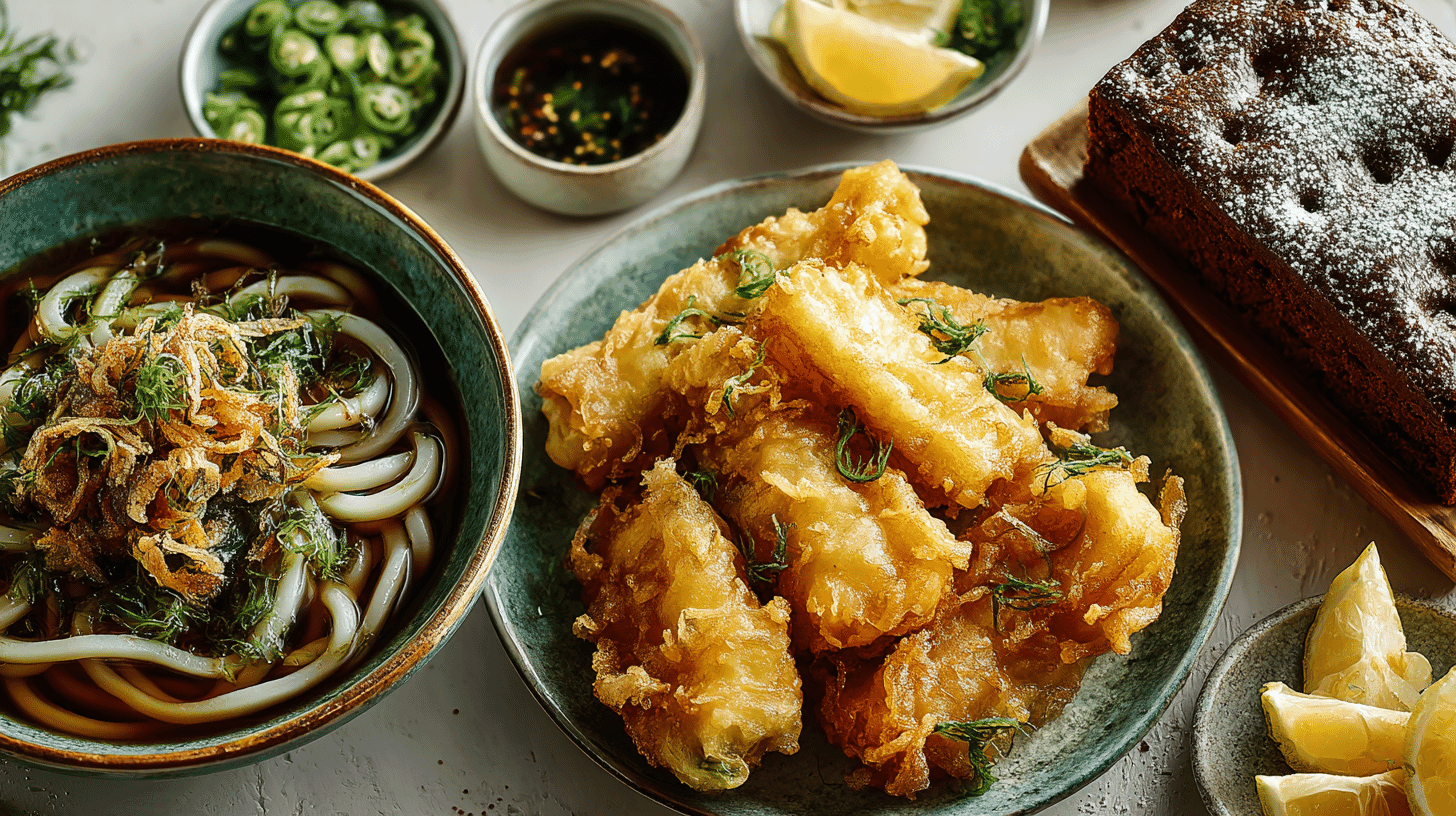
Those tiny golden crunchy bits left in the fryer after tempura, meet tenkasu.
Once dismissed as kitchen waste, these humble deep-fried batter flakes are now about to go global.
Otafuku Holdings, the Hiroshima-based maker famous worldwide for its okonomiyaki sauce, has completed a brand-new tenkasu-dedicated factory in Omura, Nagasaki, through its group company Nakagawa. Annual production capacity jumps from 4,200 to 6,300 tons, a 1.5x increase, with full operations starting in July 2026. The target? Europe and beyond, riding the global Japanese food boom.
Why is "tempura scraps" suddenly a strategic export product? Let's dig into Japan's unique konamon (flour-based) food culture, and its surprising parallels around the world.
Otafuku's big Nagasaki bet
Nakagawa, a subsidiary of Otafuku Holdings, held the completion ceremony for its new factory at Omura Hi-Tech Park, Nagasaki Prefecture, on January 30, 2026. Full-scale production begins in July 2026.
The new two-story steel-frame facility spans about 41,800 m² of land with 5,100 m² of floor space. The company added a third large fryer (up from two), installed eight filling machines, and built a dedicated warehouse that the old site lacked.
The result: annual tenkasu production rises from roughly 4,200 to 6,300 tons. Nakagawa's flagship product, "Ika-ten Iri Tenkasu Tenka" (squid-tempura crumbs), is actually one of the top three best-sellers across the entire Otafuku Group lineup, bigger than you might guess for something that started life as fryer residue.
At the completion ceremony, Nakagawa's president made clear the company's ambition reaches far beyond Japan's borders. Tenkasu, he suggested, can be sprinkled on pasta and pizza, dropped into a bowl of Vietnamese pho, the idea is to position it not as an obscure Japanese side ingredient but as a universal "crunchy topping" that fits any cuisine.
What is tenkasu, anyway?
Tenkasu (天かす), or agedama (揚げ玉) in eastern Japan, are crispy fragments of deep-fried wheat-flour batter, essentially the scraps that break off during tempura frying. The characters literally mean "tempura dregs."
A famous 2003 survey by the NHK Broadcasting Culture Research Institute found that 68% of Japanese call them tenkasu while 29% say agedama. Western Japan (Kansai and beyond) prefers tenkasu; eastern Japan, especially the Kanto region around Tokyo, leans agedama. Even the dish names differ: hot udon with tempura crumbs is tanuki udon in the east, but haikara udon in Kansai.
Where you'll find tenkasu in a Japanese meal
Okonomiyaki, Both Osaka-style (mixed) and Hiroshima-style (layered) savory pancakes. Mixed into the batter, tenkasu raises the internal cooking temperature so the cabbage steams perfectly, delivering that signature "crispy-outside, molten-inside" texture. The oil inside melts out and adds richness.
Takoyaki, The octopus balls of Osaka street food fame. For most Osakans, takoyaki without tenkasu is simply not takoyaki.
Udon and soba noodle soup, A scoop of tenkasu floats on the hot broth, starting crunchy and gradually softening as it drinks in the dashi. Two textures in one bowl.
Onigiri, Lawson, Japan's second-largest convenience store chain, launched the "Akuma no Onigiri" (Devil's Rice Ball) in 2018, rice seasoned with tenkasu, tempura dipping sauce, and green onion. It became a nationwide hit and is still a staple today.
Born in Osaka, the city that "eats itself bankrupt"
Commercial tenkasu owes its existence to Osaka's kuidaore ("eat until you drop") food culture. According to Otafuku's corporate history, Nakagawa's predecessor was a small edible-oil company founded in Osaka in 1947. The owners would collect used oil from tempura shops, and with it, they'd take home the leftover tempura scraps. Giving those scraps to local okonomiyaki and takoyaki shops, they discovered a hungry market. A waste product became a business.
In other words, tenkasu is the commercialized offspring of two uniquely Japanese traditions: Osaka's flour-food obsession, and the nationwide mottainai ("don't waste") ethos applied to cooking oil.
Why the export surge, and why now?
Tailwind #1: Japanese restaurants are everywhere
According to Japan's Ministry of Agriculture, Forestry and Fisheries (MAFF), the number of Japanese restaurants outside Japan reached roughly 187,000 in 2023, more than triple the 55,000 count from a decade earlier. The growth isn't limited to North America and Europe; Southeast Asia, Latin America, and the Middle East are all expanding rapidly.
More restaurants serving okonomiyaki, takoyaki, and Japanese-style noodles overseas means surging B2B demand for authentic tenkasu.
Tailwind #2: A historically weak yen
As of April 2026, USD/JPY is trading around 158, continuing a historic stretch of yen weakness. For overseas buyers, that translates directly into "Japanese ingredients are cheap", a golden window for Japanese food-maker exports.
Tailwind #3: The global hunger for "crunchy"
"Texture", especially crunch, has become one of the defining buzzwords in Western food trends. TikTok and Instagram are overflowing with ASMR videos of crispy foods racking up hundreds of millions of views.
Tenkasu fits this moment perfectly. It's simple, flour, water, oil, but delivers an airy, shattering crunch unlike anything already on supermarket shelves in Europe or the Americas.
Otafuku's existing overseas footprint
Nakagawa doesn't have to build international infrastructure from scratch. Otafuku Group already operates overseas factories in three countries:
- Los Angeles, USA, Otafuku Foods, Inc. (founded 1998, now in Santa Fe Springs, California). Produces sauces for the North American market.
- Qingdao, China, Daitafuku Foods Qingdao Co., Ltd. (roughly 20,000 m² factory).
- Negeri Sembilan, Malaysia, Otafuku Sauce Malaysia, which began operations in July 2025, the group's only halal-certified facility, serving Southeast Asia, the Middle East, and Europe.
The Malaysia halal plant is particularly strategic. By producing halal-certified okonomi sauce and other seasonings locally, Otafuku can tap into Muslim markets that import halal-compliant products. Meanwhile, the newly expanded Nagasaki tenkasu factory completes the picture: sauces made locally, tenkasu shipped from Japan, an entire "okonomiyaki kit" assembled globally.
In fact, tenkasu is already sold in the U.S. as, unsurprisingly, "Tenkasu," both for foodservice and retail. But American chefs haven't just been using it the traditional way.
"Tenkasu on sushi?": a California-born twist
Here's a detail Otafuku's own official history proudly highlights: in the United States, tenkasu has found an unexpected new home on inside-out sushi rolls (the California-roll-style rolls with rice on the outside).
Instead of sesame seeds or tobiko (flying fish roe), American sushi chefs have started coating the exterior of inside-out rolls with tenkasu. Picture a California roll that shatters in your mouth with each bite, a Japanese crunchy roll that didn't exist in Japan.
This wasn't a Tokyo sushi master's invention. It emerged from experimentation by non-Japanese cooks who wanted to add another layer of texture. Tenkasu has started evolving independently of its homeland.
Other emerging uses include:
- As croutons on salads (the oil content plays well with dressings)
- Sprinkled over pasta, especially simple dishes like aglio e olio or carbonara
- On top of creamy soups, in place of croutons
- As a salty-sweet contrast topping on ice cream (yes, really)
"Eating fried batter scraps": a surprisingly global idea
Let's pause and ask a bigger question: Is the concept of eating fryer-leftover batter unique to Japan?
As it turns out, not at all.
Britain's beloved "scraps"
Head into almost any British "chippy" (fish-and-chip shop), especially in Northern England, and you'll find scraps, small bits of deep-fried batter that broke off while cooking the fish. Many shops traditionally give them away free with an order of chips; others sell them by the bag.
The naming is a linguistic map of Britain itself. In Lancashire and Yorkshire they're scraps; in South Wales, scrumps; in Lincolnshire, bits; in Cornwall, screeds; in Leicestershire, scratchings; in Scotland, fish bits. Yorkshire is reportedly the country's biggest scraps-consuming region.
When some chippies recently started charging small fees for scraps amid rising costs, it sparked heated public debate. One Yorkshire food lover, speaking to the Yorkshire Post, declared that scraps are a fundamental human right, on par with free salt and vinegar.
France's feuilletine
Head across the Channel to France and there's feuilletine, crushed fragments of thin baked crêpe or paillette feuilletine, used by pastry chefs to add crunch inside chocolate cakes and entremets. Wikipedia's tenkasu article explicitly cross-references feuilletine as a related concept.
A side-by-side comparison
| Country | Name | Source material | Main use |
|---|---|---|---|
| Japan | tenkasu / agedama | tempura (seafood, veggies) | okonomiyaki, takoyaki, udon, onigiri |
| UK | scraps / bits / scrumps | fish & chips (fish batter) | topping on chips |
| France | feuilletine | crêpe / galette batter | pastries, chocolate desserts |
What all three have in common is the thrifty instinct to turn a cooking by-product into an ingredient. What sets Japan apart is industrialization: Nakagawa is a tenkasu specialist factory, a business model that barely exists outside Japan. In Britain and France, scraps and feuilletine are mostly generated incidentally by individual shops and kitchens. Japan alone built a dedicated supply chain for the stuff.
From "kitchen waste" to global strategy product
Back in 1947, a small Osaka oil-processing workshop started handing out leftover tempura crumbs to neighborhood okonomiyaki shops. Nearly 80 years later, the company descended from that workshop is about to produce 6,300 tons of tenkasu per year at a state-of-the-art Nagasaki facility, aimed at the world.
The story captures where Japan's food exports are heading next.
Previous phases of Japanese culinary globalization rode on the star dishes: sushi, tempura, ramen. Now that the headliners are established worldwide, the game is shifting to the supporting cast, soy sauce, dashi, yuzu, sansho, and yes, tenkasu. The small flavor agents that make Japanese cuisine taste Japanese are becoming individual export categories.
Watching tenkasu evolve abroad, on sushi rolls, on pasta, on ice cream, is going to be part of the fun.
How about in your country?
In Japan, tenkasu is the indispensable supporting actor of flour-based cuisine. Britain has its scraps; France, its feuilletine. But, does your country have a tradition of eating fried-batter by-products? If you've ever tried okonomiyaki or tenkasu, what was your first impression? How might you use them in your own cooking? Tell us in the comments.
References
- Otafuku Sauce press release: "Completion of Nakagawa Nagasaki Factory, new tenkasu-dedicated facility" (January 27, 2026): https://www.otafuku.co.jp/news/press/2026/20260127-nakagawa-nagasaki-shunko.html
- Nikkei: "Otafuku HD builds new tenkasu factory in Nagasaki, production capacity up 1.5x for export expansion" (April 2026): https://www.nikkei.com/article/DGXZQOCC131V00T10C26A4000000/
- NIB Nagasaki International Television: "Domestic top-share tenkasu factory completed in Omura" (January 31, 2026)
- Otafuku Sauce overseas subsidiaries: https://www.otafukusauce.com/e/about/
- MIDA Malaysia: Otafuku Sauce Malaysia Grand Opening (December 10, 2025)
- Wikipedia: "Tenkasu" and "Scraps (batter)"
- NHK Broadcasting Culture Research Institute naming survey (2003)








Global Discussion
14 comments