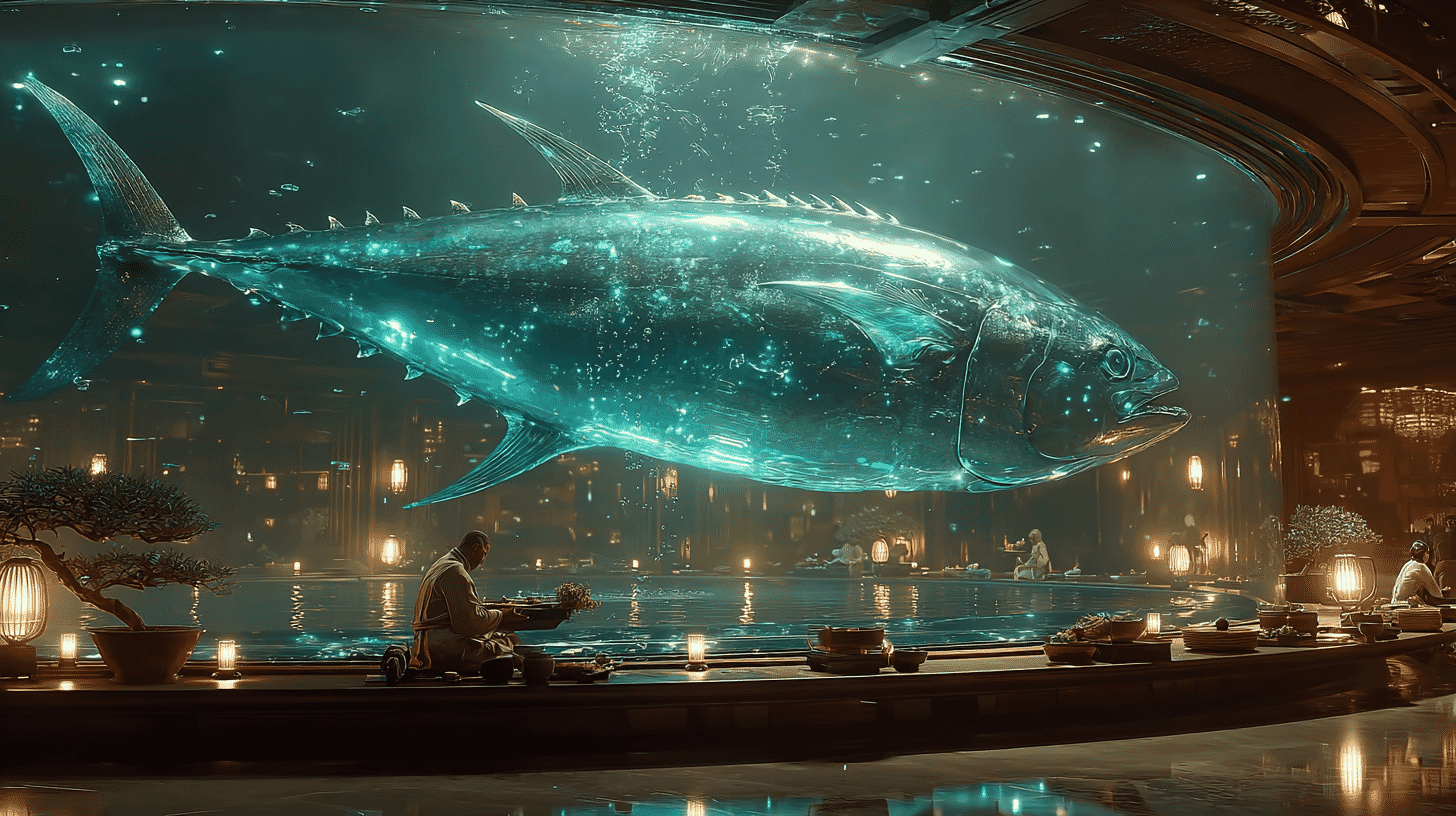
What if the future of fish didn't depend on the ocean? Japan's largest seafood company, Maruha Nichiro, is pioneering lab-grown fish meat using cells from fully farmed bluefin tuna, one of the world's most prized and endangered fish species. Partnering with Singapore biotech startup UMAMI Bioworks, they're racing to bring cultivated seafood to market by 2027. Here's what this food revolution looks like.
Why Cultivated Fish Meat, and Why Now?
For the Japanese, fish isn't just food. It's culture. Sushi, sashimi, grilled fish, and simmered dishes form the backbone of washoku, Japan's UNESCO-recognized culinary tradition. But this cherished food source is rapidly slipping out of reach.
Japan's Pacific saury (sanma) catch plummeted from roughly 355,000 tons in 2008 to just 20,000 tons by 2021, a staggering 94% decline. Wholesale prices climbed sharply over the same period. Mackerel, squid, and other once-affordable staples have followed similar trajectories. Japan's Fisheries Agency and the Fisheries Research and Education Agency attribute the collapse mainly to a weakening Oyashio current and warming waters pushing saury stocks far offshore. Overfishing compounds it, as does what the Japanese call "kaimake" (買い負け), losing the buying war to wealthier nations bidding up prices on the international market.
With the global population projected to reach 9.7 billion by 2050, securing sustainable protein sources has become a shared human challenge. Against this backdrop, "cellular agriculture" (growing real animal tissue from cells in a lab) is emerging as a revolutionary third option alongside traditional fishing and aquaculture.
What Exactly Is Cultivated Fish Meat?
Cultivated fish meat is real fish tissue, grown from cells harvested from living fish.
The process works like this: a small tissue sample is taken from a farmed or wild fish. Those cells are placed in a bioreactor, a specialized tank where temperature, pH, and nutrients are precisely controlled to encourage cell multiplication. Over time, the cells multiply and form muscle tissue that is, at its core, genuine fish meat. The resulting product can be processed into minced fish paste for products like kamaboko (Japanese fish cakes), or even shaped into fillet-like cuts using 3D printing technology.
Fish cells may also be easier to cultivate than mammalian ones. According to Maruha Nichiro's research team, fish cells can grow at lower temperatures (roughly 25–30°C / 77–86°F) compared to the 37°C (98.6°F) required for beef or chicken cells. Since fish are cold-blooded animals, they also tolerate a wider range of temperature conditions, giving researchers more flexibility in designing cultivation environments, and potentially lower energy costs.
Maruha Nichiro's Bold Vision: "Made" Fish, Not Just "Caught" Fish
Maruha Nichiro is a seafood powerhouse with over 140 years of history, and Japan's largest marine products company. In recent years, the company has declared a strategic pivot: adding "cultivation" as a third pillar alongside traditional "wild catch" and "aquaculture."
The journey into cultivated fish meat began in August 2021, when Maruha Nichiro partnered with IntegriCulture, a Tokyo-based startup specializing in large-scale cell cultivation using its proprietary "CulNet System." IntegriCulture brought expertise in growing bovine and poultry cells, which it would now apply to fish species. Maruha Nichiro's role was equally critical: leveraging decades of aquaculture expertise to supply high-quality living fish cells as the starting material.
In August 2022, Ichimasa Kamaboko, a leading fish cake manufacturer from Niigata Prefecture, joined the collaboration, bringing its processed seafood expertise to explore applications like cultivated kamaboko (fish cakes).
The ambitions grew further in August 2023, when Maruha Nichiro began collaborating with UMAMI Bioworks, a Singapore-headquartered cultivated seafood startup. UMAMI Bioworks operates at the global frontier of cultivated seafood, developing cell-based eel, caviar, lobster, and whitefish products. Importantly, the company is based in Singapore, the first country in the world to approve cultivated meat for sale.
Bluefin Tuna: The Crown Jewel of Cultivated Seafood
On May 9, 2025, the partnership took a landmark step. Maruha Nichiro and UMAMI Bioworks signed a joint development agreement specifically targeting cell-cultivated bluefin tuna (kuromaguro), often called the "king of sushi."
The choice of species is symbolic and strategic. Bluefin tuna commands premium prices worldwide, a single fish has sold for over $3 million at Tokyo's Toyosu Market, but wild populations are severely depleted. Maruha Nichiro achieved a major breakthrough in 2010 when it became the first private company to successfully complete the full lifecycle farming of bluefin tuna (known as "kanzen yoshoku" or complete aquaculture).
Under the new agreement, Maruha Nichiro provides cells harvested from its fully farmed bluefin tuna to UMAMI Bioworks for the first time, combining Japanese aquaculture know-how with Singaporean biotech innovation. The agreement sets clear milestones: establishing stable cell lines, scaling production capacity, obtaining regulatory approvals, and launching test sales.
Maruha Nichiro has publicly targeted overseas sales of cultivated fish products by fiscal year 2027, starting in markets where regulatory frameworks are most advanced, namely Singapore and the United States.
The Global Cultivated Meat Landscape
Cultivated fish meat is part of the broader cultivated meat market, estimated at roughly $800 million in 2025 and projected to reach approximately $4.2 billion by 2035, with an annual growth rate of around 18%.
The regulatory landscape varies dramatically by country.
Singapore has led the way since 2020, approving multiple cultivated meat products including chicken and quail. The United States built a joint FDA-USDA framework and approved cultivated chicken in 2023 and cultivated pork fat in 2025. Wildtype's cultivated salmon, the first lab-grown fish cleared for raw consumption, reached restaurant menus in mid-2025. Israel approved cultivated beef in 2024, a world first for that category. Food Standards Australia New Zealand finalised approval of Vow's cultured quail in June 2025, opening both countries to commercial sales.
However, pushback exists too. Florida and Indiana have enacted laws banning or restricting cultivated meat sales, and several other U.S. states are considering similar measures, driven by concerns ranging from religious beliefs to agricultural industry protection.
Japan's Regulatory Journey: Playing Catch-Up
Japan currently has no specific law either permitting or prohibiting cultivated meat sales. Formal safety discussions began in November 2024, when the Consumer Affairs Agency's Food Sanitation Standards Council launched deliberations on cell-based foods. The agency is methodically evaluating safety hazards at each production stage (cell sourcing, production, harvesting, and food processing) following the framework outlined by FAO/WHO.
By February 2026 the council had put a draft outline of production guidelines on the table. The Japan Association for Cellular Agriculture (JACA), led by Abigail Yoshitomi, has lobbied for a regulatory pathway with 2026 as its target for enabling sales in Japan. The process is a lap behind Singapore and the U.S., but cross-ministerial discussions have picked up speed, with the Ministry of Agriculture, Forestry and Fisheries and the Ministry of Economy, Trade and Industry both involved.
An important cultural dimension is naming. Japan's Food Tech Public-Private Council adopted "saibousei shokuhin" (cell-based food products) as the official term, deliberately avoiding "baiyouniku" (培養肉, cultivated meat) to prevent confusion with traditional aquaculture and fermentation processes, a distinctly Japanese sensitivity to linguistic nuance.
Three Walls to Climb: Cost, Safety, and Consumer Psychology
Three major challenges stand between cultivated fish meat and your dinner plate.
Cost remains the biggest obstacle. The world's first cultivated hamburger, unveiled in London in 2013, cost roughly €250,000 to produce, about $330,000 at the time. Prices have dropped dramatically since then, but commercially viable price points are still elusive. The main expense is the cell culture media, particularly animal-derived serum components and growth factors. UMAMI Bioworks is tackling this head-on by developing plant and algae-derived bioactive extracts as cheaper alternatives, and reporting that fish cells actually grow better in these plant-based media than in traditional formulations.
Safety assurance requires building long-term data and establishing regulatory frameworks. While FAO/WHO has published guidelines, no universal international standard exists yet. Each country is developing its own evaluation process, making global commercialization complex.
Consumer acceptance may be the subtlest challenge. The perception of cultivated meat as "artificial" or "unnatural" triggers resistance that pure science cannot overcome. Maruha Nichiro plans to address this through transparent communication, public tasting events, and emphasizing the "authentic" nature of cell-cultivated seafood, after all, the cells come from real fish, producing real fish tissue.
What the Future Holds
Maruha Nichiro's vision is a three-pillar supply model: wild catch, aquaculture, and cultivation working in concert. The company took the name "Umios" (from "umi," ocean) on March 1, 2026, and plans to invest roughly $100 million over three years into aquaculture facilities, R&D, and brand transformation.
If cultivated fish meat succeeds, the implications extend beyond stable supply. Growing fish cells in a controlled facility eliminates the greenhouse gas emissions associated with fishing vessels, transport logistics, and feed production. Precise environmental control also opens the door to "designer seafood", fish meat with enhanced nutritional profiles or specific omega-3 fatty acid concentrations tailored to health needs.
Cultivated fish won't replace a fresh-caught wild fish or a carefully farmed one. But one more option on the table matters.
In Japan, there's a concept called "mottainai" (もったいない), a deep sense of regret over waste, rooted in respect for resources. Cultivated fish meat, in many ways, is the scientific expression of that philosophy: a refusal to accept the depletion of the sea as inevitable.
What's the conversation around cultivated meat or seafood like in your country? How do traditional fishing communities and food cultures view this technology? We'd love to hear your perspective.
Notes
After this article was published, Maruha Nichiro became Umios Corporation on March 1, 2026, and moved its headquarters from Toyosu to Takanawa Gateway City in Tokyo. Group companies are being renamed in stages. * Terminology remains unsettled. MAFF's Food Tech Public-Private Council adopted "saibousei shokuhin" (細胞性食品, cell-based food), while the Consumer Affairs Agency's rulemaking uses the provisional "saibou baiyou shokuhin" (細胞培養食品, cell-cultured food). Its New Foods Investigation Subcommittee presented a draft guideline outline on February 5, 2026, and a regulatory framework could be in place during 2026.
References
- https://www.maruha-nichiro.co.jp/corporate/news_center/news_topics/2025/05/9.html
- https://www.nikkan.co.jp/articles/view/00751711
- https://foodtech-japan.com/2025/05/14/umami-bioworks-5/
- https://jaca.jp/2025/07/7937/
- https://prtimes.jp/main/html/rd/p/000000022.000034252.html
- https://foodtech-japan.com/FoovoBridge/2025/05/21/maruha-nichiro-and-umami-bioworks/






Global Discussion
13 comments