Hydrogen at one-tenth of today's price may be getting closer to reality. Clean "green hydrogen" currently costs about $5 per kilogram, but it might one day be produced for as little as $0.50, and candidate sites exist even in Japan's Tohoku and Kyushu regions. Here is the latest on "engineered mineral hydrogen," pioneered by a US startup.
What Is Engineered Mineral Hydrogen?
In February 2026, U.S. startup Vema Hydrogen announced it had completed drilling the world's first two pilot wells for "Engineered Mineral Hydrogen™" (EMH) in Quebec, Canada. The milestone marks the transition of this technology from laboratory research to real-world field testing.
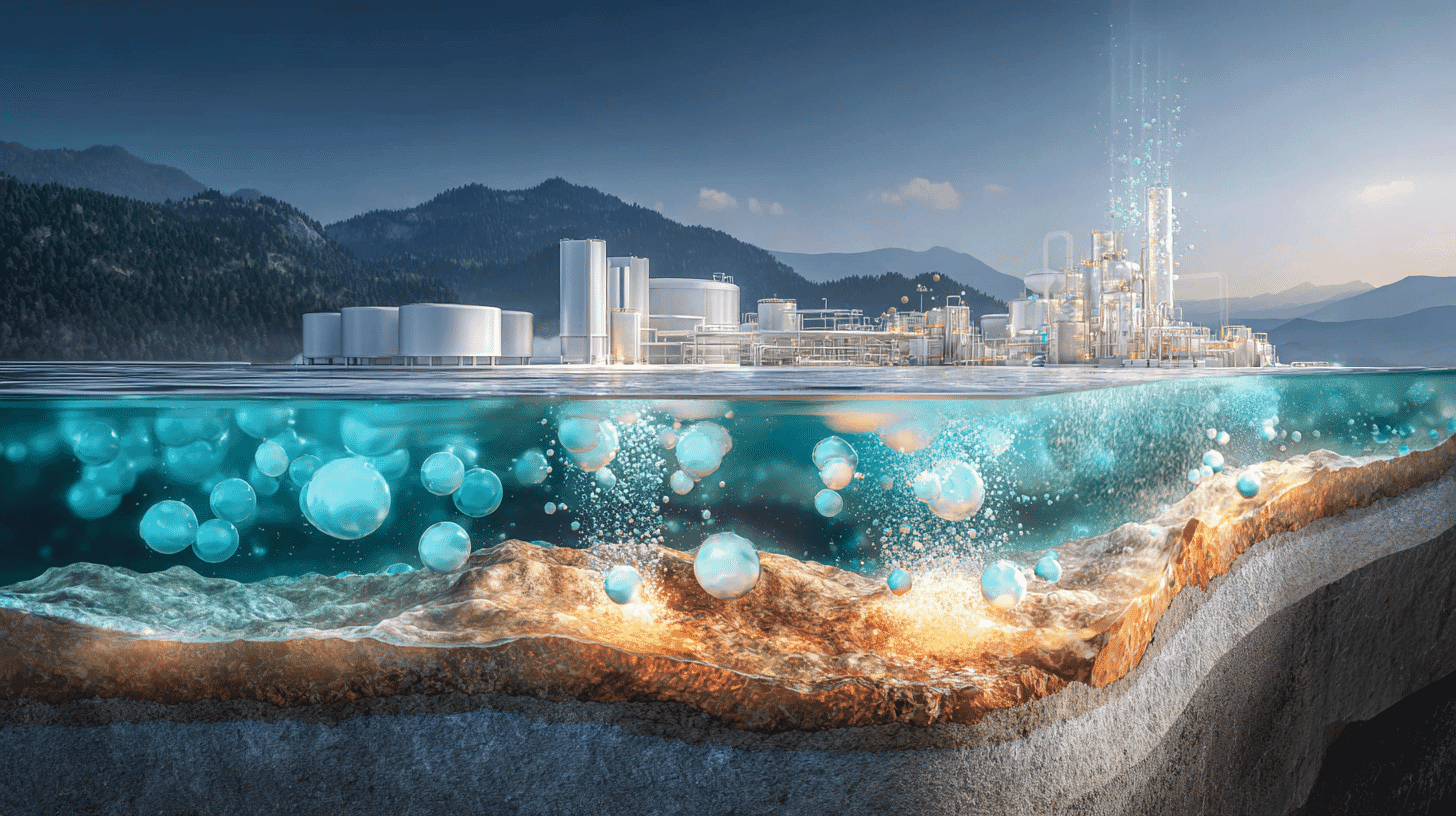
The underlying science is elegantly simple. Deep beneath the Earth's surface, iron-rich minerals such as olivine naturally react with water through a process known as "serpentinization," producing hydrogen gas. This reaction has been occurring naturally for thousands of years across the planet.
The problem? Nature takes its time. Vema's breakthrough lies in artificially accelerating this natural process. The company injects a catalyst-enhanced brine solution into shallow rock formations, stimulating the iron-bearing minerals to react with water and generate hydrogen at commercially viable rates. The hydrogen is then recovered through wells drilled into the formation.
Think of it like oil drilling, but with zero CO2 emissions. And unlike fossil fuels, this process can be strategically deployed wherever the right rock formations exist.
Why a 90% Cost Reduction Is Possible
Understanding hydrogen's cost problem requires knowing its "color spectrum." Conventional "gray hydrogen," made from natural gas, is cheap (around $0.70–$1.60/kg) but produces significant CO2 emissions. "Green hydrogen," produced by splitting water with renewable electricity, is clean but expensive, roughly $5/kg, creating a major barrier to adoption.
Vema Hydrogen projects that EMH could eventually be produced for less than $0.50 per kilogram. If achieved, this would make it simultaneously among the cleanest and cheapest forms of hydrogen available.
The economics work because EMH leverages the Earth itself as both raw material and energy source. Traditional green hydrogen requires massive electrolyzers and enormous amounts of renewable electricity. EMH needs neither. As Vema puts it, "Most of the work is performed by the Earth itself." The iron-rich minerals that serve as feedstock are among the most abundant materials in the planet's crust and mantle.
The Quebec Pilot: From Lab to Field
Quebec was chosen for its geological suitability. Eastern Canada features ancient geological formations rich in olivine and other iron-bearing minerals, including ophiolites and banded iron formations (BIF), ideal candidates for EMH production.
Through the two pilot wellbores, Vema will conduct subsurface analysis to evaluate fluid movement and monitor hydrogen generation. The data gathered will refine commercial models and guide the next phase: drilling the first commercial well reaching 800 meters depth, planned for 2027. Even the pilot wells are expected to produce several tons of hydrogen per day.
Vema's commercial momentum is already building. In December 2025, the company signed a 10-year hydrogen purchase agreement with Verne Power to supply clean hydrogen for data centers across California, with operations beginning as early as 2028. Vema has also been recognized as a Qualified Supplier by California's First Public Hydrogen Authority (FPH2).
"This pilot will provide the critical data needed to validate Engineered Mineral Hydrogen at commercial scale," said Pierre Levin, Vema's CEO. "The quality of the rock within our core samples is exactly what we expected, and is very promising for hydrogen yields."
What This Means for Japan
Here's where the story gets particularly interesting for Japan. According to maps published on Vema Hydrogen's website, candidate sites for EMH production exist in Japan's Tohoku (northeastern) and Kyushu (southwestern) regions.
This aligns with Japan's geological reality. Sitting atop multiple tectonic plate boundaries, Japan has unusually accessible deposits of olivine-rich rock. At the Hakuba Happo Onsen hot spring in Nagano Prefecture, natural hydrogen produced through serpentinization has already been documented, making it Japan's only known "natural hydrogen hot spring." Japanese institutions are already pursuing this frontier. In 2025, Kyushu University and Kyushu Electric Power began a NEDO-funded research project exploring natural hydrogen commercialization in the Kyushu region. Tohoku University also received NEDO funding for research on enhanced hydrogen recovery from ultramafic rocks. And JOGMEC (Japan's energy and mineral resources agency) has launched domestic surveys to identify natural hydrogen generation sites.
The stakes for Japan are enormous. With an energy self-sufficiency rate of only about 13%, among the lowest of any developed nation, Japan imports the vast majority of its energy. If EMH technology can be deployed domestically, it could fundamentally alter this dependence.
Japan has been a global pioneer in hydrogen policy, publishing the world's first national hydrogen strategy in 2017. The revised 2023 strategy targets 12 million tons of annual hydrogen deployment by 2040 and 20 million tons by 2050, backed by approximately $100 billion in combined public-private investment. The "Hydrogen Society Promotion Act" passed in 2024 provides a legal framework.
Yet current projections suggest that even by 2050, domestic production would cover only about 30% of demand, with the rest imported from overseas. EMH could be the game-changer that rewrites these projections entirely.
Won't the Resources Run Out?
A natural concern is resource depletion. Vema Hydrogen addresses this directly, stating that "even if hydrogen replaced all fossil fuels, thousands of years' worth of hydrogen exists in the Earth's subsurface."
This isn't just corporate optimism. USGS research geologist Geoffrey Ellis has estimated that the Earth could supply global hydrogen demand for thousands of years. Mass balance models supported by the USGS suggest between 1 billion and 1 quadrillion tons of natural hydrogen may exist underground, vastly exceeding current global demand of approximately 97 million tons per year.
Just as "oil money" shaped the 20th century's geopolitics, "hydrogen money" could reshape the 21st century's energy landscape.
A New Factor in Data Center Location Strategy
The implications extend beyond energy policy. As AI-driven demand causes data center power consumption to surge worldwide, EMH could introduce a new variable into site selection.
Traditionally, data centers are built where electricity is cheap and cooling is easy. But if clean, affordable hydrogen can be produced underground and converted to electricity on-site, locations with the right geological formations become attractive data center sites. Vema's partnership with Verne Power for California data centers reflects exactly this logic.
In Japan, where data center distribution to rural areas is already underway, the convergence of hydrogen resources and computing infrastructure could create a unique virtuous cycle, simultaneously advancing regional revitalization and energy independence.
Challenges Remain
To be clear, significant hurdles persist. EMH technology is still in the pilot phase, and whether commercial-scale production is viable depends on forthcoming data. JOGMEC reports note that natural hydrogen reserves remain unquantified, and economic feasibility assessments are premature.
In Japan specifically, detailed geological surveys, drilling and refining technology development, environmental impact assessments, and public consensus-building all lie ahead. Earthquake risk evaluation, uniquely critical for Japan, adds another layer of complexity.
Still, global momentum is unmistakable. The number of companies exploring natural hydrogen has quadrupled since 2020. France has amended its mining code to include natural hydrogen. The U.S. Department of Energy has allocated $20 million to natural hydrogen projects. And the USGS published a natural hydrogen potential map for the continental United States in January 2025.
A 90% drop in hydrogen costs isn't just a technological milestone, it's a potential rewriting of energy geopolitics. For Japan, a nation long described as "resource-poor," the idea that a vast energy source may lie beneath its own soil is nothing short of revolutionary. The "hydrogen society" (suiso shakai) that Japan has envisioned since 2017 might just begin from the ground up, literally.
How is hydrogen energy being developed in your country? Do you see potential in underground geological hydrogen?
References
- https://www.globenewswire.com/news-release/2026/02/03/3230886/0/en/Vema-Hydrogen-Drills-Pilot-Wells-in-Quebec-for-World-s-First-Engineered-Mineral-Hydrogen-Test-Project.html
- https://www.vema.earth/
- https://www.enecho.meti.go.jp/category/saving_and_new/advanced_systems/hydrogen_society/
- https://www.jogmec.go.jp/publish/plus_vol19.html
- https://www.mizuho-rt.co.jp/business/consulting/articles/2025-k0021/index.html
- https://www.technewsworld.com/story/pilot-wells-lay-groundwork-for-hydrogen-powered-energy-production-180152.html
- https://www.kankyo.tohoku.ac.jp/activity/a20250604.html








Global Discussion
15 comments