
🚂 The 999 is pulling out of the station again. On July 25, 2026, Toei Animation confirmed it is making a new Galaxy Express 999 theatrical anime, with Rintaro, who directed the 1979 film, drafting the story. There is no title yet. No director. No release date. Just the announcement itself.
The first announcement for a film that doesn't have a name yet
The statements Toei Animation and Leijisha, the company Leiji Matsumoto founded, put out that day are almost startlingly brief. A new theatrical anime is being made. Rintaro takes the story concept. Animation goes to Toei Animation, which hit its 70th year in 2026. That is the extent of it. Nothing has been said about a director, a script or a voice cast, and every outlet covering the news outside Japan attached the same caveat about missing staff and timing. Casting carries a particular weight now: Masako Ikeda, the original voice of Maetel, died of a cerebral haemorrhage on March 3, 2026, at 87. She had held the role since the television series began in 1978.
Makiko Matsumoto, Leiji Matsumoto's eldest daughter and representative director of Leijisha, added a comment: roughly half a century after the theatrical Galaxy Express 999, the family has been given the chance to announce what she calls a project her father longed for. Making an animated film, she says, was something he wanted from childhood and chased for the rest of his life. Matsumoto died on February 13, 2023, at 85.
This will be the first 999 theatrical work since 1998's Galaxy Express 999: Eternal Fantasy.
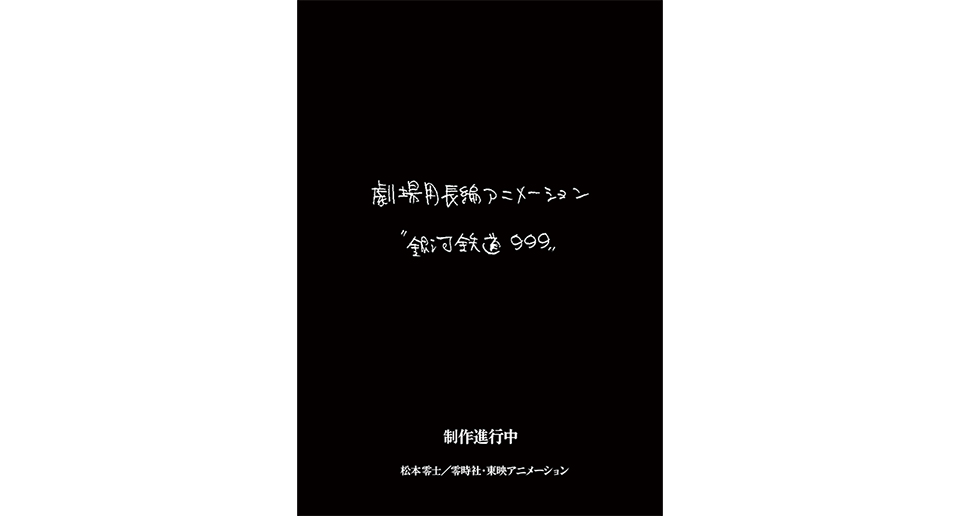
Source: Toei Animation official site
Rintaro is 85, and he started at Toei as an in-betweener
Rintaro was born on January 22, 1941. He joined Toei's animation studio in 1958 at the age of 17 and worked as an in-between animator on Hakujaden, Japan's first feature-length color animated film. He went on to Osamu Tezuka's Mushi Production, where he worked on Astro Boy and Kimba the White Lion, and in 1972 he was among the founders of Madhouse. He watched Japanese animation turn into an industry from inside the room.
His best-known work includes the 1979 Galaxy Express 999 film, its 1981 sequel Adieu Galaxy Express 999, and 2001's Metropolis. 68 years after he first walked into that company as an in-betweener, his name goes on a Toei production again, at 85.
One thing worth being precise about: he is credited with the original story draft, not with directing. That distinction has already blurred in some coverage. Rintaro is laying out the bones of the story; the people who actually put it on screen have not been named. Until that staff list lands, nobody can really predict what this film will look like.
The 1979 film rewrote the Japanese box office
The film that opened on August 4, 1979 had an unusual pedigree even for its time, with live-action master Kon Ichikawa credited as supervisor. It was also a gamble structurally: the manga was still running and the TV series was still airing, yet the movie sprinted all the way to an ending.
It finished 1979 as the No. 1 Japanese film of the year by distributor revenue, and it is generally cited as the first time an anime had ever led the annual chart. Japan's yearly box office rankings are dominated by animation now. The 999 pushed that door open first.
Godiego's theme song, also titled "Galaxy Express 999," peaked at No. 2 on the Oricon chart. The lyrics pair Yoko Narahashi's English words with Keisuke Yamakawa's Japanese ones, and the chorus stays in English. That structure is a large part of why the song carried to listeners who spoke none of the language.
The 1981 sequel, Adieu Galaxy Express 999, landed too, and the series proved twice over that animation could headline a cinema.
Why Matsumoto's name travels so well outside Japan
For a lot of readers abroad, Matsumoto is the 999 guy, and he is also somebody they met through a completely different door. That door is Daft Punk. The French duo's 2003 visual companion to Discovery, Interstella 5555, was animated by Toei Animation and directed by Kazuhisa Takenouchi, with Matsumoto supervising. There is a whole layer of European music fans who absorbed his character design without ever having watched 999 or Captain Harlock.
France made it official on October 23, 2012, when Matsumoto was named a Chevalier of the Ordre des Arts et des Lettres at a ceremony held at the French embassy in Tokyo.
The commercial appetite in Europe hasn't faded either. On January 28, 2026, Anime Limited released a 4K UHD and Blu-ray Collector's Edition of the 1979 film, with French subtitles and a 32-page booklet, a release Toei Animation promoted on its own English-language site. A 47-year-old movie still gets that kind of packaging.
What's still unknown, and what you can watch right now
The only certainty about the new film is that it exists as a project, which leaves international distribution and streaming wide open. Toei Animation does run subsidiaries in Los Angeles, Paris, Hong Kong and Manila, so the pipeline for getting its own titles overseas is already built.
The TV series and the 1979 film both stream on Crunchyroll, though which regions get them varies by country, and Discotek Media handles home video in North America. The original manga ran in Weekly Shonen King from 1977 to 1981 across 18 volumes, and the TV anime runs 113 episodes.
If you are in Japan, Kadokawa Musashino Museum in Tokorozawa, Saitama is worth the trip. "Galaxy Express 999 THE GALAXY EXPERIENCE" turns the 1979 film into a walk-through space rather than something you sit and watch, and it runs through October 26, 2026. From September 19, 2026, the same building hosts "Leiji Matsumoto: A Journey of Creation" as part of the Galaxy Express 999 50th Anniversary Project, with more than 300 original drawings including early works.
At its heart, 999 was always a story that kept asking a boy what a limited life is worth in a world where a mechanical body buys you forever. A new film getting underway after its creator's death is a strange, slightly ironic answer to that question. How did 999 reach you, wherever you are? Some of you caught it on TV as kids. Some of you got there through a Daft Punk video.
References
- https://www.toei-anim.co.jp/news/detail/swrts4ocpb/
- https://leijisha.jp/news/651
- https://www.animenewsnetwork.com/news/2026-07-25/new-galaxy-express-999-theatrical-anime-announced-with-story-by-rintaro/.239959
- https://www.toei-video.co.jp/special/999movie-4k/
- https://toyokeizai.net/articles/-/506611
- https://www.uta-net.com/song/1630/
- https://www.toei-animation.com/galaxy-express-999-anime-limited/
- https://mediag.bunka.go.jp/article/post_182-529/
- https://kadcul.com/event/260








Global Discussion
0 comments